Explore Beijing / Beijing Travel Times: How Long Things Actually Take, and How Many Sights Fit in a Day
Beijing Travel Times: How Long Things Actually Take, and How Many Sights Fit in a Day
Most Beijing itineraries fail on time, not distance. Real door-to-door hours for the Forbidden City, the Great Wall and the Summer Palace, the places a day quietly loses an hour, and how many sights actually belong in one day.
10 min read · KOULING's Beijing Travel Guide
Beijing is not a hard city to cross. It is a hard city to enter. The metro will carry you twelve kilometres in about thirty-five minutes, and then you will spend fifteen minutes walking from the platform to the right gate, ten more in a security line, and another ten discovering that the entrance you need is on the far side of a wall. Almost every over-ambitious Beijing itinerary fails the same way: it budgets the travel and forgets the four dull gaps between arriving in the neighbourhood and standing in front of the thing. This guide puts real hours against the sights visitors actually go to, shows where a day quietly loses an hour, and gives you a rule for how many belong in one day.
Two clocks, one day
Plan every day with two numbers, not one. Travel time is door to door: platform to platform, plus the walk at both ends, plus any security line in between. On-site time is from the moment you get in to the moment you walk out. Map apps give you the first and quietly forget the last five hundred metres; guidebooks give you the second and forget the first. Add them together and add roughly twenty per cent, because on unfamiliar ground you will move slower than you expect.
In-station walking — Big interchanges such as Xizhimen, Dongzhimen, Guomao and Songjiazhuang can add 8–15 minutes between platforms, before you have even left the station.
The last 500 metres — The Summer Palace, 798 and the Great Wall all leave you well short of the gate. Budget 10–20 minutes on foot or on a shuttle.
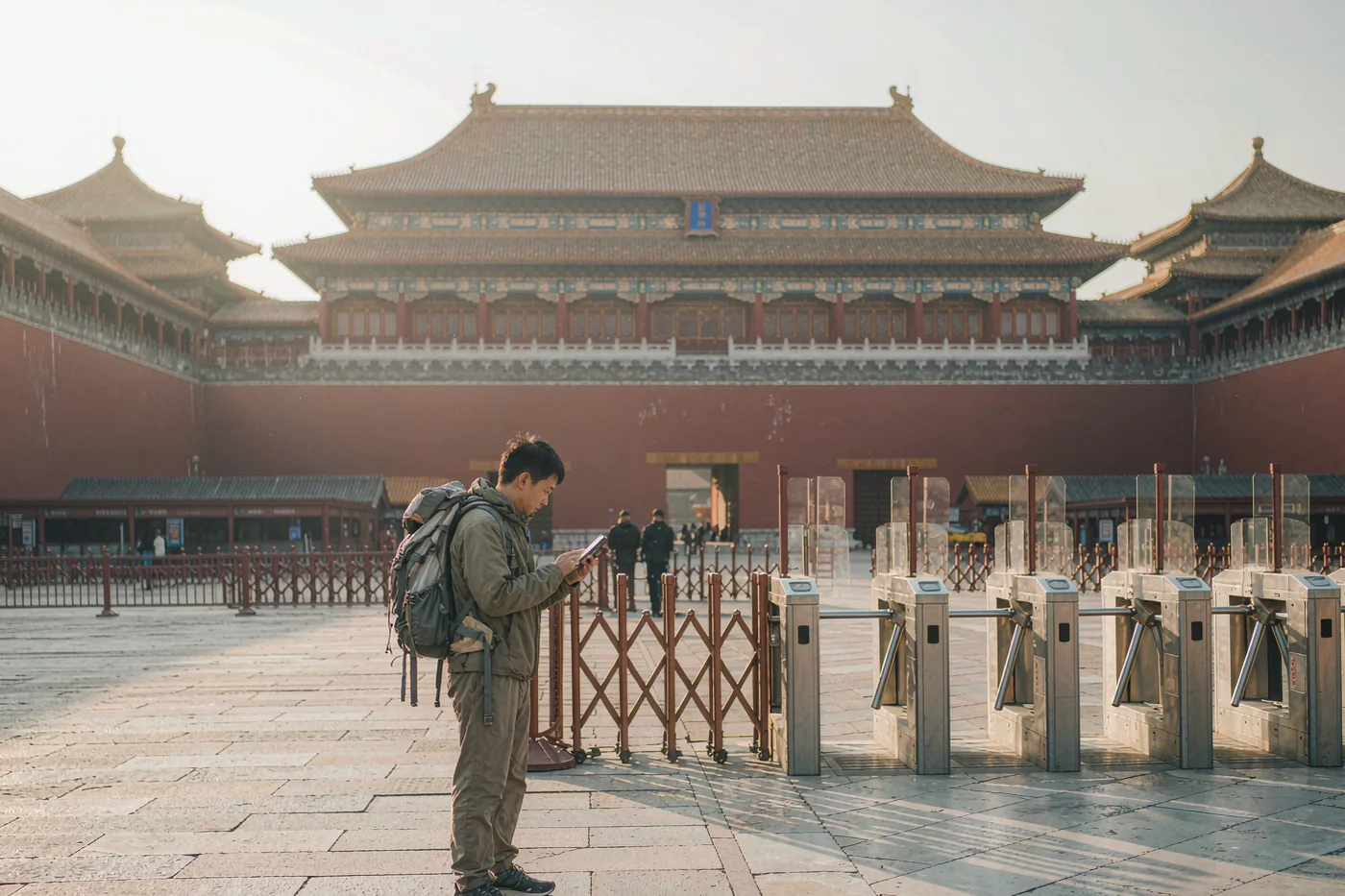
Security and ID checks — The metro, Tiananmen Square, the approach to the Forbidden City and every major sight have bag or passport checks. Each runs 5–20 minutes.
What the big sights actually cost you in hours
These are on-site hours for a first visit at an ordinary pace, and they do not include getting there. Where the range is wide, the difference is whether you walk the whole site or just the headline axis.
Forbidden City — 2–4 hours — The central-axis route published by the Palace Museum is 2–3 hours. Add the Treasure Gallery or the Clock Gallery and you are at half a day. Closed Mondays except on public holidays.
Great Wall at Mutianyu — 2.5–3 hours on the wall — And still a whole day once travel is counted. See the section below.
Summer Palace — 3–5 hours — It is a lakeside park, not a building. The walking is the visit, and the long corridor to the lake and back is most of it.
Temple of Heaven — 1.5–2.5 hours — The park is far larger than the altars, and early in the morning you will mostly be sharing it with locals exercising.
Hutongs — 2–3 hours — Nanluoguxiang plus the Shichahai lanes; 3–4 hours if you add the Drum and Bell Towers.
798 Art District — 3–5 hours — There is no metro at the gate, so the approach is part of the time.
Lama Temple — 1–1.5 hours — 2–3 hours with the Wudaoying and Confucius Temple lanes right next door.
Beihai Park — 1.5–2 hours — It sits directly across from the Forbidden City exit, which makes it the easiest add-on in the whole city.
Cross-town trips that take longer than the map suggests
Central Beijing is compact. Beijing as a whole is not, and the moment one end of your day sits in the northwest or the far northeast the arithmetic changes. Treat these as planning figures and confirm your own address in Amap before you commit to a schedule.
Centre to Mutianyu — 1.5–2 hours each way by car in normal traffic, longer at weekends and on holidays. There is no metro to the gate.
Forbidden City to Summer Palace — Around an hour by metro with one change, plus the walk at each end. Treat it as a half-day move rather than a hop.
The Mutianyu tourist coach — The classic route without a car, running from a downtown transport hub; the coach alone is roughly 1.5–2 hours. Verify the departure point and timetable for your date before you travel.
To the airports — Allow 60–90 minutes door to door to PEK using the Airport Express depending on where you start, and generally longer to PKX from most central addresses. See Beijing Airports: PEK vs PKX and How to Get to the City.
From a well-connected base — From Guogongzhuang on Line 9, most major sights are 30–50 minutes away with a single change — which is why a station-adjacent hotel often beats a nominally more central address.
The Great Wall is a day, not a morning
Here is the arithmetic, and it is the most useful single thing to know before you plan Beijing. Leave central Beijing at 07:30–08:00. Drive 1.5–2 hours. Arrive 09:30–10:00. Tickets, the shuttle to the foot of the wall and the cable car take about 30 minutes, so you are on the wall by 10:00–10:30 and stay 2.5–3 hours. Lunch at the base takes 1–1.5 hours. Leave at 14:00–15:00 to miss the worst of the return traffic and you are back in the city between 16:30 and 18:00. That is eight to ten hours before anything goes wrong, and nothing else belongs on that day.
Never on arrival or departure day — The Wall day has no slack in it. A delayed flight or a slow check-in costs you the whole thing.
The section changes the maths — Badaling is closest at roughly 1–1.5 hours each way. Jinshanling and Simatai add another 1–1.5 hours in each direction and make for a longer, emptier day.
What to do with the evening — Plan something short and near your hotel — a Peking duck dinner, or the Shichahai lanes at dusk. Do not plan a sight.
Where an hour quietly disappears
None of these appear on a map and none of them are in a guidebook, and between them they are the reason a comfortable day turns into a rushed one.
Security and real-name checks — Every major sight scans your passport against your ticket. The approach to Tiananmen Square and the Forbidden City can add 20 minutes or more at peak times.
Rest stops — The Forbidden City and the Great Wall are hard work on the legs, and most visitors need a sit-down they never planned for.
How many sights fit in a day: the 2 + 1 rule
Two big sights and one small one, and no more. A big sight is anything over two and a half hours on site — the Forbidden City, the Summer Palace, the Great Wall, 798. A small one is an hour to ninety minutes: Beihai, the Lama Temple, the Temple of Heaven, a hutong walk, a single museum. Three big sights in one day is the plan that collapses somewhere around 15:00.
With kids, or anyone over 70 — Drop to one big plus one small, and put the big one in the morning while everyone still has legs.
A Wall day counts as full — It is the one big sight you do not add to, and the one you do not ask anything else of.
When two big sights do work — Only when they are neighbours. The Forbidden City and Beihai are ten minutes apart; the Lama Temple and Wudaoying are the same trip.
Three day shapes that survive contact with reality
These are the shapes that hold up. The hours given are on-site time, so add travel on top of them.
Day A — the imperial core — Forbidden City 3.5 hours, exit north into Jingshan, lunch, Beihai 1.5 hours, Nanluoguxiang in the evening. Around eight hours of actual sightseeing.
Day C — the Wall — The full day set out above, and nothing else.
Day D — temples and lanes — Lama Temple 1.5 hours, Wudaoying and the Confucius Temple 2 hours, Drum and Bell Towers 1 hour, Shichahai at dusk. Around six hours with plenty of stops.
The days that quietly close on you
Four closing-day traps account for most of the ruined itineraries in this city, and all four are avoidable if you plan around them at the start rather than discovering them on the day.
Mondays — The Forbidden City and most national museums close on Mondays, except on public holidays. Put the Great Wall, the Summer Palace, the hutongs or 798 on a Monday instead.
Last entry is not closing time — The Forbidden City stops admitting visitors well before it closes, and winter hours are shorter. Always check the times for your own date.
The first slot of the day — Arriving at opening is the only reliable crowd tactic in Beijing. An 08:30 start buys you roughly an hour of quiet before the tour groups land.
Related Beijing guides
If this was useful, these answer the question most visitors ask next:
Book a timed entry slot — It does not make the site faster, but it removes the one queue that can cost you an hour.
Carry the physical passport — Every real-name check wants it, and a photo on your phone will not do.
Start at the far end — At the Summer Palace and the Forbidden City most people enter at the same gate and stop at the same point. Walking the other way round is faster.
Keep the Wall and your departure day apart — Never the same day, and ideally not consecutive ones if you want your legs back.
Use Amap for the journey, not the plan — It is accurate about minutes and has no idea how long you will want to stay.
Plan one fewer thing than feels right — Almost every visitor who enjoyed Beijing did less than they had written down.