Beijing's public toilets are free, signed and everywhere — but mostly squat, mostly without paper. Here is the sign to look for, the search order that works, and what to carry.
Nobody puts restrooms on an itinerary, and then they become the thing that quietly shapes the whole day. Beijing is, in practice, one of the easier big cities in Asia for this: public toilets are free, they are signed, and there are a lot of them. What trips visitors up is not scarcity — it is the format. Many are squat pans. Most do not stock paper. Some have no soap. Once you know which characters to look for and the order in which to try places, this stops being a problem and becomes a thirty-second errand. This is the field guide to the part of a Beijing trip nobody writes down.
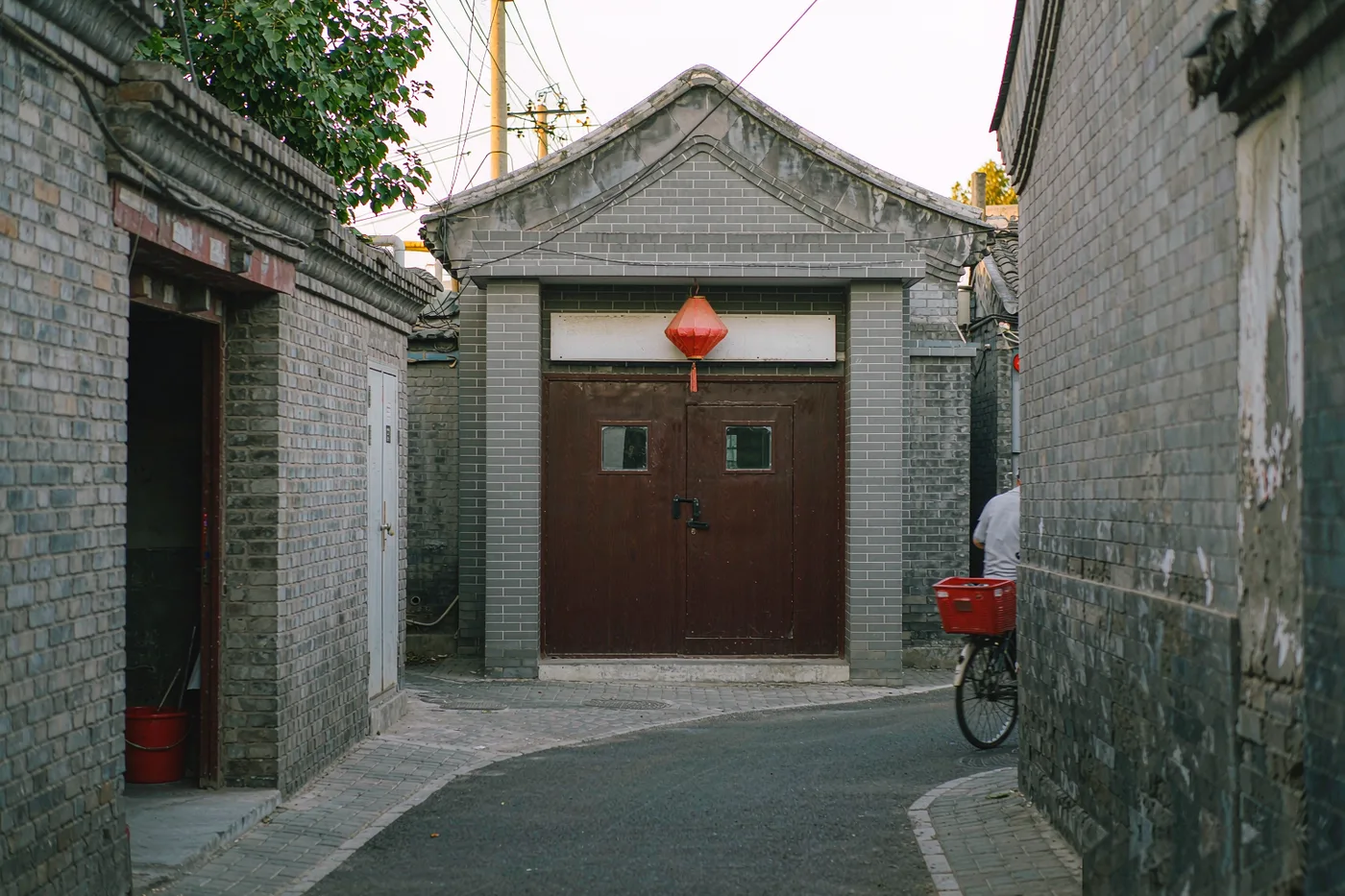
Two things catch nearly every first-time visitor. The first is the pan itself. A squat toilet (蹲便器) is a porcelain trough set into the floor with footpads on either side; you face the raised hood at one end. It is common in older public toilets, in hutong lanes, in parks and in some stations. Western-style cubicles (座便器, or simply 马桶) are now standard in malls, metro stations, international hotels, airports and newer attractions — and where both exist, the Western stall is usually the one with a seat symbol on the door. The second surprise is paper. Assume there will be none.
You are looking for a short Chinese phrase, not a pictogram alone. The standard municipal wording is 公共卫生间 (gōnggòng wèishēngjiān, roughly 'public hygiene room'), and it appears on street signs with an arrow. Older and smaller places use 厕所 (cèsuǒ) or 卫生间 (wèishēngjiān); restaurants and malls tend to prefer 洗手间 (xǐshǒujiān, literally 'wash-hands room'), and hotels will sign theirs as 大堂洗手间. A single 厕 character on a doorway counts.
Don't wander around hoping to spot a sign. Work down this list instead — it runs from most reliable to least, and in central Beijing you are almost never more than two or three minutes from the first option.
Beijing's metro is one of the largest networks in the world, and the great majority of its stations have toilets — typically at one end of the platform, signed on the platform wayfinding boards and on the concourse. The catch is the paid area. On many lines the toilet sits inside the gates, on the platform; once you have tapped out you cannot get back in without paying for a new trip. Treat this as a rule: use the station toilet before you exit, not after. A smaller number of stations keep theirs outside the concourse, and staff will normally let you through if you ask.
Beijing's shopping malls are the single most underrated resource a visitor has — not for the shopping, but because every floor has a clean, well-lit, Western-style restroom with paper and soap, free and open to anyone during opening hours. Look for the 洗手间 signs near the lifts or at the escalator landing. Hotel lobbies work the same way: walk in, look like you know where you are going, and go. Nobody in a large international hotel will challenge you, and the lobby restroom is usually the cleanest room you will use all day. Chain cafés and fast food are the fallback — Starbucks, McDonald's, KFC and the domestic chains are dense enough that in the centre you are rarely more than a few hundred metres from one, and none of them require you to buy anything.
The imperial core is a long visit with no popping out and back in, so plan around the facilities. Restrooms are distributed along the main north–south axis and in the eastern and western side palaces; there are accessible cubicles and a nursing room, and wheelchairs and strollers can be rented. The most central blocks draw the longest queues — walking a few minutes into a side compound instead can easily save you fifteen minutes.
Day trips are where this actually bites, because you leave the dense grid of malls and metro stations behind. At Mutianyu and Badaling there are toilet blocks in the entrance complexes and at the base of the wall; once you are up on the ramparts, options thin out sharply. Treat the base facilities as your last comfortable stop and go before you start climbing, not after. The Summer Palace and Beijing's big city parks — Jingshan, Beihai, the Temple of Heaven — have signed public toilets near their main gates and along the principal paths, generally free and generally the older kind. On any coach or package tour, ask the guide at the start where the next scheduled stop is: they plan these in and will tell you straight away.
You will notice a small wastebasket next to the toilet far more often than you would at home. In much of Beijing the plumbing — especially in older buildings, hutong lanes and parks — is narrow, and used toilet paper is meant to go in the bin rather than down the bowl. Follow the bin: if there is one, that is the instruction. It is emptied frequently, and ignoring it is how you cause exactly the blockage the bin exists to prevent. In malls, metro stations, airports and international hotels the pipework is modern and flushing is fine.
Pointing works, but three phrases get you much further — and once you have tried, staff will often walk you to the door themselves. Clear matters more than perfect tones.
For children the routine is much as anywhere, with two local advantages. Nursing rooms (母婴室) are standard in Beijing's malls, larger metro interchanges, railway stations and major attractions — a proper room with a changing table and somewhere to sit, not a fold-down shelf inside a cubicle. And when a child announces with no warning that they need to go, the mall-first rule matters more than usual: in central Beijing you are usually within a couple of hundred metres of one. For wheelchair users and anyone who needs support, look for the blue 无障碍 symbol. Accessible cubicles are wider, Western-style and fitted with grab bars, and you will find them in metro stations, railway stations, airports and the major sights; step-free routes to them are the norm in newer stations and in the international terminals. One last thing: after a long day on the Great Wall, a squat pan is a genuine physical ask — the extra fifty metres to an accessible cubicle is worth it.