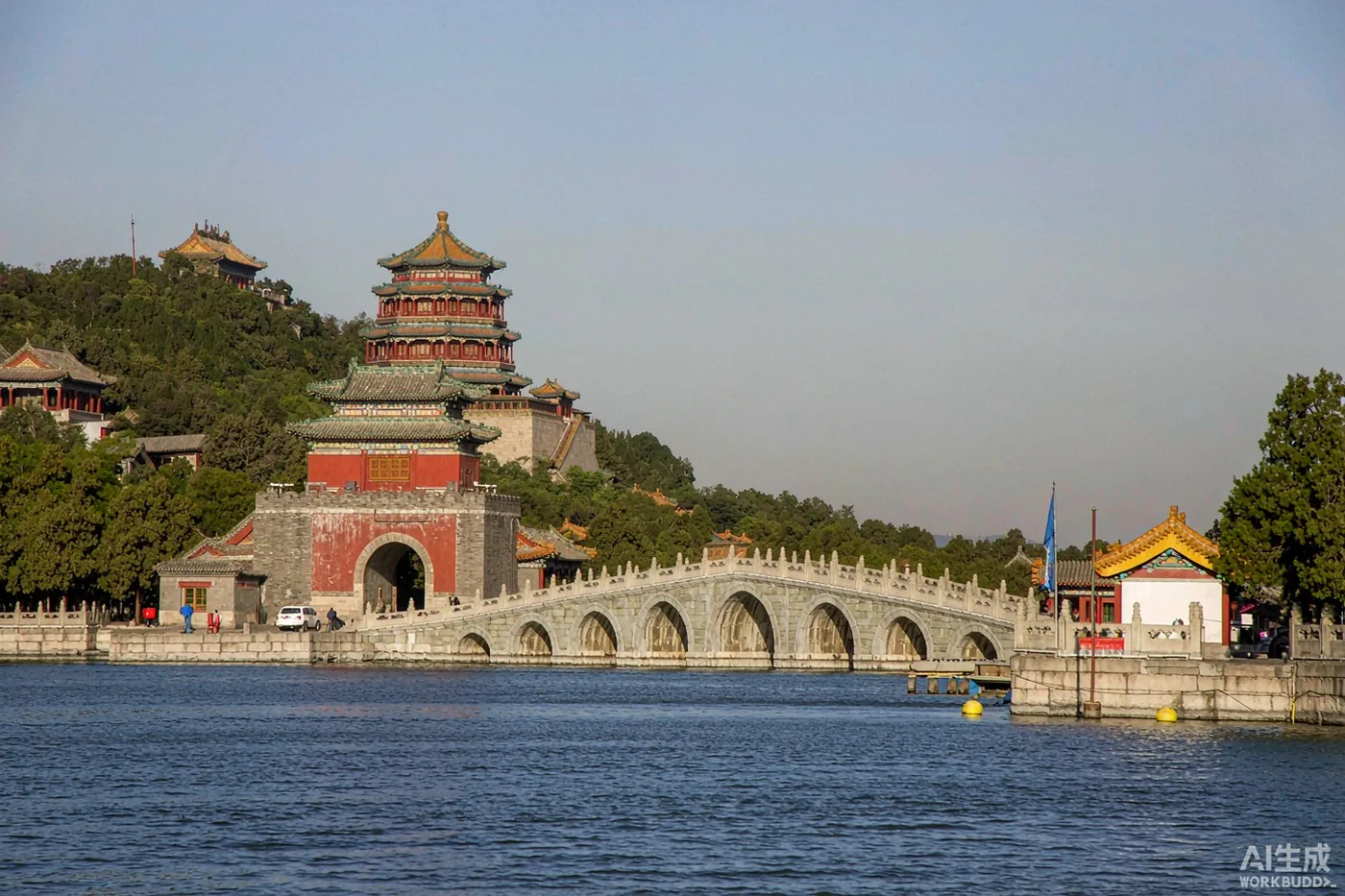
Beijing's most beautiful imperial garden — the Long Corridor, the Tower of Buddhist Incense and a boat on Kunming Lake. A straight Line 9 to Line 4 run from KOULING Ruiyue.
The Summer Palace (颐和园, Yíhéyuán) is the grand finale of Chinese imperial garden design — a vast lakeside park of pavilions, bridges and a painted long corridor built around Kunming Lake. It is the most beautiful of Beijing's classic sights and an easy half-day. From KOULING Ruiyue it is a straight run up Line 9 and then Line 4.
After the enclosed grandeur of the Forbidden City, the Summer Palace feels like breathing out. The 长廊 (Long Corridor) is painted with thousands of scenes; the 佛香阁 (Tower of Buddhist Incense) and 石舫 (Marble Boat) are postcard icons; and a boat across Kunming Lake is the move on a warm day. It is enormous, so go early — the light on the water is best before noon.
Enter via the North Palace Gate (北宫门) for the quickest route to the lakeside, or the East Palace Gate (东宫门) for the classic frontal view. The must-sees are the Long Corridor, the Tower of Buddhist Incense, the Marble Boat and a boat ride on Kunming Lake. The garden is huge — pick a loop rather than trying to see everything.
The Summer Palace charges separately for the park and its sights. The basic entrance ticket (around ¥30 peak season, ¥20 in winter) covers the grounds, the Long Corridor and Kunming Lake shoreline only. Longevity Hill's Tower of Buddhist Incense, the Garden of Virtue and Harmony, Wenchang Pavilion and Suzhou Street each need the through ticket (联票), roughly ¥60 in summer — buy this on arrival at the gate or in the WeChat mini-program; foreign passports work at staffed counters, and the passport itself is your ticket at the turnstiles. The dragon boats across the lake cost extra, around ¥10–20 depending on the route, and are worth it in the afternoon when the marble boat side of the park is far from the north gate. Cash is still accepted at ticket windows, which helps if your WeChat or Alipay setup fails on the day.
The Summer Palace absorbs enormous crowds on Chinese public holidays — avoid the May Day and National Day golden weeks entirely if you can. On normal days, tour groups arrive in force from about 10:00 and peak through the early afternoon; before 9:00 the Long Corridor is nearly empty and the light across the lake is best. Weekdays are noticeably calmer than weekends, and Sunday afternoons are the worst slot. Seasonally, spring (April–May) brings blossom along the west dike, summer means lotus on the lake and heavy humidity, and late autumn — late October to early November — offers the best photography of the year, with red foliage on Longevity Hill. Winter has its own austere beauty and the smallest crowds, though the lake freezes and the boats stop running, usually from December to March.
The Old Summer Palace (Yuanmingyuan, 圆明园) sits two metro stops away on Line 4, which makes an easy half-day add-on if you have the energy. Enter the Summer Palace early, walk the Long Corridor and lake by late morning, then take Line 4 from Beigongmen to Yuanmingyuan station. The ruined European-style palaces at the far end of the site require a combined ticket on top of the entrance fee, and the walk to them from the gate is long — the shuttle carts help if legs are tired. Be honest about your stamina: the Summer Palace alone is a five-to-six-kilometre walk with hills, and many visitors arrive at Yuanmingyuan with nothing left. If you must choose one, do the Summer Palace first; if you want both comfortably, split them across two mornings. Check seasonal opening hours before combining, as closing times shift with the seasons.
If you found this useful, these cover the next question most visitors ask: