Explore Beijing / Beijing Security Checks: What You Can and Can't Carry on the Metro, Trains and Planes
Beijing Security Checks: What You Can and Can't Carry on the Metro, Trains and Planes
Beijing has three transport networks and three different security rulebooks. Power banks, aerosols, knives, alcohol and suitcases — the actual numbers, so nothing gets taken off you at the belt.
10 min read · KOULING's Beijing Travel Guide
Beijing has three transport systems and three different security rulebooks, and almost nobody tells you they disagree with each other. A power bank that sails through Beijing South railway station can be refused at Daxing Airport. A pocket knife that rides the metro without comment gets sent to the left-luggage desk at Beijing West. A 200 ml can of hairspray is over the line on a train and irrelevant on the subway. This guide gives you the real numbers — watt-hours, millilitres, millimetres and kilograms — so you can pack once and walk through every checkpoint in the city without losing anything.
The three checkpoints, and who writes the rules
Knowing who sets the rules explains why they conflict. Airport security is national and the strictest of the three. Railway security is also national, but built around a different catalogue. Metro security is set locally, and Beijing publishes no numeric limits for most everyday items.
Airport (PEK / PKX) — CAAC civil aviation rules, identical at every airport in China. Bags X-rayed, electronics out, power banks inspected one by one. Verify your boarding pass against the airport before you leave: Beijing Capital and Daxing are on opposite sides of the city.
Railway stations — The national railway prohibited / restricted items catalogue, in force since July 2022. Every bag is X-rayed and staff may open anything they cannot read clearly on screen.
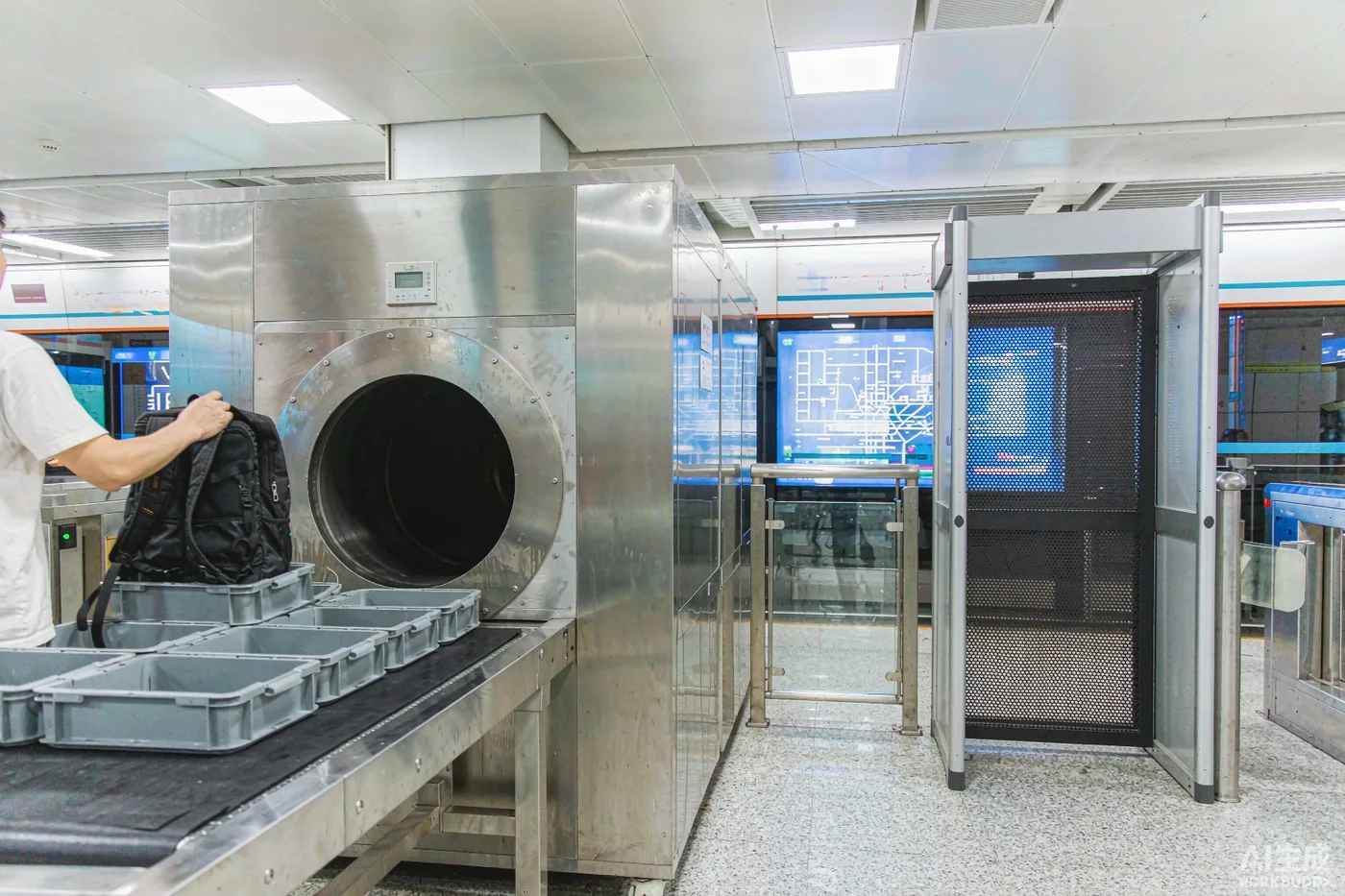
Beijing metro — There is security at every station entrance — X-ray for your bag, walk-through gate or a handheld wand for you. Expect 10 to 30 seconds on a normal day, noticeably longer at rush hour and at big interchange stations.
Power banks: the item most visitors get wrong
Nothing causes more arguments at Beijing checkpoints than a power bank. The railway rule and the aviation rule genuinely differ, and flying got stricter in 2025.
On trains — two conditions — The unit must have legible markings, and each unit must be rated 100 Wh or less — about 27,000 mAh at the usual 3.7 V. Wh = V × mAh ÷ 1,000, so a 20,000 mAh bank at 3.7 V is 74 Wh and comfortably fine. Damaged, swollen or unlabelled units are refused regardless of size.
On domestic flights — the 3C rule — Since 28 June 2025, a power bank with no 3C mark, an unclear 3C mark, or a recalled model is banned outright from domestic flights. Everything else still applies too: 100 Wh or less needs no approval, 100–160 Wh needs airline approval and is capped at two per passenger, above 160 Wh is prohibited, and it travels in hand luggage only — never in a checked bag. Do not use it in flight; keep any switch off.
Why your old power bank may fail — Power banks entered China's compulsory product certification (3C) catalogue in August 2023, and from 1 August 2024 uncertified units could not legally be sold here. A perfectly good branded unit bought outside China, or made before 2024, may simply carry no 3C mark — and that alone can get it refused at the airport.
On the Beijing metro — Beijing has not published a watt-hour or quantity limit for power banks, while several other Chinese cities have — Guangzhou caps units at 20,000 mAh, Chongqing at 100 Wh. Treat the absence of a rule as a courtesy, not a right: carry one clean, undamaged unit under 20,000 mAh and nobody will ask. ⚠️ Local metro rules change; this is not the item to argue about at the gate.
Liquids, sprays and gels on trains — the exact numbers
The railway catalogue splits toiletries into two families, and which family your bottle belongs to decides whether the limit is 100 ml or 150 ml. These are the official figures, not folklore.
Non-aerosol flammables — Perfume, cologne-style toilet water, non-pressurised sprays and gels: container no larger than 100 ml, and one bottle per type. A 250 ml perfume bottle that happens to be half empty is still a 250 ml container.
Pressurised aerosols — Hair spray, mousse, hair dye, insecticide, air freshener: container no larger than 150 ml, one can per type, and no more than 600 ml in total across all of them. This is what catches people travelling with full-size dry shampoo and sunscreen mist.
Nail polish and remover — Combined total of 50 ml or less.
Hand sanitiser and wipes — Alcohol-based wipes are fine. Larger bottles of sanitiser are treated under the flammable-liquids logic — keep the container small and sealed.
Alcoholic drinks — Sealed and clearly labelled, between 24% and 70% ABV, up to 3,000 ml per passenger — roughly four standard bottles. Anything above 70% ABV is prohibited outright.
Knives, tools and the 60-millimetre line
This section surprises visitors who carry a folding knife or a multi-tool every single day back home.
The line itself — Everyday knives — kitchen knives, fruit knives, scissors, utility knives, craft knives — with a blade longer than 60 mm may not be carried onboard, but can go in checked luggage. Blades of 60 mm or less are normally acceptable.
Always prohibited — Daggers, switchblades and other locking folders, triangular blades, stun devices, crossbows and similar controlled items — prohibited both carried and checked.
Multi-tools and Swiss army knives — Screening staff judge what they can see on the X-ray. A small folding blade usually passes; anything longer, or any locking blade, is a coin toss. Put it in your checked bag if you have one.
Tools and sports gear — Drills, chisels, saws, axes, hammers, ice axes and trekking poles with exposed metal tips cannot be carried on, but can be checked. Heading for the Great Wall? Hiking poles belong in the suitcase, not the daypack.
Self-defence sprays — Small pepper sprays of up to 50 ml fall into the cannot-carry-but-can-check class. Think twice before packing any at all.
The other things that get taken off people
Lighters and matches — Up to two ordinary lighters and two small boxes of safety matches per passenger. The hotel matchbook plus a lighter is fine; a ten-pack of disposables is not.
Cigarettes — Up to 50 cartons may be carried — a large number, which is only worth knowing because it is not a small one.
Self-heating food — Self-heating hotpot and self-heating rice whose heating pack is magnesium–aluminium powder are prohibited. That includes most self-heating hotpot sold in Chinese convenience stores.
Hoverboards and scooters — Balance scooters, e-scooters and similar wheeled personal transporters must travel packed in rigid packaging, and must not be used anywhere in the station or onboard. Bicycles, folding bikes included, need the same hard packing.
Drones — Do not launch or land on station or airport property, or alongside railway lines — and Beijing has its own drone rules: read the dedicated guide before flying anywhere in the city.
Animals — Live animals are not carried alongside you, with two exceptions: a guide dog travelling with its working papers, and seafood packed as food in a sealed container. Dogs and cats can travel as checked consignments with quarantine documents — arrange it in advance with the station.
Beijing metro: the local rules you will meet every day
The subway checkpoint is one you pass several times a day, and its rules come from Beijing's own rail transit passenger code rather than the national transport catalogues.
Every bag goes through the X-ray — Even at sleepy stations. Put your bag on the belt and keep your phone and anything metal in your pockets or the tray. Liquids are sometimes checked by scanner, sometimes by asking you to take a sip from an open bottle.
No eating onboard — Eating on the train is prohibited, with exceptions for infants and unwell passengers. Bottled water is tolerated in practice, but do not unpack a picnic. Smoking, including e-cigarettes, is banned throughout.
No pets — Cats, dogs and other animals are not allowed, except police dogs and certified guide dogs.
Folding bikes and scooters — You may carry them folded and packed; you may not unfold or ride them anywhere in the station or train. Inflated balloons are also not allowed through the gate.
Noise and space — No playing music or video out loud, no occupying more than one seat, no putting your feet on seats. Enforced mostly by staff announcements, but they are enforced.
Flying out of Beijing: beyond the liquids bag
Two airports, one rulebook. If you are taking a domestic connection onward — Xi'an, Shanghai, Chengdu — this is the part that catches visitors.
Check your power bank before you leave the hotel — Carry-on only, and 3C-marked. If it fails, you still have options at Capital Airport (PEK): hand it to a companion who is not flying, post it home from the 24-hour courier counter, or leave it in airport storage for up to seven days — T3 at the guest service centre on level 1 of the car park, T2 at the guest service centre on the basement level. Daxing (PKX) has its own left-luggage facilities; ask at the information desk rather than assuming the same arrangement.
Liquids in hand luggage — The usual international standard still applies: containers of 100 ml or less, together in one resealable bag. This sits on top of the railway-style catalogue, not instead of it.
Build in more time than feels necessary — Chinese domestic terminals run heavy schedules and security queues at busy times can be long. Doing life admin before you arrive — power bank sorted, liquids bagged — is worth far more than arriving ten minutes later with an unsorted bag.
Train luggage: how much you get for free
Weight — Free allowance is 20 kg per adult and 10 kg per child, and no single item may weigh more than 20 kg.
Size — Each item's length + width + height must not exceed 160 cm, and must not exceed 130 cm on high-speed trains — worth knowing before you buy an enormous hard case. Rod-shaped items are capped at 200 cm, or 130 cm on high-speed services.
Wheelchairs and pushchairs — A folding wheelchair used by a traveller who needs it, and a folding pushchair accompanying an infant, are carried free and do not count against the allowance.
Wheeled transporters — Balance scooters and similar devices must be in rigid packaging to travel at all.
Getting through faster — and what to do when something is refused
Most confiscations are decided in about three seconds, by someone reading an X-ray image. Your job is to make that image boring.
Stage your bag before you reach the belt — Power bank and laptop out and visible, liquids together in one small pouch, metal objects emptied from your pockets.
Lie your suitcase flat on the belt — Flat and square gives a cleaner image and fewer rescans than balancing it on a wheel.
Learn five words — 充电宝 power bank, 打火机 lighter, 喷雾 spray, 指甲油 nail polish, 刀 knife. Very useful when you need to ask what just happened.
Always ask about checking it instead — Railway stations have left-luggage offices and courier counters, and far more items are refuse-to-carry rather than refuse-to-own. Ask politely whether it can be checked (托运) or posted home before you agree to abandon anything.
Ask for the duty manager if you are stuck — English is limited at most checkpoints. Asking for the 值班站长 usually produces someone with more authority and often better English — do it calmly, and keep your voice down.
Never argue a safety rule at the belt — You will lose, and you will lose more time than the item is worth. Decide quickly: check it, post it, or leave it.
Related Beijing guides
If you found this useful, these cover the next question most visitors ask: