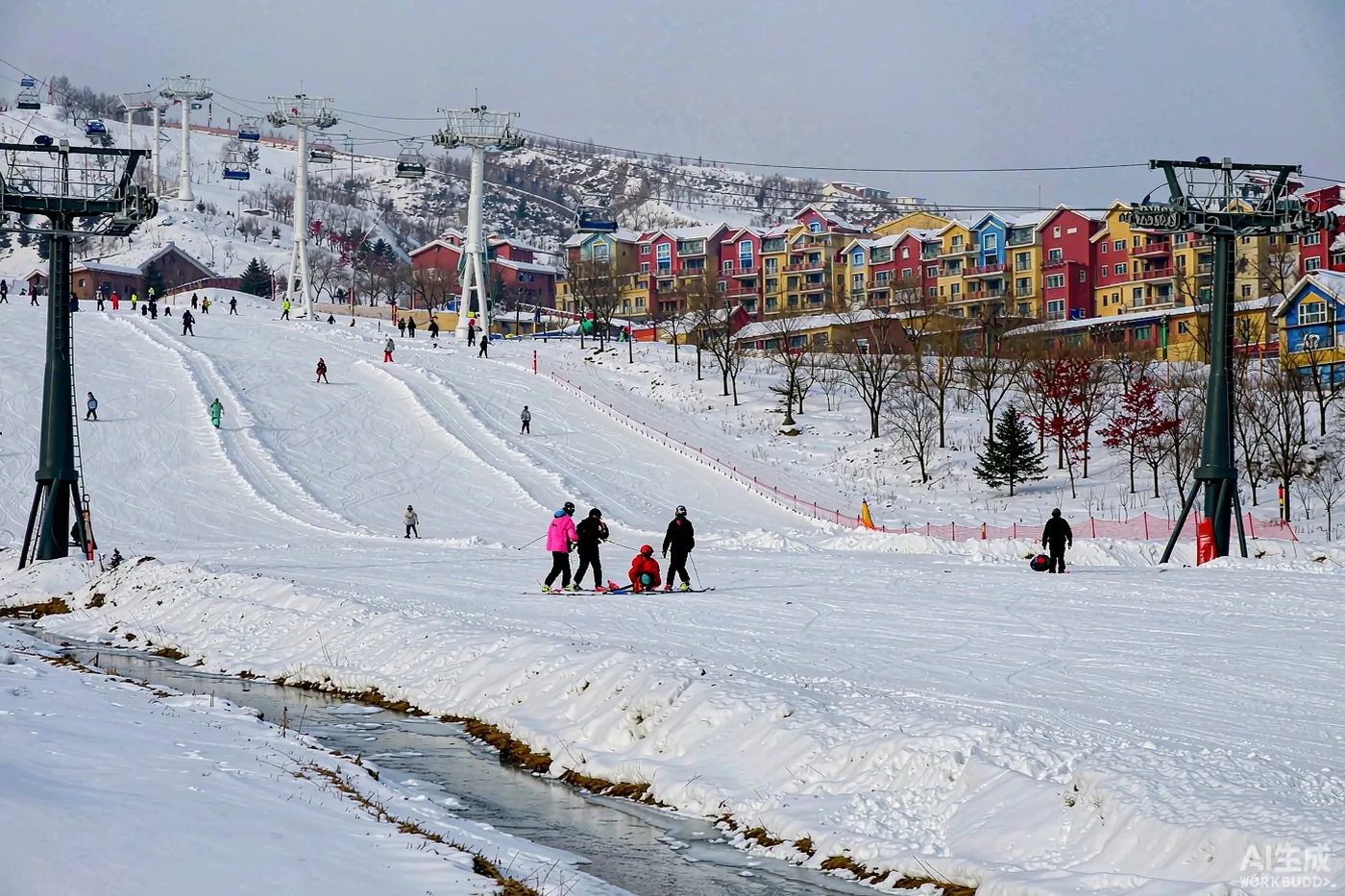
Beijing Skiing & Winter: Chongli Resorts, Trains, Costs and Gear
How to ski near Beijing — Chongli's five Olympic-resort slopes versus the city's day-trip hills, the 1-hour high-speed train, what snow passes and rentals cost, whether to buy or rent gear, and how to stay safe.
8 min read · KOULING's Beijing Travel Guide
Beijing's winter has one serious advantage: the 2022 Olympic slopes at Chongli are about an hour away by high-speed train. The snow there is dry and soft, the terrain is far bigger than anything near the city, and ski-in/ski-out packages are genuinely good value. The trade-off is distance — Chongli is roughly three hours by road, so it needs a night. This guide covers which of the five resorts suits you, how to get there with your skis, what passes and rentals cost, whether to buy or rent gear, and the safety rules that matter.
Chongli or Beijing — pick your base
The choice is between snow quality and convenience.
Chongli — the real thing — Dry, soft snow; far more runs and terrain; Olympic-standard facilities; and ski-in/ski-out packages that make a weekend good value. The cost is distance: about three hours from Beijing, so plan an overnight.
Beijing's local hills — Huabei, Shijinglong and Jinshanling are the value picks for a single day; Nanshan costs a little more. The National Alpine Skiing Centre (Xuefeiyan) has Olympic-level courses — narrow runs that suit skiers rather than boarders, and quieter black runs.
The rule of thumb — One day and no car: stay near Beijing. Two days or more, or you care about snow: go to Chongli.
The five Chongli resorts
They are not interchangeable — each has a clear personality.
Wanlong — the powder benchmark — China's self-styled powder heaven: dry, soft snow and a high share of advanced terrain, with 32+ runs and six FIS-certified ones. Day passes run 08:30–16:30, with night skiing 18:30–21:30 on some lifts (separate ticket). Free shuttle from Taizicheng station at 08:30, 12:40, 16:15 and 19:45.
Fulong — closest to town, kindest to beginners — Right by Chongli town centre and known for being warm and sheltered from wind. A snowboard favourite and the easiest resort with children. Free shuttle from Chongli station at 09:30, 13:35, 17:10 and 20:45.
Genting Resort Secret Garden — the Olympic venue — 41 runs (13 advanced, 20 intermediate, 2 beginner, 6 off-piste) and five high-speed gondolas with heated seats — the only resort in China where every lift is heated. Expect crowds and lift queues; national teams train here.
Taiwoo — the biggest vertical — Sits on Chongli's main peak, Yushiliang, at 2,160 m with 510 m of vertical and around 4 million square metres of snowmaking. A full resort town. Two caveats: the shaded side is genuinely cold, and there is no night skiing. Runs free direct buses from Beijing South, Capital Airport and Daxing Airport.
Cuiyunshan Galaxy — long, cold season — Peak 2,100 m, winter averages −15 °C to −30 °C, and snow cover lasting about five months (November to March). 320 m vertical, runs named after the zodiac, and over 2,000 rental sets through its Salomon partnership.
Xue Ruyi — new, still settling — The Olympic jumping-venue resort, only a couple of seasons old. Season passes are listed around RMB 3,388 (weekday), RMB 4,988 (full season) and RMB 3,388 (youth) — but visitor feedback on facilities is mixed, so check before committing.
One-line summary — Skiers with budget go to Wanlong; boarders, families and beginners go to Fulong; if you want to watch the national team train, go to Genting.
Getting there — and getting your skis there
The train is the reason Chongli works from Beijing.
High-speed train — Beijing North or Qinghe to Taizicheng or Chongli, about an hour, second class roughly RMB 74–87. Taizicheng serves Genting, Taiwoo and Xue Ruyi; Chongli station is closer to Fulong and Wanlong.
Last mile — Free resort shuttles meet the trains and take 10–22 minutes to the slopes; a taxi is around RMB 20.
Your skis — You cannot carry skis onto the train — they go as checked consignment for about RMB 80. Cheaper and easier: ship them door-to-door with SF Express or JD, roughly RMB 40 per packed board each way.
Driving — About three hours via the Jingli expressway, with tolls around RMB 100. Chargers are spaced roughly every 50 km and the four main resorts have them; carry snow chains in winter and avoid travelling in heavy snow.
Coach — Direct ski coaches run from Capital Airport, Daxing Airport and Beijing South to Chongli, one or two departures a day, skis can be checked, journey about 3.5 hours, around RMB 80.
What it costs
Resorts price by day type, and the gaps are large. Figures below are published 2025–26 resort rates; always check the current season's price board.
Hours — Day session 08:30–16:30; night session 17:30–21:30.
One day — RMB 525 / 639 / 764. A day pass covers the full 08:00–17:00 day.
1.5 and 2 days — 1.5-day pass (any 12 hours across two days) RMB 793 / 1,009 / 1,235; two-day pass (two day sessions) RMB 945 / 1,151 / 1,376.
Night and afternoon-plus-night — Night only RMB 248 / 347 / 441; afternoon plus night RMB 483 / 609 / 735.
Rental — weekday/weekend/holiday — Skis RMB 50/70/100, boots RMB 40/70/120, poles RMB 10/20/30, snowboard RMB 60/80/120. Snow wear RMB 80, helmet RMB 20, goggles RMB 30, lockers RMB 20–40 a day. Deposits are typically RMB 1,000 on hard goods.
Low vs peak season — Before about 20 November and from mid-March is low season and cheap either way. Weekends cost more than weekdays, and spring snow is priced highest.
Season passes — Generally RMB 3,000–5,000. Worth it only if you will ski more than about ten weekend days.
Children — Under 1.2 m is usually free with a paying adult. Some resorts also free-ride 1.2–1.4 m or under-12s — policies differ, so check the specific resort. Child and youth season passes run a few hundred yuan and are excellent value if a child is in lessons.
Ski-in packages — A typical peak weekend: about RMB 450 for a day pass, and roughly RMB 1,200 for a room with two passes and breakfast for two. Every resort has slope-side hotels and walkable apartments — the closer, the dearer.
Gear: rent or buy
The break-even point is about five days in a season.
Under five days — rent — A board-and-boots set runs around RMB 100 a day. Renting also suits anyone who isn't sure they'll stick with it, and anyone without a car.
More than five days — buy — A used board-and-boots set is under RMB 1,500 and can be resold afterwards. Five days of renting is roughly RMB 500 spent on gear that is lower quality and less hygienic than your own.
Shipping home — SF Express or JD will ship a packed board for about RMB 40 each way — far easier than travelling with it.
Buy, never rent — Helmet, goggles, face covering, gloves (mittens for boarding, fingered for skiing) with liners, base layers, thin down layer, shell, impact shorts, knee pads and ski socks. Decathlon covers all of it in one stop.
It is colder than Beijing — Chongli runs about 10 °C below the capital. Bring a down liner, a heavier shell and boot liners — this is the single most common packing mistake.
Lessons and staying safe
Skiing injuries are mostly avoidable, and technique is the cheapest insurance.
Take a lesson — If you are new, hire an instructor — one-to-one is the fastest and, per outcome, the cheapest option. Even gifted athletes should take at least a three-hour private lesson: correct basic movement is what prevents injury.
Match the slope — Only move to harder runs when you can stop safely and avoid other people and obstacles.
Pull over to stop — Rest at the edge of the run and check uphill before rejoining. Never stop in the middle or in a narrow section.
Don't collide — The old saying holds: falling is fine, colliding is not. Most serious injuries involve a person, tree or net.
Never ski alone off-piste — Don't go into trees, steep faces or gullies by yourself — three or more together is the safe minimum.
How to fall — Drop your weight and sit back; don't flail, don't go head first, and avoid tumbling.
If someone is hurt — Don't move them. Report it to resort patrol and let them handle it.
Hard no — No skiing after drinking, or if you have heart conditions, high blood pressure, or are pregnant.
Winter in the city — if you're not skiing
A Beijing winter is worth the trip even without a lift pass.
Natural ice — Shichahai and Houhai freeze over and open as informal skating rinks — the most atmospheric thing in the city on a clear cold day.
Snow on the palace — Snow on the Forbidden City's glazed roofs is the classic Beijing winter image, and the crowds thin out. Book ahead — tickets still release seven days in advance.
Hotpot season — This is when Beijing food makes most sense. See our food guide.
Air and clothing — Winter air is often at its clearest after a front passes, but also its coldest. Layer, and check the AQI daily.
Related Beijing guides
If you found this useful, these cover the next question most visitors ask: