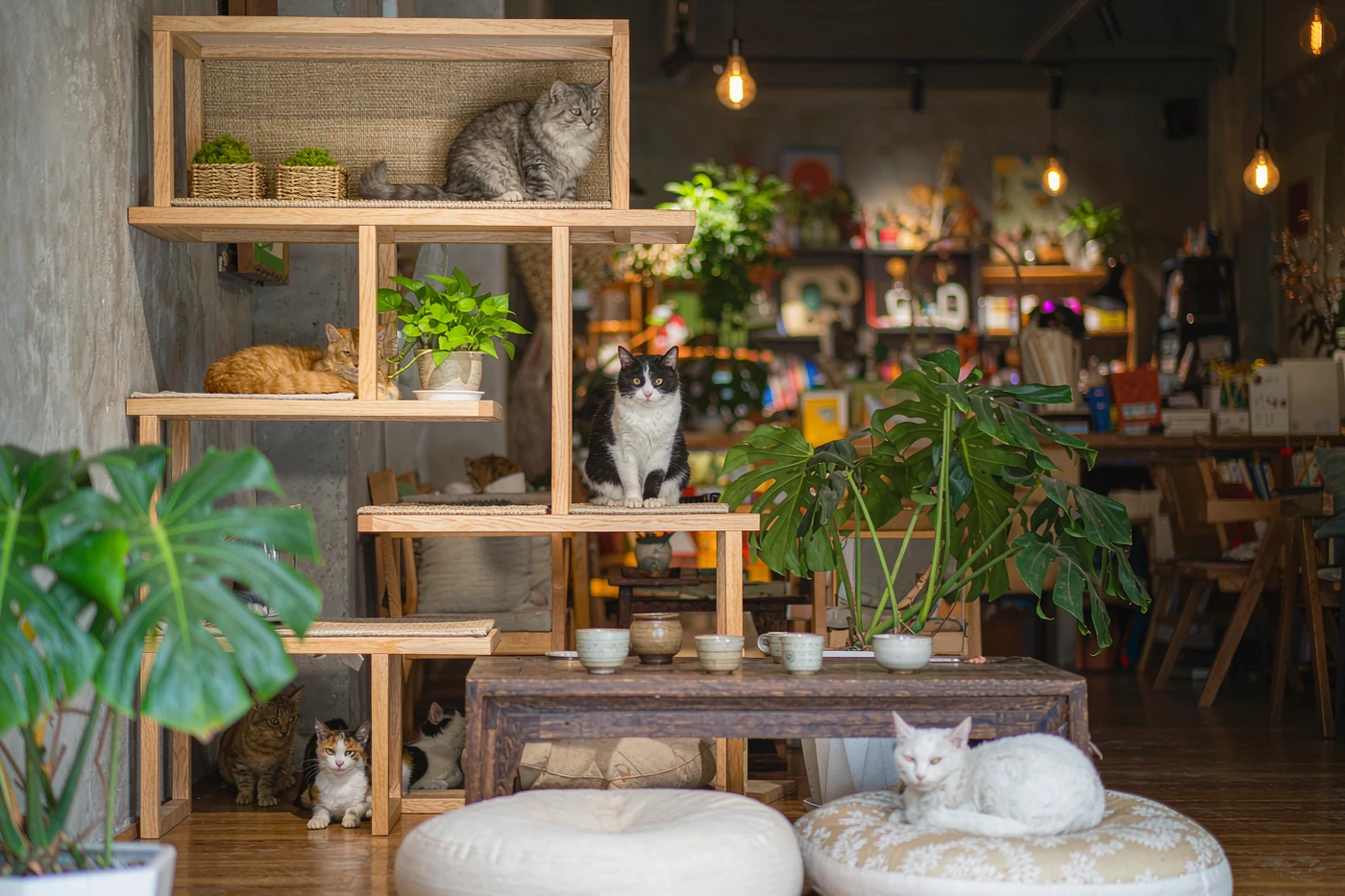
How to find and book a Beijing cat café without Chinese, what a session really costs, the welfare checks that matter, plus zoo, aquarium and safari-park prices and travel times.
Beijing has hundreds of cat cafés — 猫咖 or 撸猫馆, rooms of resident cats that you pay by the hour to sit in — and almost none of them surface in an English search. That cuts both ways. A good one is among the cheapest, gentlest ways to spend a wet afternoon in this city: about ¥50, one drink, and a warm animal asleep on your coat. A bad one is a room you will think about uncomfortably for the rest of the trip. This guide covers how the scene is built, how to find and book a session if you speak no Chinese, what sessions actually cost, the specific signals that separate a well-run cat room from a tired one, and the bigger-ticket alternatives — the pandas at Beijing Zoo, the aquarium inside the same grounds, and the safari park in Daxing — with current prices and realistic travel times. Treat every price here as a sanity check rather than a quote: these are small private businesses and their packages change constantly.
Before you open an app, decide which of these you are actually in the market for. They share almost nothing except the word animal.
Everything runs through two apps: 大众点评 (Dianping) and 美团 (Meituan). Same company now, both mostly Chinese-language, both perfectly usable without reading much. Search 撸猫 (lū māo, to pet cats) or 猫咖 (māo kā, cat café) together with a district — 中关村, 西单, 三里屯, 望京 — and sort by rating rather than by distance. A typical listing gives you the address, the phone number, the hours and a 团购 voucher: buy the voucher in the app and show the QR code at the door, which is cheaper than paying on arrival and is how you reserve a slot. Walk-ins are fine on a weekday afternoon; weekends, Friday evenings and school holidays genuinely book out. Two things to expect. First, many of these venues sit on the second or third floor of mixed residential-commercial buildings — the app address may be the only signage you get, so read the unit number (门牌) and look for a handwritten board at the building entrance rather than a shopfront. Second, if your Chinese is thin, the phone number on the listing is the fastest way to ask whether there is room right now — and asking your hotel's front desk to make that call for you is a completely normal request in Beijing, not an imposition. Payment at the door means Alipay or WeChat Pay; very few places take cash from a stranger and almost none take a foreign credit card directly.
Ballpark figures for 2026, taken from the voucher listings on Dianping and Meituan rather than from shop windows.
You can size up a cat room in about ninety seconds, and the signals are the same ones you would use at home.
None of these alone proves anything, but two or three together should end the visit — and an unused voucher is usually refundable in the app.
The 异宠 (exotic pet) category is where the gap between what is permitted, what is licensed, and what is simply happening is at its widest. China's wildlife framework requires permits for keeping and commercially displaying terrestrial wild animals, and a legitimate venue can produce documentation — ask, and pay attention to what comes back rather than how confidently it is said. More usefully, apply the obvious test: raccoons, meerkats and kinkajous are not domesticated animals anywhere in the world, they are wild animals with wild requirements, and a room lit for photographs at three in the afternoon is not meeting them. A nocturnal animal being woken and passed around at midday is being handled precisely when it should be asleep. Reptile rooms are the mildest version of all this — most lizards and snakes do not want contact, so a display-based setup is close to their actual needs, and the ticket is usually the cheapest in the building. If what you actually want is animals being animals rather than animals being props, take the same money to Beijing Wildlife Park, or, at zero cost, to one of the city's wetland parks at dawn; the birdwatching guide linked below lists the ones that actually work.
The cheapest world-class animal experience in Beijing, and the one nobody believes the price of. A working municipal zoo on imperial-era grounds, with the Panda House as the reason most people come — a large indoor hall with glass viewing and a rotation of animals, open from 08:00, an hour after the park itself. Buy the combo ticket that includes the Panda House rather than the base admission; the base ticket does not cover it, and the difference is a few yuan. Arrive at opening if you want active pandas: they eat and move in the morning and sleep through much of the afternoon. Viewing at the Panda House is managed in short timed groups when it is busy, and there are no toilets inside the hall — leaving means buying a new ticket to come back in, so go before you queue. The whole park is non-smoking, pets are not admitted, flash photography is prohibited and feeding the animals is not allowed. Children aged 6 and under, or under 1.2 m tall, enter free; ages 6–18 and full-time students get half price on presentation of a passport.
The aquarium sits in the northern part of the zoo grounds with its own gate, and the two are sold as one combined ticket, so you can walk between them in the same visit. It is a large indoor facility: a shark tunnel, a ray pool, a beluga enclosure and scheduled presentations. It is entirely indoors and heated, which is exactly why it is packed on the days nobody wants to be outside — a July afternoon, a January morning, or any day with an air-quality warning. That is also its weakness: on those days it is genuinely crowded, and going at opening or in the last two hours before closing changes the experience completely. Show times are posted at the entrance and change seasonally, so check on the day rather than planning around a schedule you found online.
Something quite different: roughly 3,600 mu of woodland in Daxing, about 40 km south of the centre, split into three areas — a walking zone, a predator zone you ride through in a caged truck (included in the ticket), and a self-drive area that costs a vehicle pass on top. The animals live in large enclosures rather than cages, and the caged-truck ride through the tiger and bear sections is the reason most people make the trip. It is a real day out: four to five hours inside once you are through the gate, plus an hour or so each way from central Beijing. There is no metro to it. The bus route involves taking Line 4 south and transferring, and most visitors simply take a taxi or a ride-hailing car, which becomes reasonable value with three or more people splitting it. Book on the app a day ahead for a better price, and bring water and snacks — the food inside is expensive and the walking area is large.
The cats in a licensed café are vaccinated and the chance of anything serious from a scratch is low — but it is not zero, and both precautions are cheap. If you are scratched or bitten, wash the wound under running water with soap for a solid fifteen minutes, then go to the emergency department of a large hospital; post-exposure rabies care is routine in Chinese hospitals, and it is not a decision you want to be making at midnight with an internet connection. Take the venue's name and the cat's vaccination date before you leave. Skip the visit entirely if your cat allergy is a real one rather than a sniffle: these are indoor rooms holding twenty animals and the ventilation cannot fully compensate. Bring an antihistamine, use the lint roller by the door, and wash your hands before you eat. Most venues set a minimum age, commonly around six, and children need to be children who can be told not to chase.
If you found this useful, these cover the next question most visitors ask: