Beijing sits on a major migration flyway. Where to see cranes, ducks and raptors, which weeks to pick, and how to reach every site by metro and rail.
Beijing sits on the East Asian–Australasian Flyway, one of the great migration routes of the world, and the city has quietly become one of the easiest places in China to watch wild birds without a guide, a permit or a rented car. In spring and autumn the sky over the western hills fills with raptors riding the ridge thermals; in the wetlands north and east of the city, tens of thousands of ducks, geese and cranes stop to rest and feed. This guide covers where to go, which weeks to aim for, what to carry, and how to reach all of it by metro and rail.
Two migration pulses pass over the city each year, and they are not mirror images of each other. Spring (roughly late March to mid-May) is the season of species: April brings the widest variety, May brings the biggest numbers, and the daily window is the early one, about 08:00–11:00. Autumn (roughly late August to early November) runs longer and is often better for sheer volume: numbers peak in September, species variety peaks in October, and the daily window shifts later, about 09:00–14:00, because raptors wait for the thermals to build. Wetlands work on a different clock from hillsides — at Yeyahu, Hanshiqiao and Cuihu the best hours are the first three after sunrise and the last two before sunset, when birds move between feeding and roosting water. Midday on a wetland is usually dead. Winter is not empty either: Yeyahu holds a large wintering flock of common cranes. Summer is the weakest season — migrants have gone, and you are left with breeding residents and heat.
Beijing birding splits neatly into three kinds of outing, and choosing the right one matters more than choosing the right site. Raptor passes are hillside watchpoints where you sit and wait: half a day, cheap, spectacular when it works, empty when the wind is wrong. Open wetlands are the reliable option — big water, big numbers of waterbirds, long boardwalks, and a real chance of something rare, but one to two hours of travel each way. City parks are the low-commitment version: an early morning before the crowds, no travel budget, and a surprisingly long species list if you know where to stand.
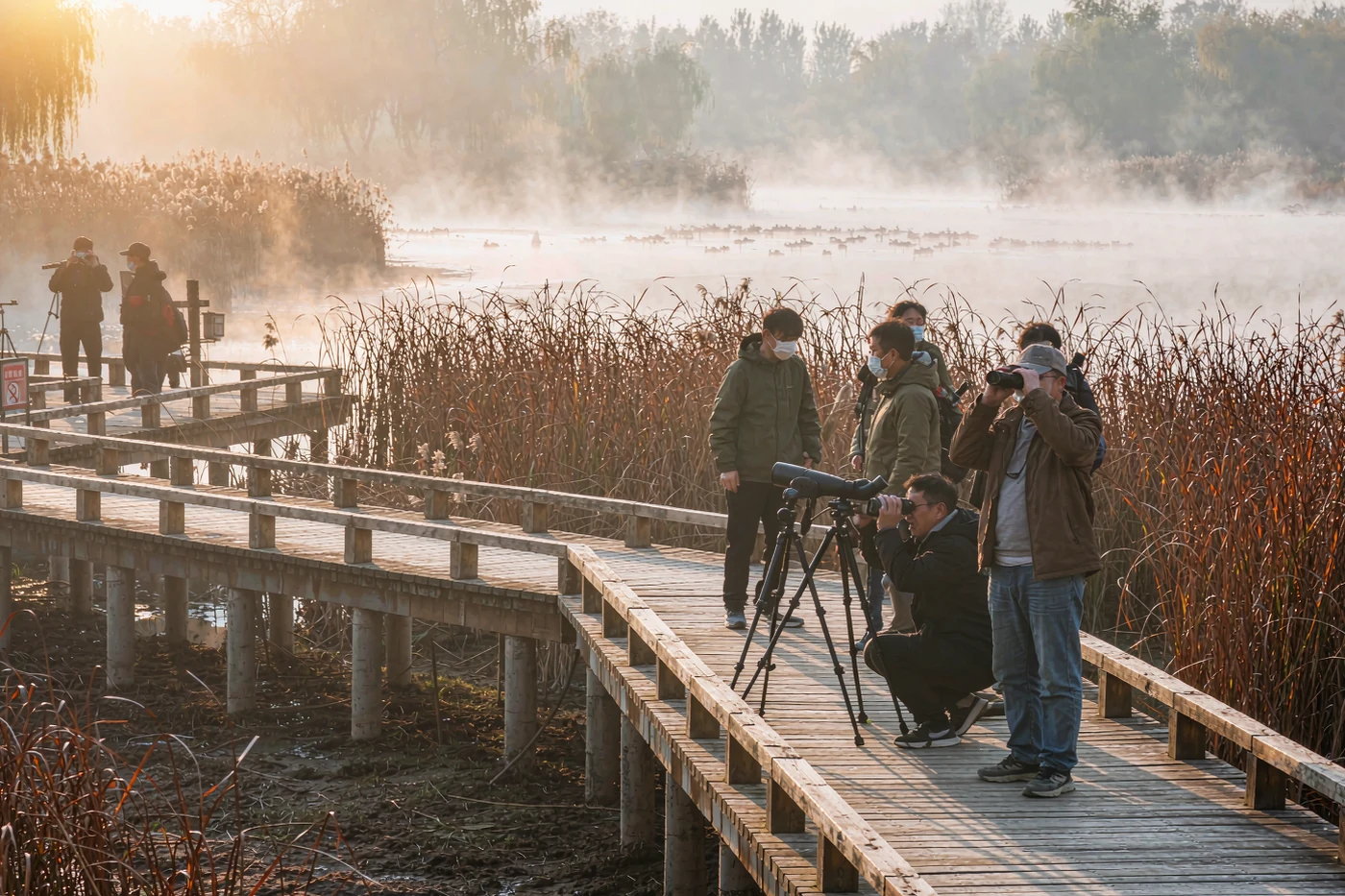
Yeyahu, in Yanqing district north-west of the city, is Beijing's largest wetland nature reserve and the single best place in the municipality to see waterbirds in volume. Around 370 bird species have been recorded here — more than two-thirds of everything ever recorded in Beijing — and several thousand common cranes winter on the site, with single-day counts reported above 4,600 birds. The lake circuit is a flat boardwalk of roughly 4.6 km, so it is walkable with children and pushchairs. Start at the wetland museum to learn what you are looking at, then use the crane-viewing platform and the lakeside tower with binoculars. Wide open water means distant birds: this is the one site where a spotting scope genuinely helps.
Hanshiqiao, in Shunyi district north-east of the city, is the only large reed-marsh wetland left on the Beijing plain: a landscape of reed beds, lotus ponds and open water that locals once simply called the lake. Entry is free, which makes it the cheapest serious birding site near the city, and the boardwalks and observation tower put you level with the marsh without wading into it. Autumn is the best season — the reeds flower, and the marsh fills with ducks, herons and passing waders. Boat trips into the reed channels and a small deer enclosure are paid extras; you do not need either to see birds.
Cuihu, in Haidian's Shangzhuang area, is Beijing's only national-level urban wetland park and the best choice if you want a first, low-commitment look at Chinese wetland birding without a long drive. It is free, it is close to the city, and it is deliberately kept quiet: daily visitor numbers are capped, so the water stays undisturbed and the birds stay close. The catch is the booking. Turn up without a reservation and you will very likely be turned away. Reserve through the park's official channel one to three days ahead and reconfirm the day before you go.
Baiwangshan, in the north-western Haidian hills, is the most famous raptor migration site in Beijing and the easiest mountain birding site to reach from the centre. Migrating raptors ride the rising air along the ridge here, and on a good day they come over in streams — the local birders talk of eagle rivers and eagle columns. Official monitoring in 2025 recorded 34 species of daytime migratory raptors on this passage, around two-thirds of all raptor species in Beijing, with the birds passing at heights of roughly 190–510 m. Go up to the summit watchpoint (Wangjinglou) for all-round views, or to Heishantou for close morning passes; the 282 watchpoint and Wangxiang Pavilion are the other regular stations. Around 217 bird species have been recorded in the park overall.
You do not have to leave the city to see interesting birds, and if your schedule is tight this is the better use of a morning. Three parks do most of the work. The Temple of Heaven is the famous one among Beijing birders: despite having almost no open water, more than 200 species have been recorded in its groves and nursery plantings, and spring and autumn migration turn its trees into a feeding stop for passing songbirds. The Summer Palace is the waterbird option — walk in through the west gate to the fenced-off Tuancheng Lake, which has become a safe roost with roughly 30–60 waterbird species through the year, heron and cormorant nests on the lake island in summer, and reed beds along the west causeway for warblers. The Olympic Forest Park is the easy one: free, directly on Line 8, with a large lake, woodland and reed edges that hold far more than the joggers notice.
Birding gear does not need to be expensive, but three things are non-negotiable: binoculars, dull clothing and patience. An 8×42 roof-prism binocular is the sensible all-round spec — enough magnification for distant water, wide enough field to find a moving bird, and light enough to carry for three hours. Dress in grey, khaki or dark green; bright red, yellow and white push birds away long before you are close enough to see them. Bring a hat, water and sun protection, because wetland wind and glare are harder than they look, and bring a bird identification app so you can name what you see on the spot rather than from a photograph later. Photographers should know that raptors at Baiwangshan fly at 190–510 m: 400 mm is the practical minimum and 600 mm is comfortable.
Every site in this guide is reachable by public transport, with one caveat that catches visitors out: the wetlands are easy to reach and hard to leave. Didi will happily take you to Yeyahu or Hanshiqiao, but finding a return car from a rural reserve gate can take a long time, and drivers sometimes cancel. Either ask your driver to wait, or plan the return around a bus or a booked car. For Yeyahu the cleanest option is the Beijing–Zhangjiakou high-speed rail to Yanqing Station and a short taxi from there. For everything inside the city, the metro opens around 05:00–06:00, which is exactly when you want to start. Carry your passport — several sites require it for ticket purchase — and carry some cash, because small rural ticket windows and boat operators do not always handle foreign cards smoothly.
Chinese nature reserves are managed for the birds first and visitors second, and the rules are enforced. Do not feed anything — handouts make waterbirds dependent and can delay or derail a migration. Stay on boardwalks and marked paths; reed-bed nesting areas are closed to entry. Keep your distance and let the optics do the work: if a bird changes behaviour because of you, you are too close. Keep voices low, especially in groups, and never use playback calls or flash. Drones are off-limits. Baiwangshan is a first-level fire-prevention area, so no open flame, no smoking and no camping; pets, scooters and tents are not allowed in. Finally, accept that reserves close at short notice for water-level work, bird-flu precautions or ecological management — checking the day before is part of the hobby, not paranoia.