Explore Beijing / Shenzhen Night Markets: When They Start and Which Ones Are Worth It
Shenzhen Night Markets: When They Start and Which Ones Are Worth It
A practical guide to Shenzhen's best night markets for first-time visitors, including typical opening times, what to eat, and how to pay.
5 min read · KOULING's Beijing Travel Guide
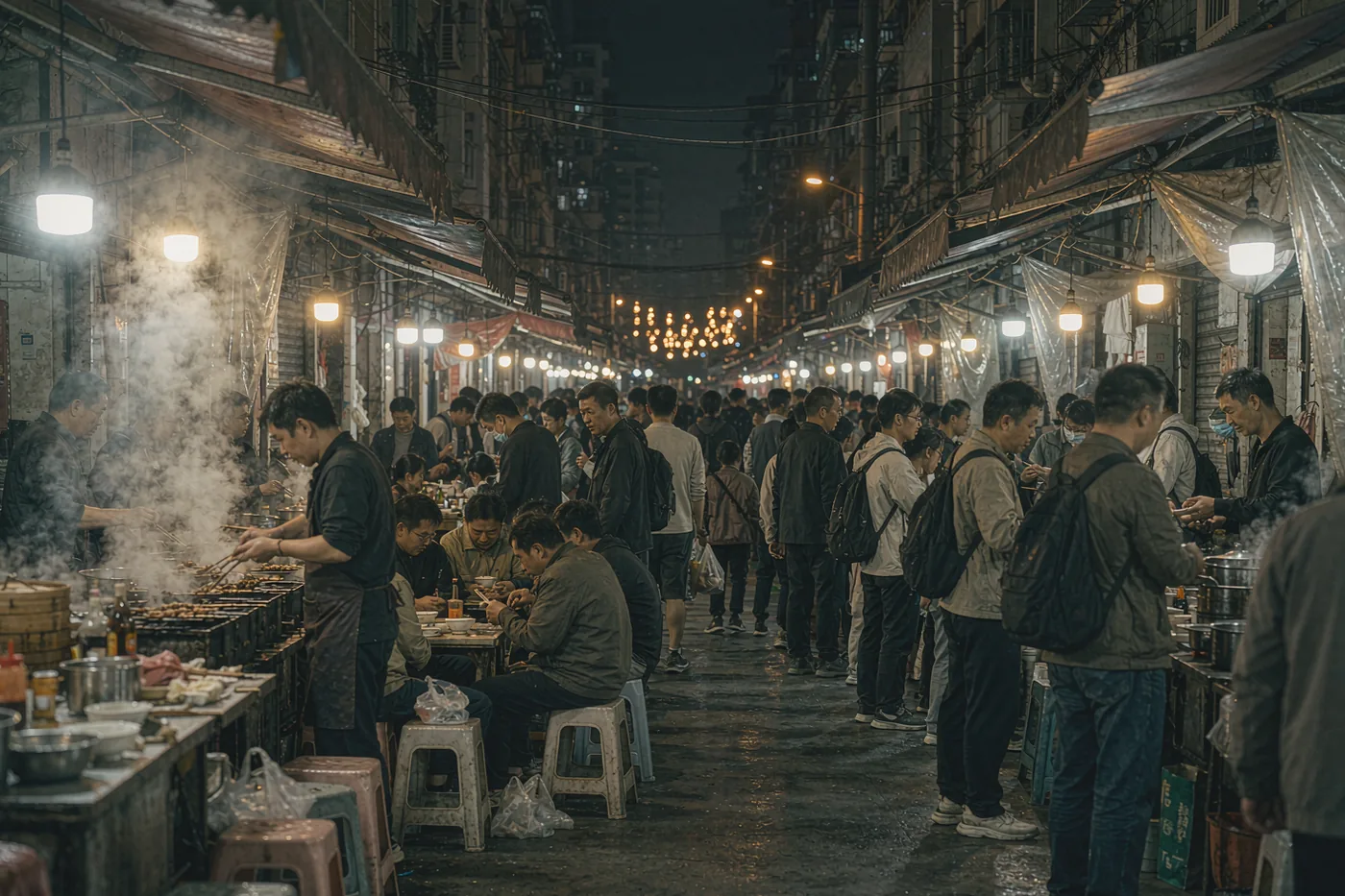
Shenzhen is a young, immigrant city, and its street food reflects that: Sichuan spice, Hunan heat, Cantonese comfort, and flavors from across China all collide in its night markets. Most stalls get going around 6:00–7:00 PM (18:00–19:00) and trade until roughly 11:00 PM (23:00), though exact times vary by market and season [verify before travel]. Bring a phone with WeChat Pay or Alipay set up — cash is increasingly rare [verify before travel].
When Do Night Markets Actually Start?
Shenzhen's night markets are not on a strict schedule. Vendors typically begin setting up late afternoon, food stalls fire up around 6:00 PM, and crowds peak between 7:30 and 10:00 PM. Weekend nights are busier and often run later. A few markets skew late-night, with stalls still serving after midnight [verify before travel]. If you want the fullest selection and shortest lines for popular grills, arrive between 6:30 and 7:30 PM.
Best arrival time — 6:30–7:30 PM (18:30–19:30) for full stall selection [verify before travel].
Peak crowds — 7:30–10:00 PM (19:30–22:00), especially Friday and Saturday.
Closing — Most wind down by 11:00 PM (23:00); some run later on weekends [verify before travel].
Payment — WeChat Pay or Alipay; set up an international card in advance [verify before travel].
What to Eat
You don't need a plan — walk, sniff, and point. But a few signatures are worth seeking out: grilled seafood and skewers (shao kao), Hunan-style stir-fries, Sichuan malatang, Cantonese cheung fun and congee, plus Hubei hot dry noodles and Xinjiang lamb skewers brought by migrants. Expect 10–40 CNY (roughly $1.50–$6) per dish at most stalls [verify before travel].
Shao kao (BBQ skewers) — Grilled lamb, oysters, and eggplant with chili — the backbone of any night market.
Malatang — Pick skewers or veggies, boiled in spicy broth; great for customizing heat.
Seafood — Shenzhen's coastal location means fresh oysters, clams, and shrimp.
Desserts and drinks — Fresh sugarcane juice, mango pomelo sago, and bubble tea are everywhere.
Dongmen Pedestrian Street (Luohu)
Shenzhen's oldest and most famous food quarter, near the Hong Kong border. It's less a single market than a dense district of snack streets, hole-in-the-wall eateries, and late-night dessert shops. Very tourist-friendly and busy most nights [verify before travel].
Metro
Dongmen or Laojie Station, Line 1/3 (confirm current line and exits) [verify before travel]
Opening hours
Shops from late morning; street food liveliest 6:00–11:00 PM [verify before travel]
Tickets
Free to enter; budget 50–150 CNY (about $7–$21) for a food crawl [verify before travel]
How long
2–3 hours
Shangmeilin Area (Futian)
A local favorite in Futian district known for dense clusters of affordable restaurants and evening street stalls — strong on Hunan, Sichuan, and BBQ. Fewer tourists than Dongmen, so menus may be Chinese-only; translation apps help [verify before travel].
Metro
Shangmeilin Station (confirm current line and station name) [verify before travel]
Opening hours
Stalls and eateries typically 5:30–11:00 PM [verify before travel]
Tickets
Free; most dishes 10–40 CNY (about $1.50–$6) [verify before travel]
How long
1.5–2.5 hours
Bagualing Food Street (Futian)
Once an industrial zone, Bagualing has reinvented itself as a late-night eating destination packed with BBQ joints, hotpot, and Hunan kitchens that stay open past midnight [verify before travel]. Popular with young locals and office workers unwinding late.
Metro
Bagualing or nearby Futian stations (confirm current line and station name) [verify before travel]
Opening hours
Ramps up around 6:00 PM; many spots open until 1:00 AM or later [verify before travel]
Tickets
Free; expect 40–100 CNY (about $6–$14) per person [verify before travel]
How long
2–3 hours
Related Beijing guides
If you found this useful, these cover the next question most visitors ask:
Budget expectations help, because prices vary more between districts than newcomers expect. At Dongmen, individual street snacks typically run ¥5–15 each — grilled skewers, stinky tofu, a cup of lemon tea — so a grazing dinner of four or five items lands around ¥40–60 per person. Sit-down places in Shangmeilin or Bagualing push that to ¥60–100 with beer. Cash is rarely needed: set up Alipay or WeChat Pay with a foreign card before you arrive, since many stalls have no cash box at all. Small vendors sometimes impose a ¥10–20 minimum for card payments, though enforcement is loose. Factor in the metro ride — Shenzhen Metro fares start around ¥2–3 and almost every market listed here is within a ten-minute walk of a station. A realistic solo budget, transport included, is ¥70–120 for a generous evening. If a stall displays no prices, ask 「多少钱」 before ordering; tourist-adjacent stretches of Dongmen occasionally quote higher to unfamiliar faces.
Common First-Timer Mistakes
Arriving too early — Before 6:30–7:00pm many stalls are still setting up and you'll see half-empty streets. Go at 7:30pm or later for the full scene.
Eating only on Dongmen's main drag — The pedestrian street's frontage is the priciest and least interesting. The side lanes and the arcade basements hold the better stalls.
Skipping the queue logic — A line of locals almost always means something. If a stall has no queue and no diners at 8pm, there is usually a reason.
Ordering too much at one stall — One or two items per stall, then move on. Filling up at the first stop is the classic wasted evening.
Forgetting your power bank — Everything — ordering, paying, maps — runs through your phone, and a dead battery ends the night. Shared power-bank rentals exist but need a deposit via a Chinese app.
Assuming English menus — Outside hotels, assume none. Photo menus or pointing at other tables' dishes works fine; Google Translate's camera mode helps with handwritten boards.
Practical Tips for First-Timers
Go with a full battery — You'll need your phone for payment, translation, and maps; bring a power bank.
Cash is nearly useless — Set up WeChat Pay or Alipay with an international card before you travel [verify before travel].
Spice levels — Say 'wei la' (mildly spicy) or 'bu la' (not spicy) if you're heat-sensitive.
Queuing culture — A long line at a stall usually means it's good; watch where locals order.
Metro hours — The Shenzhen Metro generally stops running around 11:00 PM–midnight, so plan your ride home [verify before travel].