Explore Beijing / Packing a Small First-Aid Kit for Beijing: What to Bring vs What to Buy on Arrival
Packing a Small First-Aid Kit for Beijing: What to Bring vs What to Buy on Arrival
A practical guide to building a compact first-aid kit for Beijing — the essentials worth carrying from home, and the everyday items you can buy cheaply once you land.
5 min read · KOULING's Beijing Travel Guide
Beijing is a modern, well-served city with pharmacies on almost every commercial street and hospitals ranging from neighborhood clinics to internationally oriented facilities. Still, the smartest move for a first-time Western visitor is a small, well-chosen kit you pack at home — because the medications you rely on may be sold under different names, different strengths, or not at all in China. This guide splits your packing list into two columns: bring it, or buy it here.
Bring From Home: Prescription and Familiar Medications
Start with anything you take daily, plus a personal backup supply. Keep original packaging and carry a doctor's note or prescription copy for prescription drugs, especially if they contain controlled substances — rules on what counts as controlled can differ from the US, UK, or EU, so check Chinese customs guidance before you fly [verify before travel]. Add your go-to remedies even for minor issues: motion-sickness tablets, your preferred antihistamine, and the specific antacid that works for you. Western brand names like Pepto-Bismol or Benadryl are not reliably available, and finding an equivalent in a Chinese pharmacy usually requires explaining symptoms in Chinese.
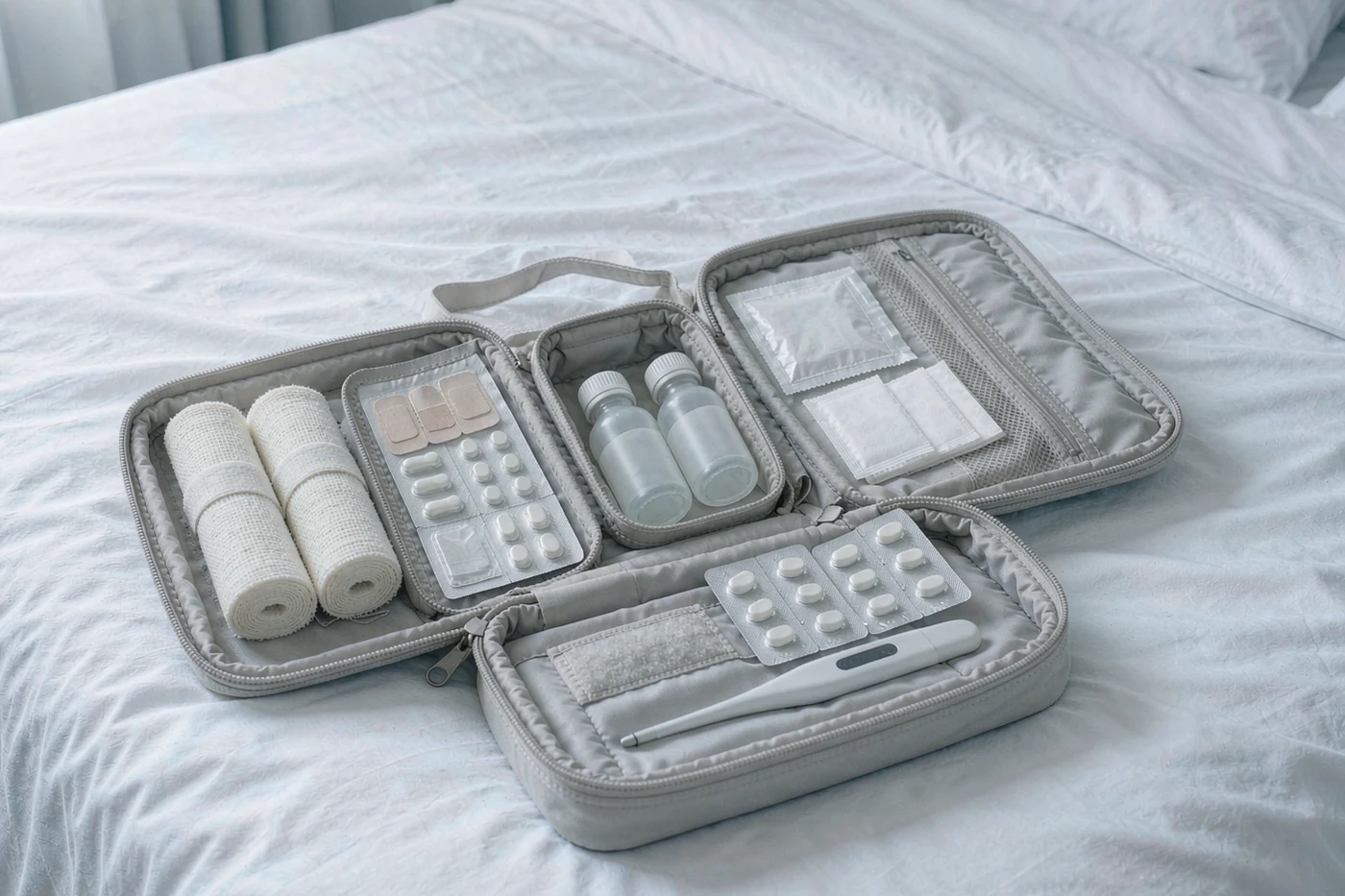
Prescription medications in original boxes — Bring more than your trip length requires, plus a copy of the prescription and a doctor's letter. Confirm Chinese customs rules for your specific drug [verify before travel].
Antihistamine and motion-sickness tablets — Useful for long flights, dusty spring days, and unfamiliar foods.
Antidiarrheal (e.g., loperamide) and oral rehydration salts — Mild traveler's stomach is the most common complaint; these let you manage it from your hotel room.
Pain relievers you know (ibuprofen, acetaminophen/paracetamol) — Chinese equivalents exist (e.g., ibuprofen is sold as 布洛芬), but carrying your own avoids dosing confusion.
Buy on Arrival: Cheap, Easy-to-Find Everyday Items
Don't waste luggage space on things Beijing sells everywhere, often at a fraction of Western prices. Bandages, antiseptic wipes, hand sanitizer, sunscreen, insect repellent, and blister plasters are stocked by chain pharmacies and convenience stores citywide. Large chains like Yifeng (益丰), Dashenlin (大参林), and Nepstar (海王星辰) are common, and a basic bandage pack costs only a few CNY — roughly a dollar or less. Note that 24-hour pharmacies exist in central areas but are not guaranteed near every hotel; daytime hours are typically around 08:00–22:00 [verify before travel].
Bandages, antiseptic wipes, gauze — A basic kit costs a few CNY (under US$1–2). Look for chain pharmacy signs with a green cross.
Sunscreen and insect repellent — Widely available, though some Western brands are pricier or hard to find — check the SPF and ingredient list, which may be in Chinese only.
Hand sanitizer and face masks — Ubiquitous and cheap; masks remain socially common during flu season.
Pharmacy Culture: How Buying Works
Many pharmacies in Beijing have a small counter service model: describe your symptom (or show a translation on your phone) and the pharmacist recommends a product. Some medications that require a prescription in the West are sold over the counter here, and vice versa — always check the active ingredient on the box rather than trusting brand familiarity. Use a translation app with the camera function to read labels, and ask for the English insert if available. For anything beyond minor issues, go to a hospital's outpatient service rather than self-treating; top hospitals have international departments with English-speaking staff [verify current locations and appointment procedures].
Chain Pharmacy (Yifeng / Dashenlin / Nepstar)
The easiest first stop for bandages, sanitizer, sunscreen, and basic remedies. Staff rarely speak English, so bring a translation app and, if possible, a photo of the product you want.
Metro
Branches are widespread; the nearest one to your hotel is usually within a 10–15 minute walk — confirm the nearest branch location
Opening hours
Typically around 08:00–22:00; 24-hour branches exist but are not guaranteed [verify before travel]
Tickets
No entry fee; most everyday items cost 5–50 CNY (roughly US$1–7)
How long
15–30 minutes
Hospital Pharmacy / International Department
For prescription fills or anything more serious, Beijing's major hospitals run outpatient pharmacies, and several have international departments designed for foreign patients. Expect longer waits than at a Western clinic even in the international section; bring your passport, which is required for registration.
Metro
Major hospitals are spread across the city; confirm the nearest international department and current metro access before you go [verify before travel]
Opening hours
Outpatient services generally run daytime hours with reduced weekend service [verify before travel]
Tickets
Registration and consultation fees vary; budget roughly 100–600 CNY (about US$15–85) at international departments [verify before travel]
How long
1–3 hours including registration and waiting
Convenience Stores (Bianlidian)
Chains like 7-Eleven and FamilyMart stock hand sanitizer, masks, bandages, and sometimes basic pain relievers — handy for a late-night top-up when pharmacies are closed. Prices are slightly higher than pharmacies but still modest by Western standards.
Metro
Everywhere in central Beijing, often inside or near metro stations
Opening hours
Most branches open 24 hours [verify before travel]
Tickets
Small items typically 5–30 CNY (roughly US$1–5)
How long
5–10 minutes
Quick Packing Checklist and Practical Tips
Pack prescriptions + antihistamine, antidiarrheal, pain reliever, rehydration salts — These are the items where brand familiarity matters most and substitution is hardest.
Buy bulky items on arrival: bandages, wipes, sunscreen, sanitizer, masks — Cheaper in Beijing and saves luggage weight.
Carry a translation app with offline Chinese — Pharmacy labels and pharmacist conversations are almost always in Chinese only.
Bring your passport to any pharmacy or hospital purchase — Registration for medical services and some restricted purchases require ID.
Check your travel insurance covers China — Keep emergency contact numbers and your insurer's app handy; some international departments bill directly, others require payment upfront (mobile payment or cash) [verify before travel].
Skip needles and syringes — They can raise customs questions; Beijing healthcare supply is reliable for anything requiring them.