Explore Beijing / Where to Run in Beijing: A Visitor's Guide to Routes, Parks, and Staying Fit
Where to Run in Beijing: A Visitor's Guide to Routes, Parks, and Staying Fit
Beijing is more runnable than first-time visitors expect. Here's where to jog safely, how to navigate parks and air quality, and how to keep your routine on track.
5 min read · KOULING's Beijing Travel Guide
Yes, you can run in Beijing. Beneath the wide boulevards and construction cranes lies a surprisingly jog-friendly city of lakes, imperial parks, and Olympic-era greenways. The two things first-time Western runners need to master are park entry (bring your passport and a phone with a local payment app) and air quality (check the AQI before you lace up). Do both, and running becomes one of the best ways to see the city's everyday side — morning tai chi in the park, breakfast vendors setting up, locals doing stretches by the lake.
Before You Run: Air, Timing, and Etiquette
Beijing's air has improved dramatically over the past decade, but bad days still happen, especially in winter. Check the AQI (Air Quality Index) each morning on an app like IQAir or a local weather app; anything under 100 is generally fine for most runners, while sustained readings above 150 are best skipped or moved indoors. Summer runs are best before 8:00 a.m., when it's cooler and the sun is low — July and August often exceed 32°C (90°F) with real humidity. Spring and autumn are the sweet seasons. A few local conventions: runners generally move counterclockwise around lakes and park loops, keep right on shared paths, and don't be surprised if retirees doing backward-walking or group dancing occupy the wide areas — they were there first. Parks are busiest (and most lively) between 6:00 and 9:00 a.m.
Check the AQI daily — Under 100: run freely. 100–150: shorten it. Over 150 [verify before travel]: use a treadmill or rest.
Run early — 6:00–8:00 a.m. beats the traffic, heat, and crowds. Parks open early, typically around 6:00 a.m. [verify before travel].
Carry your passport and phone — Many parks require ID or a reservation via WeChat or a mini-program for entry, and some charge a small fee (often CNY 2–15 / USD 0.30–2) [verify before travel].
Hydrate deliberately — Public drinking fountains are rare. Buy bottled water (about CNY 2–3 / USD 0.30–0.50) at convenience stores, which are everywhere.
Houhai and the Shichahai Lakes Loop
The classic central Beijing run: a flat loop of roughly 3–4 km (about 2 miles) around Qianhai, Houhai, and Xihai lakes in the historic hutong district. Go before 8:00 a.m. and you'll share the water's edge with tai chi groups, swimmers cutting holes in the winter ice, and breakfast stalls. The lakeside path is packed stone and paved sections — fine for normal road shoes. It's atmospheric but can be crowded, so treat it as a sightseeing-jog rather than a tempo session.
Metro
Take Line 6 or Line 8 to Nanluoguxiang area or Line 2 to Jishuitan; confirm the current line and exit before you go [verify before travel].
Opening hours
The lakeside paths are public and open at all hours; surrounding parks may gate and charge entry [verify before travel].
Tickets
Free for the lakeside loop; adjacent attractions like Prince Gong's Mansion charge admission (roughly CNY 40 / USD 6) [verify before travel].
How long
One loop is 25–35 minutes at an easy pace.
Olympic Forest Park
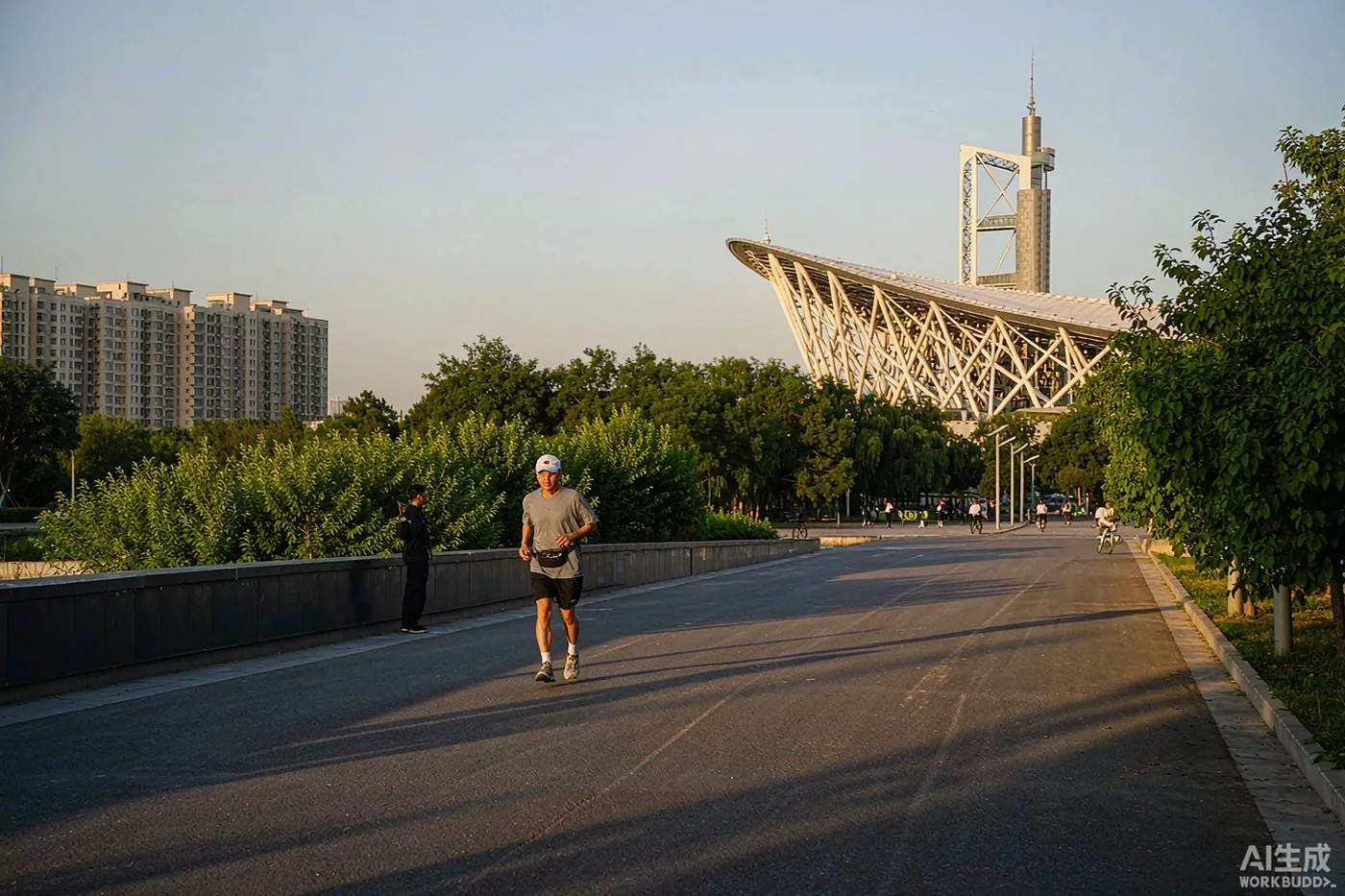
Beijing's best dedicated running venue, north of the Bird's Nest stadium. The park has a marked 5 km (3.1 mile) inner loop and a 10 km (6.2 mile) outer loop with proper running surfaces, distance markers, and plenty of shade. It's the place local running clubs train, so you'll see serious shoes and pacing groups. It's about a 30–40 minute metro ride from central districts, but if you want one quality workout during your trip, this is worth the trip.
Metro
Take Line 8 or Line 15 toward the Olympic Green area; confirm the current station and exit [verify before travel].
Opening hours
Open early morning to evening; exact gates vary by season [verify before travel].
Tickets
Free entry [verify before travel].
How long
Inner loop 5 km (~25–35 min); outer loop 10 km (~50–70 min).
The Forbidden City Moat and Jingshan Park Area
For a run with the best backdrop in the city, loop the moat that rings the Forbidden City — roughly 3.4 km (2.1 miles) on wide paved paths with the red walls and golden roofs on one side. Combine it with a climb up Jingshan Park's hill afterward (it's a stair walk, not a run) for the famous panorama over the palace rooftops. Note the moat path can be busy with tour groups from mid-morning, so go early. Security checks are standard at the park entrances, and Jingshan charges a small admission fee.
Metro
Line 1 to Tiananmen East or Tiananmen West; expect security screening at the square area [verify before travel].
Opening hours
Moat paths are public; Jingshan Park opens early morning and closes in the early evening [verify before travel].
Tickets
Moat loop is free; Jingshan Park around CNY 2–10 / USD 0.30–1.50 [verify before travel].
How long
Moat loop 20–30 minutes; add 30–40 minutes for the Jingshan climb and viewpoint.
Related Beijing guides
If you found this useful, these cover the next question most visitors ask:
Set up mobile payment before you run — Alipay and WeChat Pay dominate; cash and foreign cards often aren't accepted at park gates or kiosks. Set up Alipay's international version with your foreign card before arrival [verify before travel].
Running in summer heat — June–August regularly tops 32°C (90°F). Start before sunrise, carry water, and plan a shorter route — no shame in cutting it.
Winter running — December–February can sit between -10°C and 5°C (14–41°F) with wind. Layer up, and pair cold with a high-AQI day as a treadmill signal.
Hotels with gyms and pools — Most 4–5 star hotels have treadmills; pools are common but ask about opening times and swim-cap requirements, which are standard in China [verify before travel].
Safety and navigation — Beijing is very safe for runners, including solo women, but phone GPS may be spotty near wide avenues. Download an offline map (Apple Maps or Amap) and know your hotel's Chinese name to show a taxi driver.
Marathon season — The Beijing Marathon (usually autumn) requires registration well in advance and may require qualifications for foreign entrants [verify before travel].