Explore Beijing / Beijing's Ring Roads Explained: What the Second to Sixth Ring Mean for Your Trip
Beijing's Ring Roads Explained: What the Second to Sixth Ring Mean for Your Trip
Beijing is built as a set of concentric rings. Learn what the Second, Third, Fourth, Fifth and Sixth Ring actually are, how to read an address like 北四环东路, where the airports and stations sit, and how to use the ring number to judge travel time before you book anything.
11 min read · KOULING's Beijing Travel Guide
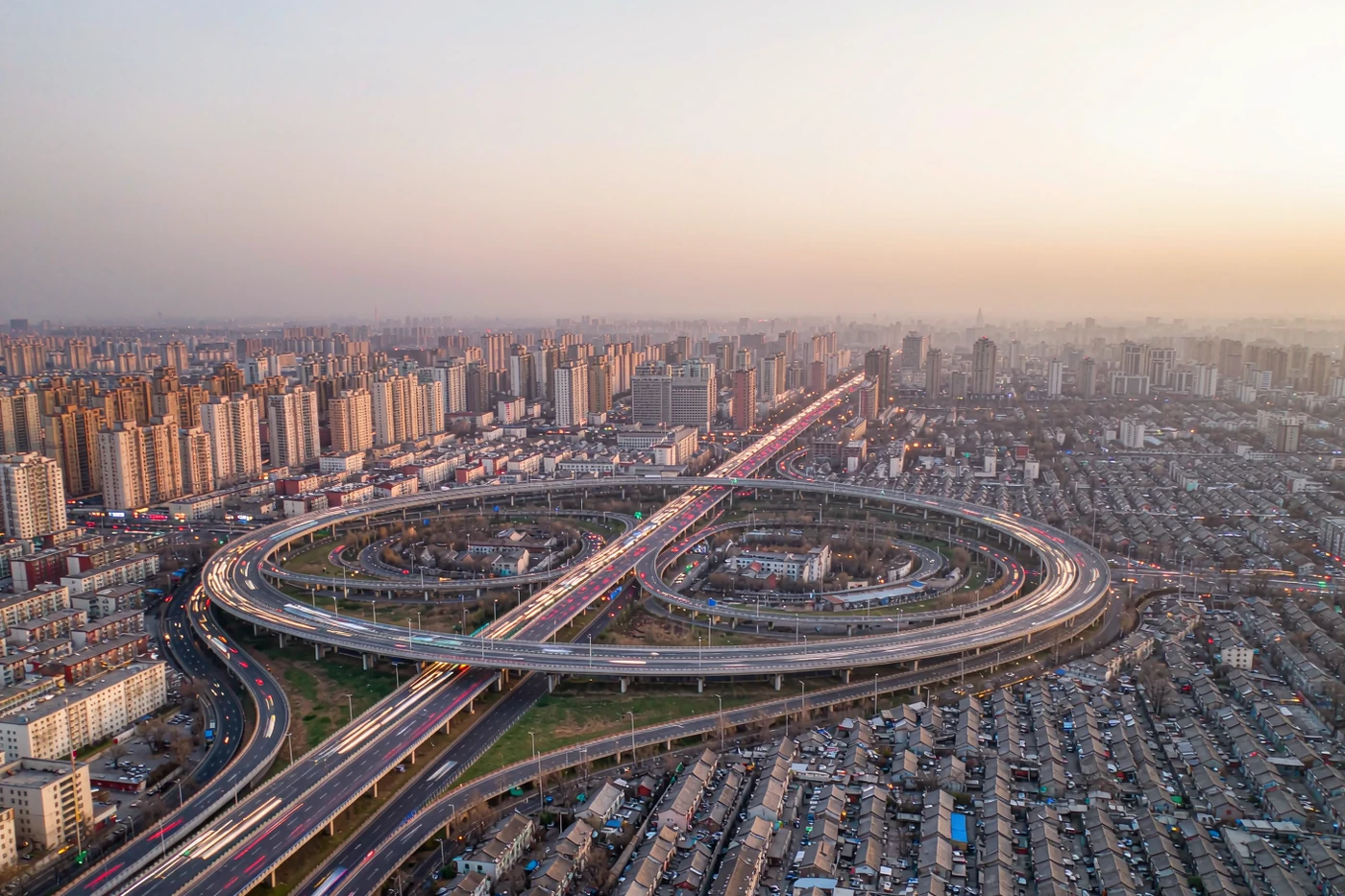
Every Beijing address, every taxi conversation and every hotel listing quietly assumes you know one thing: this city is a set of concentric rings. Beijing grew outwards from the old imperial city, and the ring roads — 环路, huán lù — are the fossil record of that growth. Once you can place a place on a ring, you can judge how far it is from the centre, how long a taxi will take, whether a hotel is convenient, and whether a driver is taking you the long way round. This guide gives you the five rings, the vocabulary to read them, and the practical rules that follow.
The five rings in five lines
The numbering starts at the middle and counts outwards. Inside the Second Ring is the old city. Outside the Sixth Ring you are effectively in the suburbs and the countryside beyond. The lengths below are the official figures for each completed ring road; the distance from the centre is a rough guide, not a measurement.
2nd Ring (二环, Èrhuán) — 32.7 km — Built on the line of the old Ming city wall and finished as a full expressway in 1992. Everything inside it is the historic core: the Forbidden City, Tiananmen, the Temple of Heaven, the hutongs.
3rd Ring (三环, Sānhuán) — about 48 km — Beijing's first completed ring road. Roughly 4–5 km from the centre. Dense, busy and full of hotels, malls and office towers.
4th Ring (四环, Sìhuán) — 65.3 km — Averages about 8 km from the centre point. The practical edge of 'central Beijing' for most visitors: Zhongguancun, the Olympic Park, 798 and most railway stations sit around here.
5th Ring (五环, Wǔhuán) — 98.6 km — Once a tolled expressway, free since 2004. Beyond it you are in outer districts: Tongzhou, most of Haidian's north, the airport corridor, Universal Beijing Resort.
6th Ring (六环, Liùhuán) — 187.6 km — Also signed G4501, a tolled orbital motorway roughly 15–20 km from the centre. The Great Wall, Daxing Airport and the ski hills of Chongli are all beyond it.
The Second Ring is the old city wall
This is the single most useful thing to know about Beijing's geography. The Second Ring Road was laid down on the line of the Ming-era city wall, and while the road was being built above ground, Metro Line 2 was being built below it. Line 2 is literally the old wall line in loop form — which is why so many of its stations are named after gates that no longer stand: Jianguomen, Chaoyangmen, Fuchengmen, Xizhimen, Deshengmen, Andingmen, Yonghegong Lama Temple and so on. Ride Line 2 all the way round and you have traced the boundary of the imperial city. If you want to see a surviving piece of the wall itself, the Ming City Wall Remains Park (明城墙遗址公园) near Chongwenmen keeps a restored stretch with a corner tower.
How to read an address on a ring
Chinese ring-road addresses assemble themselves out of four parts: direction of the ring, ring number, then which side of that ring, then the road type. Once you can take them apart, an address stops being a wall of characters. A number that ends in the street name is the building number — but on a wide ring road that number often tells you very little, which is why locals navigate by the nearest overpass instead.
北四环东路 (Běi Sìhuán Dōnglù) — The East section of the North Fourth Ring. Read it backwards: 北 = north, 四环 = 4th Ring, 东 = east section, 路 = road.
西三环中路 (Xī Sānhuán Zhōnglù) — The Middle section of the West Third Ring. 中路 marks the middle stretch of a side; 北路 and 南路 mark the outer ends.
南五环 / 东五环 / 西六环 — The same pattern for every ring. 南 = south, 东 = east, 西 = west, 北 = north.
桥 (qiáo) — the overpass, and your real landmark — Ring road junctions are all named as bridges: Sìyuánqiáo, Jiànxiángqiáo, Zǐzhúqiáo, Yùquányíngqiáo. Locals say 'meet me at Sanyuanqiao', not 'at 200 North Third Ring'. Give a driver the 桥 and you will be understood.
环路 versus 胡同 — If an address mentions a ring road, you are on a multi-lane arterial. If it mentions a 胡同 (hútòng) or 巷 (xiàng), you are on a narrow old lane and the entrance will be hard to find — allow ten extra minutes.
Where the famous places actually sit
Use this as a mental map. Ring positions here are approximate and meant for orientation — always confirm the exact address in Amap (高德地图) before you set off.
Forbidden City, Tiananmen, Jingshan — inside the 2nd Ring — Dead centre. Beijing's Central Axis runs north–south through here, and the national highway Zero Kilometre marker sits in front of Zhengyangmen (Qianmen) just south of the square.
Temple of Heaven, Beihai, Shichahai, Yonghe Temple — inside or on the 2nd Ring — All walkable from the centre, all served by Line 2 or the lines that cross it.
Summer Palace, Old Summer Palace, Beijing Zoo — north-west, around the 4th Ring — Summer Palace is right by the north-west corner of the Fourth Ring; Metro Line 4 reaches Beigongmen directly.
Olympic Park (Bird's Nest, Water Cube) — north, on the 4th Ring — A straight shot up the city's north axis; Line 8 stops at Olympic Sports Center.
798 Art District, Sanlitun, CBD/Guomao — north-east, around the 3rd to 4th Ring — 798 sits just outside the Fourth Ring in the north-east; Sanlitun and the CBD are closer in.
Mutianyu, Badaling, Jinshanling — far beyond the 6th Ring — These are not day-city trips. Badaling runs out along the G6 Badaling Expressway; budget a full day, not a morning.
Airports and railway stations by ring
The two things that most often ruin a Beijing departure are picking the wrong station and underestimating the drive. Ring position gives you a fast sanity check on both. Treat the distances as road distance, not straight line.
Beijing Capital (PEK) — north-east, outside the 5th Ring — Roughly 25–30 km from the centre. The Airport Expressway and the Capital Airport Express rail both run north-east; allow 45–70 minutes by road in traffic.
Beijing Daxing (PKX) — far south, beyond the 6th Ring — Roughly 45 km from the centre, close to the Hebei border. The Daxing Airport Express is fast and cheap by comparison; the drive is not.
Beijing South — south, around the 3rd to 4th Ring — The high-speed hub for Tianjin and Shanghai. Served by Metro Lines 4 and 14. ⚠️ 待人工确认 exact ring position; verify with Amap.
Beijing West — west, just inside the 3rd Ring — Metro Lines 7 and 9. Convenient from south-west Beijing with no changes if you are on Line 9.
Beijing Station and Beijing North — inside the 2nd Ring — Beijing Station is east of Tiananmen; Beijing North sits at Xizhimen on the north-west corner of the Second Ring and is your departure point for Qinghe-bound Badaling trains.
Qinghe, Chaoyang and Fengtai — outside the 4th Ring — Qinghe is north-west (the fast Badaling service), Chaoyang is east, Fengtai is south-west. All three are a metro ride plus a walk from the centre. ⚠️ 待人工确认 exact ring positions; verify before booking a tight connection.
主路 and 辅路: the pair of roads that trips up newcomers
Every ring road exists twice. The 主路 (zhǔlù, main road) is the grade-separated expressway: no traffic lights, no cyclists, no pedestrians, exits on the right, and a hard shoulder you must never stop on. Running alongside it is the 辅路 (fǔlù, service road): traffic lights, bus stops, bike lanes, shops, and the only place a taxi or Didi can legally and safely pull over. This is why a driver will sometimes appear to be going the wrong way, or why your car is crawling while the road next to it flows freely.
Set your Didi pickup on the 辅路, not the 主路 — If the pin defaults to the expressway, drag it to the service road or to a side street with a name. Otherwise the driver cannot stop and will call you, usually in Chinese.
Never walk on the 主路 — Cross via a footbridge (过街天桥) or underpass (地下通道). They are signed and frequent; walking across the expressway is genuinely dangerous.
Buses and shared bikes live on the 辅路 — Bus stops, subway station entrances and bike racks are all on the service-road side, which is also where you will find shops and food.
What a ring number does to your travel time
Distance is not the problem in Beijing — the rings are. Crossing one ring in rush hour can cost more time than crossing three at midday, and the ring roads themselves jam at the interchanges. Use these as planning budgets rather than guarantees, and check Amap's live estimate before you commit to a schedule.
Inside the 4th Ring, off-peak: budget 20–40 minutes — A typical hotel-to-sight hop. At 07:30–09:30 or 17:30–19:30 the same trip can double.
4th Ring to 5th Ring: budget 30–50 minutes — Common for airport-corridor hotels, Universal Beijing Resort and the outer museums.
Anywhere to PEK or PKX: budget 60–90 minutes by road — More at peak, less very early. The airport express rail is immune to the road jam — take it when the clock matters.
The metro ignores the rings for the first 6 km — Flat fare, no traffic. A 12-stop metro ride is often faster and always more predictable than a taxi covering the same ground at 18:00.
Leaving town: the radial expressways
The rings only make sense together with the spokes that cut across them. Beijing's expressways radiate out from roughly the Second Ring and are signed with a G-number and a Chinese name. Knowing which spoke you need turns a confusing motorway junction into a simple decision.
G6 京藏高速 — north-west to Badaling and Yanqing — Your road to the Great Wall at Badaling and onward towards Chongli's ski resorts.
G45 / 京开高速 — south to Daxing — Runs south towards Daxing district and the new airport.
G4 京港澳高速 — south-west — Towards Zhuozhou, Shijiazhuang and the south-west.
G2 京沪高速 — south-east to Tianjin and Shanghai — The Tianjin and Shanghai corridor.
机场高速 and 大兴机场高速 — the two airport expressways — Signed in both languages at the splits. Get into the correct lane early; the exits come up fast.
Choosing where to sleep by ring
Inside the Second Ring you pay for history and walkability — small rooms, high prices, and the Forbidden City on foot. The Third and Fourth Rings are where the value is: modern rooms, a metro station within a few hundred metres, and twenty minutes to the centre. Beyond the Fifth Ring you are trading commute time for space and price, which only makes sense if you have a specific reason — an early flight, a theme park, a long stay. Judge any listing by its metro line first and its ring second: a hotel on Line 9 just outside the Fourth Ring beats a hotel inside the Third Ring with a fifteen-minute walk to the nearest station.
What to say to a driver
You almost never need to mention a ring to a taxi driver — but you may hear one, and knowing the words helps. In practice the two things that work are a metro station name and a landmark overpass, in that order.
Give the metro station, not the ring — 我要去郭公庄地铁站 (Wǒ yào qù Guōgōngzhuāng dìtiě zhàn) — 'I want to go to Guogongzhuang metro station.' Drivers orient by stations instantly.
Give the overpass as the second reference — 到三元桥 (Dào Sānyuánqiáo) — 'as far as Sanyuanqiao.' Bridge names are unambiguous in a way that long addresses are not.
三环里 / 四环外 — inside the Third Ring / outside the Fourth Ring — These come up in hotel and apartment descriptions. 里 means inside, 外 means outside.
If a driver asks 走四环还是五环? — They are asking whether to take the Fourth or Fifth Ring. The honest answer is whichever Amap says is faster right now — ask them, or point at your phone.
Related Beijing guides
If you found this useful, these cover the next question most visitors ask:
Learn the five numbers before you land — 二 三 四 五 六 — èr, sān, sì, wǔ, liù. Recognising them on a street sign is most of the skill.
Use the ring as a distance shortcut, not an address — 'Outside the Fifth Ring' tells you it is far. It does not tell a driver where to stop. Always pair it with a metro station or a 桥.
Do not book a hotel or an airport run on ring distance alone — Open Amap and check the actual route at the hour you will travel. Two places on the same ring can be forty minutes apart.
Take the airport rail when the clock is tight — Both airports have an express rail link. It is unaffected by the ring-road jam that decides most Beijing taxi journeys.
Remember that Line 2 is the old wall — If you get lost inside the Second Ring, walk towards a Line 2 station — it will put you on the edge of the old city with a clear bearing.
Verify current figures before you rely on them — Ring lengths are fixed, but fares, tolls, opening hours and station arrangements change. Confirm anything time-sensitive in Amap or at the venue.