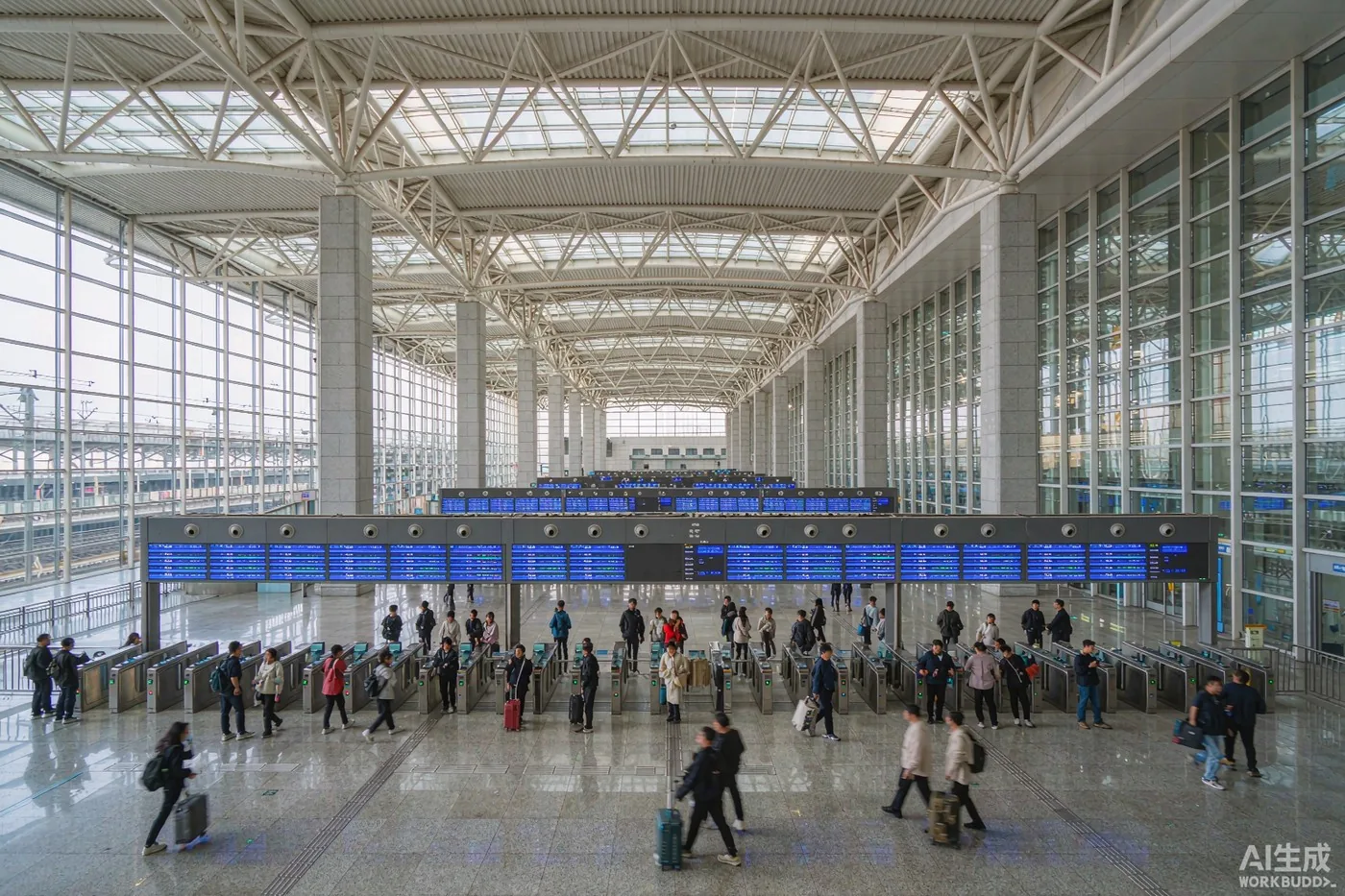
Beijing has seven passenger railway stations and they are not interchangeable. Which one your train leaves from, the metro line that gets you there, and what happens between the door and the platform with a foreign passport.
10 min read · KOULING's Beijing Travel Guide
Beijing has seven main passenger railway stations and none of them are interchangeable. Show up at the wrong one and you will watch your train leave without you — the taxi ride between two of them can take longer than the journey you booked. This guide tells you which station your destination actually departs from, which metro line puts you at the right door, and what happens between the entrance and the platform when your ticket is tied to a foreign passport.
The stations, and what each one is actually for
Learn these seven and the rest of the guide is detail. The station name on your ticket — 北京南, 北京西, 北京, 北京北, 清河, 北京朝阳, 北京丰台 — is the single most important line on it.
Beijing South (北京南站) — The high-speed hub. Beijing–Tianjin intercity (C trains), the Beijing–Shanghai line to Jinan, Nanjing, Hangzhou and Shanghai, and most G trains to Qingdao. Metro Lines 4 and 14.
Beijing West (北京西站) — South and west: Zhengzhou, Wuhan, Guangzhou, Shenzhen and Hong Kong West Kowloon, plus Xi'an and Chengdu services and a large share of conventional trains. Metro Lines 7 and 9.
Beijing Station (北京站) — The oldest and most central, just inside the Second Ring near Jianguomen. Mostly conventional trains and some services towards the north-east and the coast. Metro Line 2.
Beijing North (北京北站) — Small and central, next to Xizhimen. The Beijing–Zhangjiakou high-speed line: Badaling Great Wall, Yanqing, Zhangjiakou and Hohhot. Metro Lines 2, 4 and 13 at Xizhimen.
Qinghe (清河站) — In north-west Haidian, on the same Great Wall line, with more daily departures to Badaling than Beijing North. Metro Lines 13 and Changping, in the same building.
Beijing Chaoyang (北京朝阳站) — North-east of the centre. The Beijing–Harbin line: Shenyang, Dalian, Changchun, Harbin and Changbaishan. Metro Line 3.
Beijing Fengtai (北京丰台站) — South-west, rebuilt and reopened in 2022 for the Beijing–Guangzhou and Shijiazhuang–Taiyuan high-speed lines plus remaining conventional services. Metro Lines 10 and 16.
Beijing Tongzhou (北京通州站) — The newest station, opened at the end of 2025 for the Beijing–Tangshan and Beijing–Binhai intercity lines; Metro Line 6 at Beiyunhe East. Verify current services on 12306 before you build a plan around it.
Which station for the trip you are planning
Most visitors only ever need three of these: South for Tianjin and Shanghai, Qinghe or Beijing North for the Great Wall, and West for everything south and west. Here is the short version by destination.
Tianjin for the day — Beijing South. C trains leave roughly every 15–30 minutes, take 30–40 minutes to Tianjin station, and a second-class seat costs about CNY 55 (first class around CNY 88). Same-day tickets are usually fine outside holidays.
The Great Wall at Badaling — Qinghe or Beijing North, to Badaling Great Wall station: about 20–25 minutes from Qinghe, 30–40 minutes from Beijing North, second class roughly CNY 16–31 depending on train and departure station. From the platform it is roughly 800 m on foot to the climbing entrance.
Shanghai, Nanjing or Hangzhou — Beijing South, on the Beijing–Shanghai high-speed line. Roughly 4.5–6 hours to Shanghai Hongqiao depending on how many stops the train makes.
Xi'an or Chengdu — Usually Beijing West, running via Zhengzhou. Xi'an is roughly 4.5–6 hours; Chengdu is longer, commonly 7–10 hours.
Harbin, Shenyang or Dalian — Beijing Chaoyang on the Beijing–Harbin line, though some services still use Beijing Station. Check the departure station on your booking, not the destination on your itinerary.
Hong Kong — Beijing West to West Kowloon — a single-seat ride of roughly 8–9 hours. Bring your passport and expect an immigration check at West Kowloon, not at the Beijing end.
How early to arrive
Chinese railway stations work like airports with less padding. There is no check-in desk and no boarding pass to collect — your passport is your ticket — but there is a security queue, a passport check, and a long walk to a platform that only gets announced shortly before departure.
45 minutes for a normal departure — Enough for security, the passport lane and finding your gate at Beijing South or West on an ordinary weekday.
60–75 minutes at peak — Friday evenings, Sunday afternoons, and any day within three days of a public holiday. Security queues at Beijing South can be the longest part of the trip.
Boarding closes minutes before departure — Gates typically stop accepting passengers about 3–5 minutes before the scheduled time. Chinese trains leave on the minute, and there is no flexibility at all.
Add the metro leg separately — Budget the ride to the station on top of this. From central Beijing, allow 30–45 minutes by metro, or 40–60 minutes by car in rush hour.
Security, ID and the passport lane
This is the part that goes differently for a foreign visitor. Domestic passengers walk through a face-recognition gate with an ID card; you will be dealing with a human, and that is fine, but it takes longer.
Your passport is your ticket — Bookings made with a passport number are tied to that passport. Bring the physical document — a photo on your phone is not accepted, and neither is a copy of the visa page.
Use the manual channel — Look for the staffed gate, usually marked 人工通道 or simply the widest lane at the end. Hand over your passport; staff will check it against the manifest and wave you in.
Security is airport-style, minus the liquid rules — Bag on the belt, walk through the scanner. Drinks are not confiscated and a small pocket knife is more likely to be waved through than at an airport, but anything obviously dangerous will be taken. Keep your passport in your hand, not in the bag going through the X-ray.
Have your booking on screen — A screenshot of the 12306 order with train number, departure time and coach/seat saves every conversation. Station Wi-Fi is unreliable and the app may not load.
Reading the departure board
The big boards are in Chinese first, and the useful information is dense. You only need about five characters to navigate one.
检票口 (jiǎnpiào kǒu) — Check-in gate number. Find this first — the waiting hall is split into gate zones, and being in the wrong one means a long walk when boarding starts.
站台 (zhàntái) — Platform. Often shown only once boarding begins, so watch the board rather than looking for it an hour early.
候车 / 正在检票 / 停止检票 — Waiting / now boarding / boarding closed. 停止检票 is the one that ends your trip — move immediately when it appears.
晚点 (wǎndiǎn) and 正点 (zhèngdiǎn) — Delayed and on time. High-speed trains are punctual to a fault; if you see 晚点, believe it and wait near your gate.
Announcements — Spoken first in Chinese, with an English repeat at Beijing South and West and on trains to Hong Kong. Do not rely on catching it — rely on the board.
Boarding, and finding your seat
Once your gate opens the whole process is quick, and the train will not wait for you. Everything you need is printed above the door and on your seat back.
At the gate — Present your passport to the reader or to staff. Some gates read passports automatically; if nothing happens, step to the staffed lane rather than blocking the queue.
Coach and seat numbers — 车厢 (chēxiāng) is the coach, 座号 (zuòhào) the seat. Second class 二等座 is 3+2 across, first class 一等座 is 2+2, business 商务座 is 1+2 or 2+1 with a lie-flat seat on some trains.
Platform time is short — Follow the signs for your coach number — they are painted on the platform and colour-coded. Do not wander looking for a nice view; get on first, then sort yourself out.
Luggage — Large racks at the end of each coach, overhead bins for cabin-sized bags. A 24-inch suitcase fits overhead, a 28-inch one does not. Keep passport, phone and charger on you.
Arriving: metro, taxi and the queue to skip
Getting out is easier than getting in, and the single best decision you make is refusing the first person who offers you a ride.
Follow 地铁 signs for the metro — At Beijing South, West, North, Qinghe and Fengtai the metro station is underneath or beside the arrival hall, signed in both characters and pinyin. Buy a single-journey ticket at the machine or scan your transit QR code.
The official taxi rank — Follow 出租车 (chūzū chē) signs to the staffed rank outside. Queue there and nowhere else. Anyone who approaches you inside the arrivals hall offering a ride is unlicensed and will charge several times the metered fare.
Didi and other ride-hailing pick-up — Look for 网约车 signs — there is usually a designated pick-up zone on a specific level or in the car park. Set the pin, send the driver a message with your landmark, and expect to walk a little.
If you arrive after the metro closes — Most lines stop running shortly after 23:00. Late arrivals should budget for a taxi: from Beijing South to central Beijing is a 20–30 minute ride off-peak, longer with holiday traffic.
Airport connections — Beijing West and Beijing South both have direct links towards the airports by metro with a change, and Daxing airport express services call at some stations. Check the route before you commit — the two airports are far apart and not connected to each other by rail directly.
Left luggage, food and waiting
Stations in Beijing are small cities. If you have a gap between trains, all of them can absorb an hour or two comfortably.
Left luggage (寄存) — Staffed lockers and counters exist at the major stations, priced by the hour or by the day depending on size — expect somewhere in the region of CNY 10–30 per bag per day. You will need to show ID, and you should not leave a passport inside.
Food inside the departure hall — Convenience stores and fast-food counters sit inside security at the big stations, plus hot-water dispensers for instant noodles. Prices are modestly above street level, not airport level.
Waiting rooms — A standard ticket gets you into the general waiting hall, which is warm, seated and busy. Business-class passengers get a quieter lounge at some stations; everyone else queues for the platform with everyone else.
Four mistakes that cost people their train
Every one of these happens to visitors every week, and none of them are the railway's fault.
Reading the destination, not the station — Your itinerary says Shanghai; your ticket says Beijing South. But the same itinerary for Xi'an may say Beijing West. Always check the station characters on the booking, not the city on your plan.
Booking a train that leaves 50 minutes after landing — Capital Airport to Beijing South is not a short hop in rush hour, and you still have security and a passport check at the far end. Leave at least three hours between a landing and a train.
Assuming the two-character station is the same place — 北京南 (South) and 北京西 (West) are about 10 km apart; 北京站 and 北京北 are different again. Pinyin spellings look similar on a phone screen at speed. Match the characters, not the sound.
Trusting a tout who says your train is cancelled — Official staff wear a uniform and work behind a counter. Anyone in the forecourt telling you the station is closed or your train is full is steering you towards an overpriced car. Walk to a staffed information desk instead.
Practical tips
Book with your passport, spelled exactly — The name and number must match the document character for character. A middle name added or dropped can mean a manual check at every gate.
Screenshot the order, the station and the gate — One screenshot of the 12306 order, one of the station characters, one of the board. Between them you can point at anything and be understood.
Tickets usually open 15 days ahead — Popular Badaling and holiday services sell out. If the train matters, book when the window opens rather than the night before.
Avoid 07:30–09:30 and 17:30–19:30 on the way there — Both the roads and the metro to the station are at their worst. An off-peak departure gives you a shorter ride and a shorter security queue.
Use Amap or Apple Maps, not Google Maps — Google's transit and station-entrance data for Beijing is unreliable and its base map is offset. Amap (高德地图) shows the correct station entrance and platform-level directions.
Learn two characters: 检票口 and 停止检票 — Gate number and boarding closed. Those two, plus your train number, are genuinely all you need to read.