Explore Beijing / Private Cars, Drivers and Day Tours in Beijing: What They Cost and How to Book One Safely
Private Cars, Drivers and Day Tours in Beijing: What They Cost and How to Book One Safely
When a chartered car beats the subway, what an eight-hour day hire really costs, how airport transfers to PEK and PKX compare, and how to spot the shopping-stop day tour before you pay for it.
11 min read · KOULING's Beijing Travel Guide
Beijing's subway is cheap, frequent and reaches almost everything inside the Fourth Ring Road. But three situations break it: a 70 km round trip to the Great Wall, a 4 a.m. departure for the flight home, and four suitcases plus a grandmother. This guide covers those moments — what a chartered car with a driver actually costs, how the quote is built, how airport transfers to Capital and Daxing compare, and how to avoid the cheap day tour that quietly spends your afternoon in a jade shop.
The three ways to get a car in Beijing
These are genuinely different products with different pricing, and mixing them up is where most visitors lose money. Pick by the shape of your day, not by habit.
Ride-hailing (DiDi and similar) — On demand and metered, one trip at a time. Best for single hops across town. Surge pricing and long waits are normal at rush hour and in heavy rain, and the driver will not wait for you at the other end.
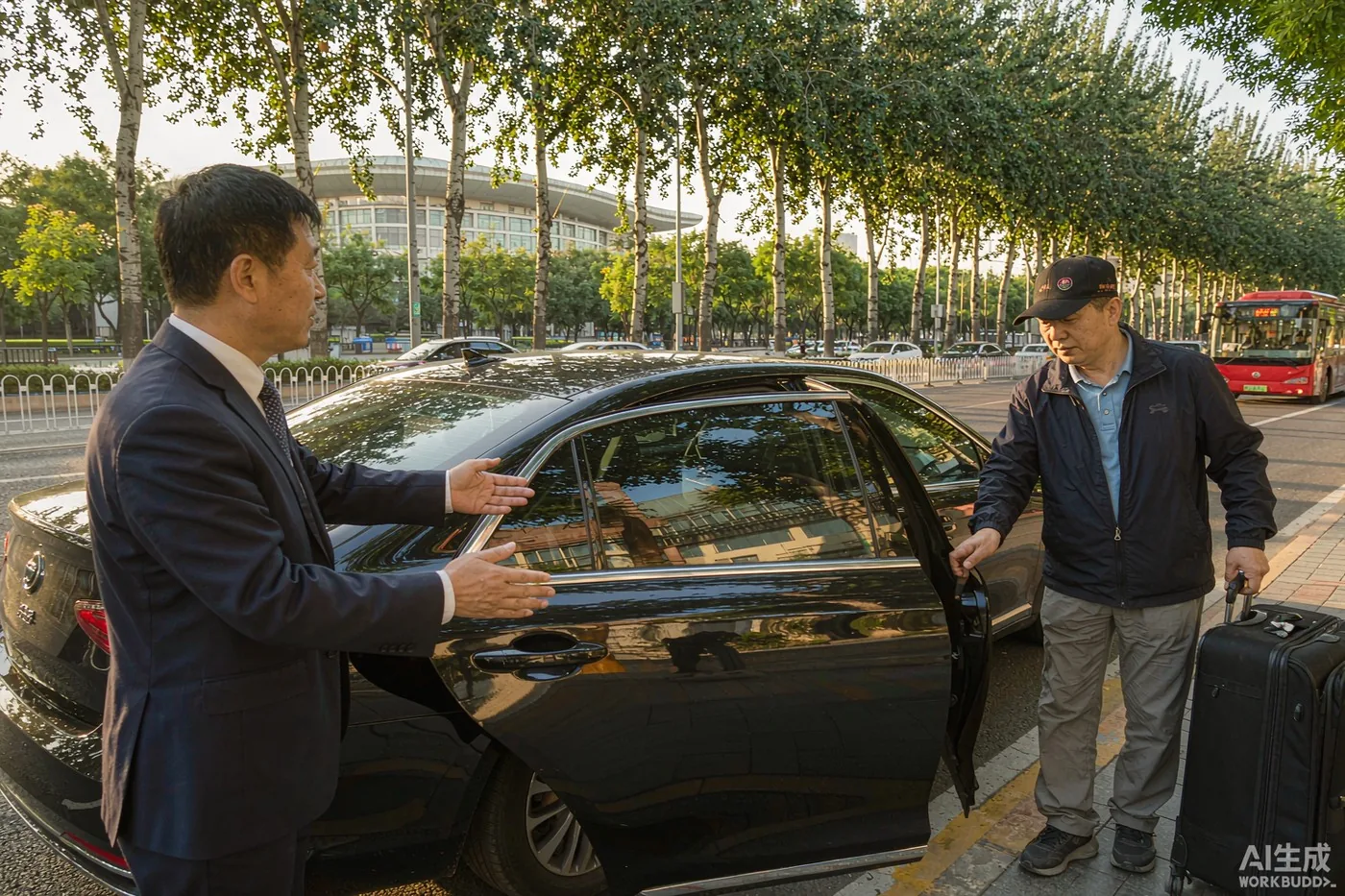
Chartered car with a driver — Booked by the day or by the trip, with a fixed quote agreed in advance and a driver who waits while you sightsee. This is the product this guide is about.
Licensed travel-agency day tour — A fixed itinerary, often with a guide and sometimes a group. Good value when it is a genuine sightseeing tour, and a trap when the price is lower than the cost of the fuel.
What a day hire actually costs
The Beijing market quotes day hire on a standard package: eight hours of service and 100 km of driving, whichever runs out first. Prices below are per vehicle, not per person, and reflect typical 2026 ranges — treat them as a sanity check on a quote, not as a fixed tariff.
Standard sedan, four seats — Roughly CNY 600–900 for 8 hours / 100 km. Comfortable for two or three people travelling with hand luggage only.
Seven-seat MPV (Buick GL8 class) — Roughly CNY 900–1,300. The default choice for families and small groups; seats four to six with real suitcases.
Nine- to seventeen-seat van — Roughly CNY 1,200–2,000 depending on vehicle grade. Worth it once you are six or more, or travelling with bulky equipment.
Full-size coach — Roughly CNY 1,600–2,400. Only sensible for genuinely large groups — coaches cannot enter many central streets and hutong lanes, so everyone still ends up walking the last stretch.
Peak-season surcharge — Golden Week, May Day and the summer holiday peak can add 20–50% and book out a week ahead. Lock the car in before you lock the flights.
Reading the quote before you pay
The headline daily rate is the least important number on the page. What decides what you actually hand over at the end of the day is the small print underneath it.
Overtime — Typically CNY 50–100 per extra hour for a sedan or MPV. Agree the rate in writing before the day starts, not when the driver mentions it at hour nine.
Extra mileage — Usually CNY 5–10 per km beyond the included 100 km. A Mutianyu round trip from central Beijing on its own consumes most of that allowance before you add any city driving.
Tolls and parking — Normally reimbursed on top of the day rate against receipts. Ask whether they are included, because the answer is almost always no.
Waiting time — For daily hire, time parked while you walk the Wall or sit in a restaurant still counts as service time. The clock does not pause when the engine does.
Driver meals and overnight costs — Within Beijing the driver generally covers his own food. On an overnight trip you are expected to cover it or add a daily allowance.
Night service — Pickups and drop-offs in the small hours usually carry a surcharge on top of the day rate. Confirm it when booking a pre-dawn airport run.
Airport transfers: PEK and PKX
Beijing has two major international airports roughly 60 km apart, and they are not interchangeable. Daxing is a long way south of the city; Capital is closer but older and busier. Check which one your ticket says before you book anything.
Capital (PEK) — Airport Express train — Flat CNY 25, running to Sanyuanqiao (Line 10) and Dongzhimen (Lines 2 and 13). Fast and unbeatable value off-peak; awkward with heavy bags on a crowded carriage.
Capital (PEK) — taxi or DiDi — Roughly CNY 100–150 to central Beijing depending on traffic and your exact destination, taking around 40–70 minutes.
Daxing (PKX) — Airport Express train — Distance-based: CNY 10 for up to 20 km, CNY 25 for 20–30 km, CNY 35 beyond that; from Caoqiao to the airport it is CNY 35. A business carriage costs CNY 50 for the whole line. Caoqiao connects to Lines 10 and 19.
Daxing (PKX) — taxi or DiDi — Roughly CNY 150–220 to central Beijing, and around 60–90 minutes because of the distance. Late at night the queue can be long.
Pre-booked car with a driver — Typically CNY 350–600 for PEK and CNY 600–900 for PKX in a standard sedan; more for an MPV. Worth it when you land after midnight, travel with children, or have more luggage than a taxi boot will swallow.
When a car is genuinely worth it — and when it is not
Be honest about the shape of your day. Most central Beijing days do not need a car at all, and paying for one can actively make the day slower.
Great Wall sections beyond Badaling — Mutianyu, Jinshanling and Simatai have no direct metro. Public routes involve a tourist bus from Dongzhimen or a long chain of buses and shuttles that eats most of the daylight.
Multi-stop days outside the city — The Ming Tombs plus a Wall section, or a rural temple and a hot spring in one loop. Transfers alone can cost you two hours by public transport.
Early starts and late finishes — Metro service on most lines runs roughly from 05:00 to about 23:00. Outside that window a pre-booked car is the only comfortable option.
Extreme weather and young children — July in Beijing is hot and humid and January is below freezing. Having a waiting vehicle turns a punishing day into a manageable one.
When it is not worth it — Inside the Second Ring Road the metro is faster at almost any hour. A car cannot reach the Forbidden City entrance, Tiananmen Square or hutong lanes anyway — you walk the last stretch either way, and you will have paid to sit in traffic doing it.
A realistic chartered Great Wall day
This is roughly how a well-planned chartered day to Mutianyu runs. Use it to sanity-check any itinerary a seller proposes to you.
07:00
Hotel pickupLeave before the city traffic builds. Confirm the exact pickup point — many central hotels can only load on the main road, not at the door.
08:30
Arrive at MutianyuAbout 70 km from central Beijing. Arriving before the tour coaches turns a 40-minute cable car queue into a five-minute one.
11:30
Lunch near the villageAsk the driver for a simple local restaurant rather than the one with the coach park outside it. Prices at the latter reflect the parking, not the food.
13:00
Start back toward the cityLeaving early avoids the late-afternoon return crawl, which can add an hour to a journey that took 90 minutes in the morning.
14:30
One central stopA chartered day usually has two or three hours left. Spend it on something inside the city rather than pushing the driver into overtime.
16:30
Drop-off and settle upExpect roughly 180–220 km for the day, well over the 100 km allowance. Budget the per-kilometre top-up in advance so the final number is not a surprise.
Hiring a guide: what a driver is not
A driver is transport, not interpretation. Most Beijing day-hire drivers speak little or no English, and they are not licensed to guide you inside ticketed sites — they park, and they wait. If you want someone to explain the Forbidden City or order dinner for you, book a guide separately.
Licensed guides carry a card — A legal guide holds a national tour guide qualification and can show you the card. Asking to see it is normal, not rude.
Cost — An English-speaking guide typically runs several hundred to around CNY 1,000 for a full day, on top of the car. Rates rise for other languages and in peak season. ⚠️ Confirm current rates before publishing.
Book through a licensed agency or platform — You get a contract, an invoice and somebody to call if the guide does not turn up. A phone number with no company behind it is not a booking.
What a guide does that a driver cannot — Walks into the site with you, translates menus, handles real-name ticket bookings, and argues with a restaurant on your behalf.
The driver-guide package — Some agencies sell one person who does both. Convenient and usually cheaper — but check they are licensed to guide, not only to drive.
The cheap day tour that is not a day tour
The most common way visitors end up with a bad car experience in Beijing is booking a day tour that includes the Great Wall, lunch and hotel pickup for a price that would not cover the fuel. The tour is real. The problem is where it spends the rest of the day.
The pattern — Two or three shopping stops — tea, jade, silk, a pearl market or a traditional medicine hall — with commission pricing and no obligation to tell you about them in advance.
The tells — A price far below the cost of the transport alone, a refusal to put the shopping stops in writing, or a contact number with no registered business behind it.
What to ask before paying — Is the itinerary in writing? How many shopping stops, and how long at each? Can I be dropped elsewhere and skip one? A legitimate operator answers all three without hesitating.
Free and almost-free tours — Nothing in Beijing is free. If a tour is advertised as free, somebody has paid for your attention and intends to collect it.
Where to book instead — Your hotel concierge, who has a reputation to protect; a licensed travel agency with a verifiable business address; or a platform with reviews you can actually check.
If it goes wrong anyway — You are free to leave a shopping stop and take a DiDi back — you have not prepaid for the afternoon. To register a complaint, call 12345, Beijing's public service hotline.
Self-driving instead: read this first
Nearly every visitor who asks about renting a car and driving themselves should not. The reasons are procedural before they are practical.
Your licence probably does not work here — China does not recognise the International Driving Permit. Driving legally means obtaining a temporary Chinese driving permit from the local traffic police, tied to the length of your visa. ⚠️ Confirm current requirements with the issuing authority before planning around this.
Traffic and road culture — Beijing's rush hours are severe, ring-road merges are aggressive by European or North American standards, and lane discipline is looser than you are used to.
Parking and access restrictions — Central parking is expensive and tight, and the city applies access rules to non-local plates plus a weekday plate-number restriction scheme. ⚠️ Confirm the current rules before booking a self-drive.
Navigation — Major road signs are bilingual, but turn-by-turn English navigation is inconsistent, and offline maps cover you better than roaming data does.
Related Beijing guides
If you found this useful, these cover the next question most visitors ask:
Get it in writing — Date, vehicle class and plate number, pickup time and place, itinerary, included hours and kilometres, and the total price.
Fix the overtime and per-kilometre rates — Ask before the day begins. Quoting an hourly rate after the fact is a negotiation you have already lost.
Ask what is excluded — Tolls, parking, driver meals and any night surcharge. Four questions now, no argument later.
Pay a deposit, not the full amount — A deposit with the balance due on completion is standard practice and leaves you some leverage if the service falls short.
Send destinations in Chinese characters — Text the driver the place names as written locally. It removes an entire category of misunderstanding at the roadside.
Keep two numbers — The driver's mobile and the agency's office line, so a single unreachable person never leaves you stranded.
Check the car before you set off — Working seatbelts in the back, air conditioning that actually cools, and a boot that fits your luggage with the lid closed.