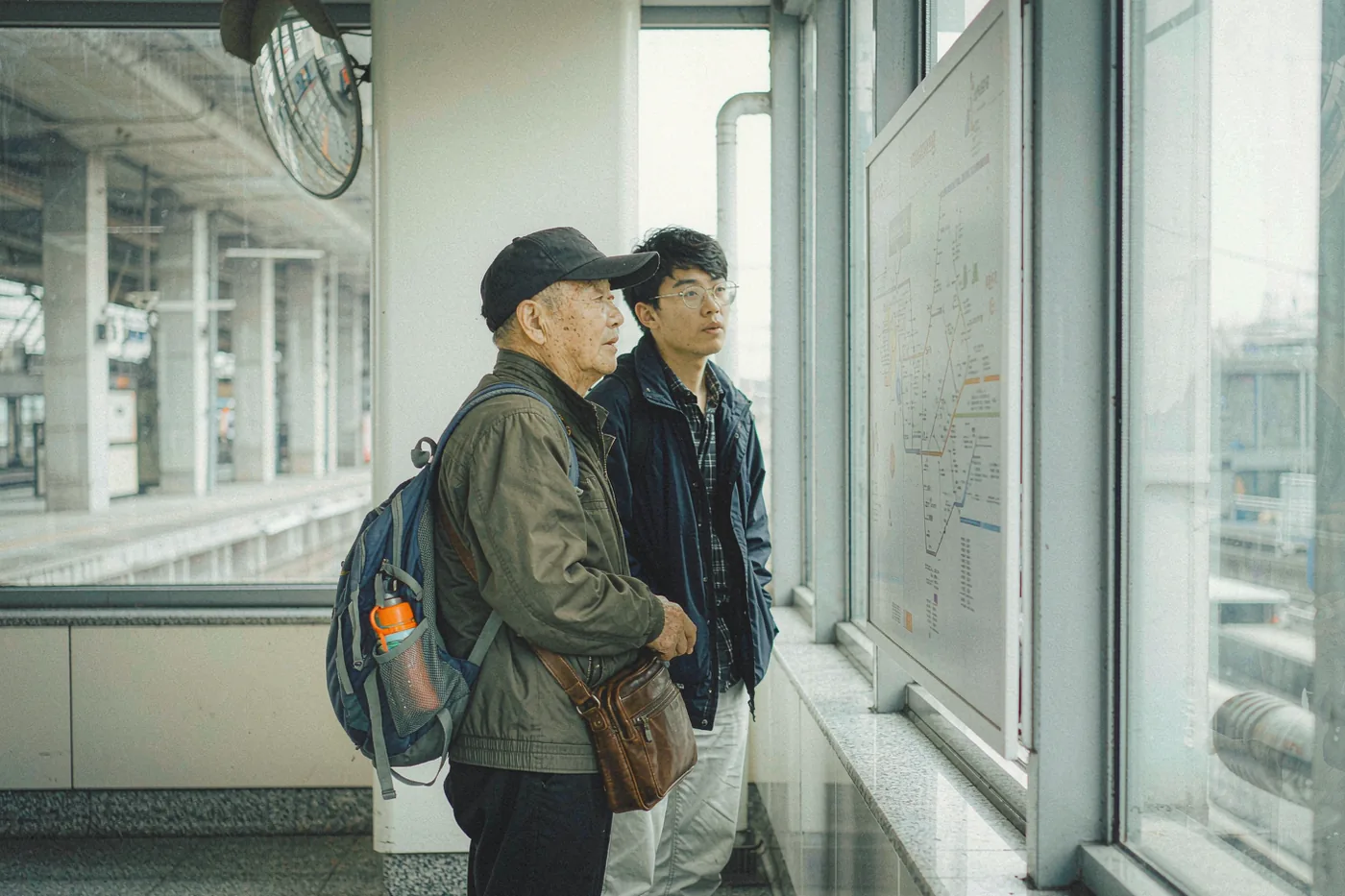
Practical strategies for guiding a parent through Beijing's subways, ticket gates, and attraction entrances when they carry only cash and a paper map — and you're doing all the tech.
Traveling with a parent who speaks no Chinese and uses no smartphone is more manageable in Beijing than you might fear — but it requires preparation. The single most important mindset shift: you become the family's phone, wallet, and translator. Beijing's subway and major attractions increasingly assume smartphone apps and QR codes, so your job is to absorb all of that digital friction and hand your parent a simple, physical experience. This guide covers entry tickets, subway gates, attraction access, elevators and accessibility, and the small scripts and props that make everything smoother.
Before you leave your hotel each morning, make sure every ticket, reservation, and payment method is registered to your phone, not your parent's. If your parent has no smartphone, they cannot scan a personal health or entry QR code at most attractions, so many sites allow one adult to book for a group — but rules vary by venue and change often [verify before travel]. Carry your parent's passport with you at all times, because foreign passports are needed to book and enter major sites like the Forbidden City. For payments, one phone with Alipay or WeChat Pay (both accept foreign cards) can cover the whole family, but keep a cash reserve of around 200–500 CNY (about 28–70 USD) per day for stalls, small shops, and any gate that surprises you [verify before travel].
This is the crux of the challenge, and it's very solvable. The easiest method: buy single-journey tokens or use a physical transit card. Single-journey tokens are small blue plastic coins available at every station's ticket machine or staffed booth — you tap in at the gate and insert the token at the exit. Machines have an English button, but if your parent struggles, go to the staffed window with cash; staff are used to helping foreign visitors [verify before travel]. Alternatively, a physical Yikatong transit card (available at station booths, load with around 50–100 CNY / 7–14 USD) lets your parent tap in and out independently with one card — no phone required [verify before travel]. You can each carry your own card, which is far less stressful than sharing. The app-based QR-code entry many locals use will not work for your parent, so simply ignore it.
Most Beijing subway stations have at least one elevator, but it is sometimes hidden, locked, or requires a staff member to unlock it — look for signs saying 无障碍电梯 (accessible elevator) or ask staff at the booth [verify before travel]. Escalators are everywhere; stairs are not always. If your parent has mobility issues, plan longer transfer times: stations like Xizhimen or Dongzhimen involve long walks. Trains have priority seating near the doors, and locals will usually offer a seat to an older adult — you can encourage this by standing beside your parent and looking a bit harried. Platform gaps and rush-hour crowds are the two real hazards; travel mid-morning or early afternoon (10:00–15:00) to avoid 07:30–09:30 and 17:30–19:30 crushes.
Major sites split into two categories. Sites requiring advance passport-based reservation (Forbidden City, National Museum of China, Tiananmen area) generally will not admit someone who just shows up — book online under your account for everyone and bring the passport originals, which are scanned at the entrance [verify before travel]. Parks and temples (Temple of Heaven, Beihai Park, Jingshan Park) typically sell simple paper tickets at the gate for a few CNY — cash or card works, no reservation needed for standard entry [verify before travel]. Either way, your parent never needs their own phone; they need their passport and you need to have done the booking. Watch for senior discounts: visitors over 60 often get reduced or free park admission with passport ID [verify before travel].
The Forbidden City is magnificent but physically demanding: expect 3–4 km (2–2.5 miles) of walking on stone surfaces, and the central axis gets crowded. Book entry up to 7 days in advance online using both passports [verify before travel]. Enter through the Meridian Gate on the south side and exit through the north Gate of Divine Prowess — there is no re-entry, so don't leave anyone inside alone. Ramps and accessible routes exist along the central axis, though some side halls have thresholds [verify before travel]. Take the east or west side paths for fewer crowds and benches.
This is your low-stress day. Tickets to the park and to the Hall of Prayer for Good Harvests are sold at gates for roughly 10–35 CNY (1.50–5 USD) depending on season and combo options [verify before travel]. No smartphone reservation is required for standard tickets [verify before travel]. The park is flat, shady, and full of benches — ideal for a slower pace. Seniors often enter free or discounted with passport [verify before travel]. Nearest subway access is via Tiantan Dongmen station on Line 5 (confirm current line and station name), which has signage in English and usually an elevator.
If you found this useful, these cover the next question most visitors ask: