The money question, answered: how much to put in the hongbao at a Beijing wedding, when to arrive, what the twenty-minute ceremony is, and how three rounds of toasts work.
Live, study or work in Beijing long enough and sooner or later somebody hands you a wedding invitation. It will probably arrive on WeChat — a red digital card with a photo slideshow and music attached. A Chinese wedding is not a ceremony followed by a party. It is a banquet with a twenty-minute ceremony bolted onto the front of it, and the gift you bring is cash in a red envelope. None of the rules are written down, everyone else at your table appears to know them, and the one question people hesitate to answer out loud — how much money — does have a real answer. It depends on the city and on how well you know the couple. This guide walks the whole day in order: what the invitation is telling you, what to put in the envelope, what time to walk in, and what to do when the couple arrives at your table holding a glass.
Most Beijing invitations are digital: a WeChat message or a link to an electronic card with a slideshow, the name of the hotel ballroom, the date and a start time. Paper cards still exist, mostly for older relatives and for families who like the formality. Either way, three things on it matter — the date, the venue, and the start time, which is when the ceremony begins, not when you should walk through the door. Reply on WeChat with a headcount. If the card says it welcomes your family, partners and children are expected; if it is addressed to you alone, ask before bringing anyone. The couple is paying per head, and an unexpected plus-one has a real price attached.
A Beijing wedding day runs from about six in the morning to nine at night, but as a guest you attend only the last part of it. The morning belongs to the two families: the groom drives to the bride's home, negotiates his way past a locked door, and the couple serves tea to both sets of parents. If you are not in the wedding party, none of this concerns you and you should not try to attend it. Your part starts with the receiving hour, and it ends when the couple stands at the door to see guests off.
This is the question everyone has and nobody wants to answer. For Beijing: a distant colleague or a casual acquaintance gives ¥200–400, a good friend or a close colleague ¥600–1,000, and somebody in the wedding party or the immediate family considerably more [verify]. The logic is not arbitrary — it tracks the cost of your seat. A mid-range Beijing banquet runs ¥2,000–5,000 for a table of ten to twelve, which is ¥200–500 a head; a five-star hotel ballroom is ¥6,000–9,000 a table, or roughly ¥500–900 a head [verify]. The custom of covering your plate means giving at least what your seat cost. Nobody will check and the couple will not count in front of you, but they will remember the number, because the ledger they keep is the one they will consult when it is your turn to marry.
There is a table just outside the ballroom doors with a relative or two sitting behind it, a guest book and a ledger in front of them. You arrive, find your name on the seating plan, sign the guest book, and put your envelope on the table — or hand it to whoever is keeping the ledger, who will write your name and the amount into it. Do not press it into the bride's hand during the receiving line, and do not announce the figure out loud. The ledger entry is private but deliberate: it is the family's record of who gave what, and it is the thing they will work from when you get married. If there is no visible gift table, ask whoever is at the sign-in table where the money goes. Then take your seat card, or memorise your table number, and go in.
Two colours to stay clear of and one to be careful with. Head-to-toe white is the traditional colour of mourning and reads badly at a wedding; all-black has the same problem, more mildly. As for red, the bride will almost certainly wear it at some point in the evening, and a guest in bright red is competing with her. Beyond that, Beijing weddings are dressy in an ordinary urban way: a suit, or a blazer with a collared shirt, for men; a cocktail dress or a smart jumpsuit for women. Being slightly overdressed marks you as a foreigner far less than turning up casual. Ballrooms swing between hard air conditioning and ten people's worth of body heat, so carry a layer you can take off.
The ceremony is short and loud. It happens on a stage at the front of the ballroom, run by a hired professional master of ceremonies with a microphone and a script. The lights go down, music comes up, the groom walks on, and the bride is walked in — usually by her father, who hands her over. Then come the vows, the rings, a few formal words from a witness, both sets of parents coming up on stage, the tea ceremony where the couple serves tea to the parents and calls them Mum and Dad for the first time (the parents hand back red envelopes of their own), the linked-arm cross-cup drink, the cake, the champagne tower, and finally the bouquet toss. You do not stand up, you do not go to the front, and you clap when everyone else claps. Then the lights come up and the food starts arriving.
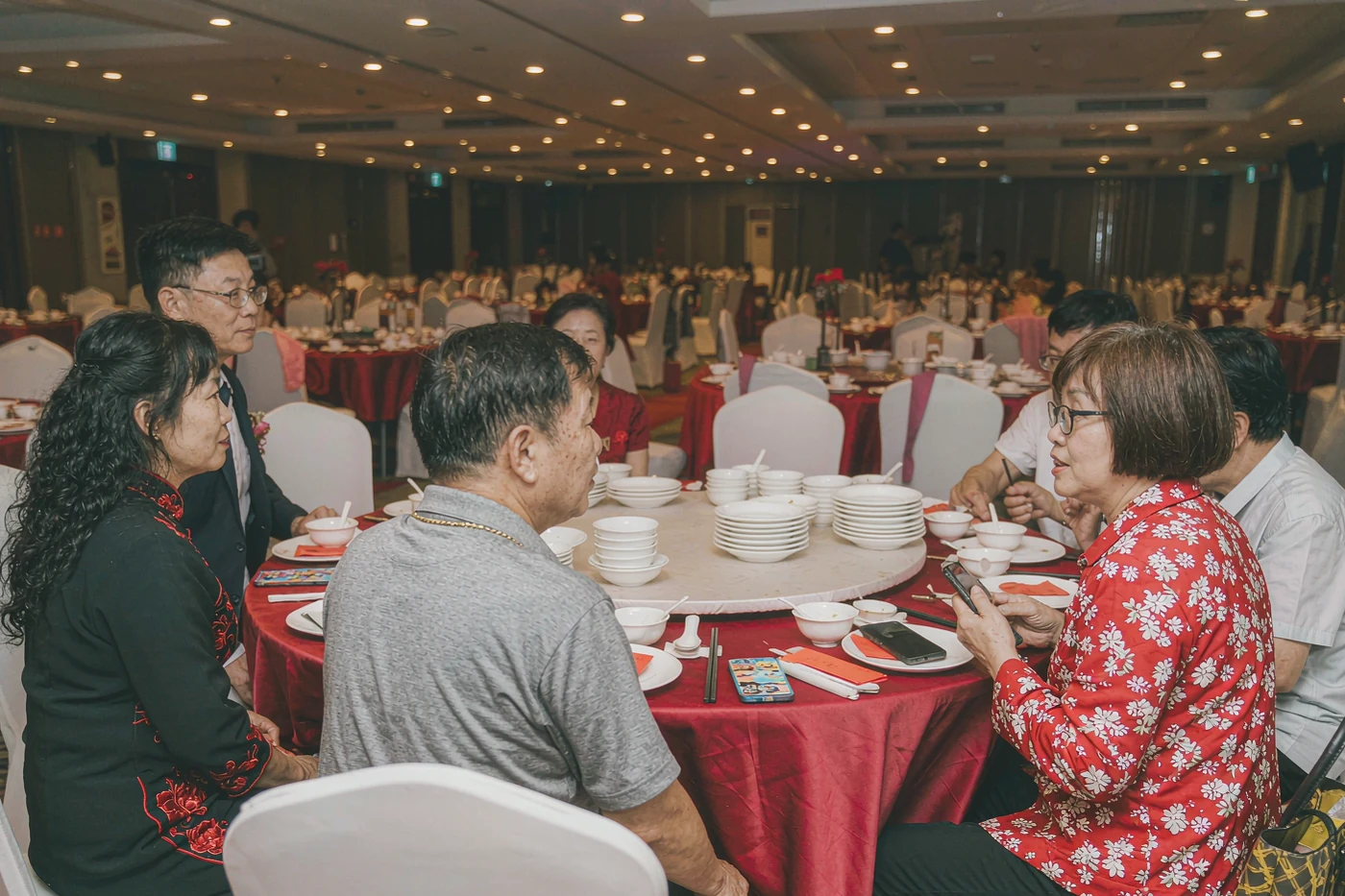
The food arrives fast and keeps arriving. Dishes land on the lazy Susan in the middle of a large round table and everyone helps themselves from whatever has stopped in front of them. A Beijing banquet menu leans on whole fish, whole chicken, prawns, the four-joy meatballs, a sweet soup, and noodles for long life. The first six dishes can arrive inside twenty minutes, so pace yourself — there is more coming, and the staple course turns up near the end. Two rules of the turning table: rotate it slowly in one direction only, and never spin it while somebody is serving themselves.
Some time after the food starts, the couple changes into a third outfit and begins working the room. The order is roughly fixed: the head table and the elders first, then the relatives' tables, then the friends' and colleagues' tables, about a minute per table. When they reach yours, stand up. This is the moment for the one Chinese phrase worth learning before you go.
Around half past eight the send-off starts: the couple stand at the ballroom doors with the sweets and cigarettes that have been sitting on every banquet table, plus a small return gift for each guest or each family. Take one and leave. Lingering is not expected — after the last guest goes the family still has a long list of things to do, from counting the gift money to boxing up what is left of the wine. If you want a photograph with the couple, take it when they reach your table during the toasts rather than joining the queue at the door.
You may be invited to two meals, and they are not equivalent. The thank-you banquet is the second, smaller one — often the bride's side hosting her colleagues, or a second sitting for a hometown or a work unit. The scale drops with it: a simpler venue, fewer guests, and a correspondingly smaller envelope. The homecoming meal is the one the bride's family holds a few days after the wedding, and it is a family occasion you are unlikely to be asked to. If the only invitation you received was to the second banquet and you know the couple through work, give what a work colleague would give. The rule that holds everywhere: find out what a guest in your position is giving and match it.