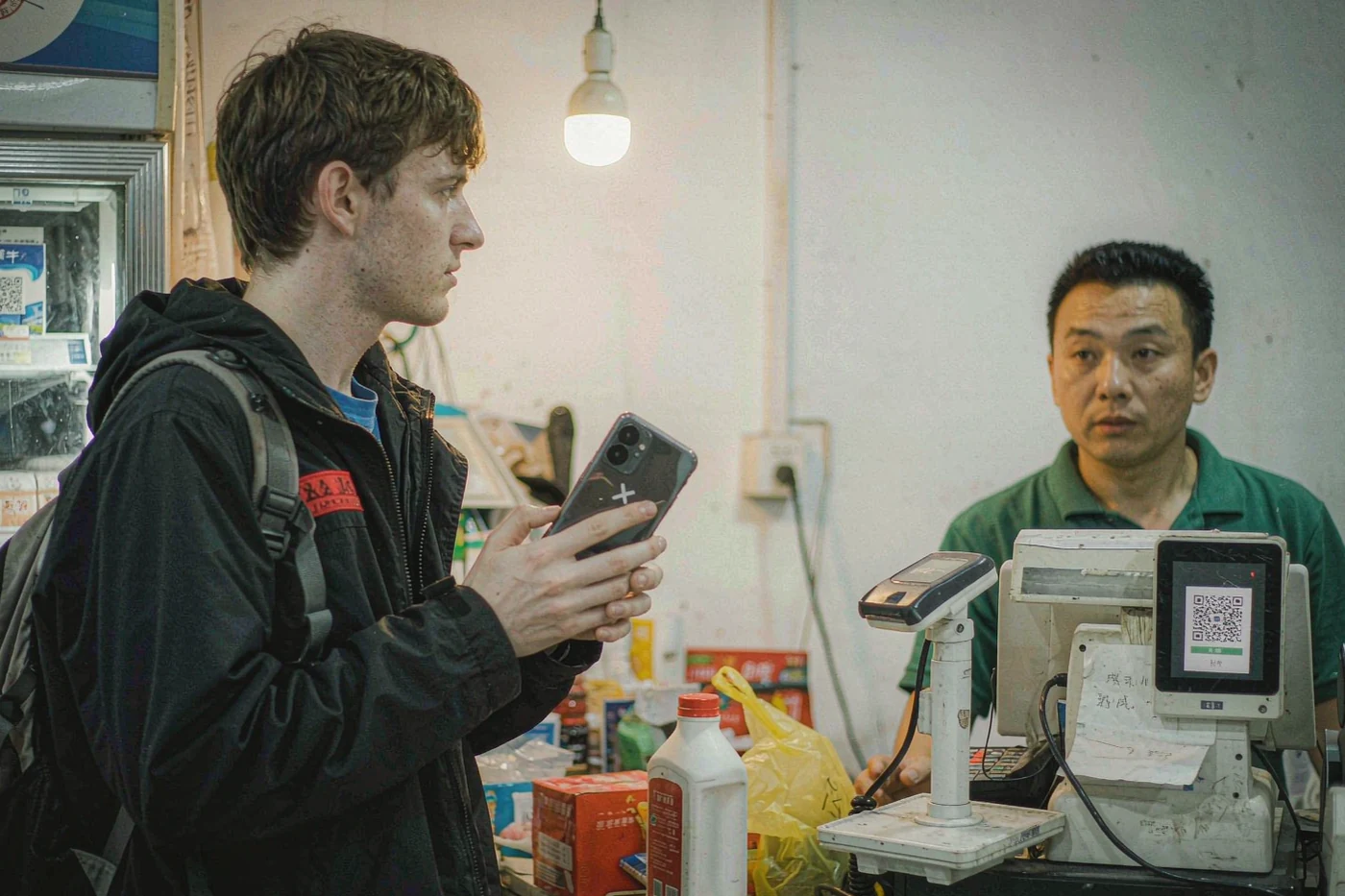
A payment that worked all trip suddenly fails. Usually it is the app limit, not your bank. What the caps actually are, how to raise them in five minutes with your passport, and the fallback order when a payment still will not go through.
Sooner or later on a Beijing trip, a QR-code payment that worked perfectly for days suddenly fails with a limit error - usually at the worst moment: a hotel bill, a hospital fee, a big purchase. It is almost never a problem with your card. Alipay and WeChat Pay apply their own caps to internationally issued cards, and the cap depends on how much identity information you have given the app. This guide explains what the limits actually are, how to raise them in minutes, and what to fall back to when a payment still will not go through.
Both apps run international-card payments through two tiers. Simplified registration - you linked a card without uploading a passport - carries deliberately low caps, designed for small daily spending. Completing identity verification with your passport moves you to a much higher tier: roughly US$5,000 per transaction and US$50,000 per year, a ceiling the People’s Bank of China asked the payment platforms to raise from US$1,000 and US$10,000 in 2023-2024.
WeChat’s official help documentation is unusually specific. Users who registered with a mainland ID carry much lower international-card caps than passport holders, so as a foreign visitor you sit in the passport lane. Under simplified registration, single payments cap at about ¥3,000, and once annual spending passes roughly ¥15,000 the app asks you to complete identity information. After verification, single and daily payments reach about ¥35,000 with an annual ceiling around ¥350,000.
Alipay tiers work the same way. The early simplified figures - about ¥3,000 per payment and ¥50,000 per month - have been superseded for verified accounts by the central-bank-driven raise to roughly US$5,000 per transaction and US$50,000 per year, matching WeChat. In practice most visitors never touch these ceilings except in one or two categories: hotels, hospital bills and big-ticket shopping.
Both platforms absorb the international-card processing fee on payments of ¥200 or less and charge 3% above that line, refunded proportionally if the order is refunded. The fee applies to the whole amount, not just the excess. This quietly reorders your spending: convenience-store runs, transit top-ups, coffee and street food stay free, while a ¥900 restaurant bill quietly costs an extra ¥27. Where a merchant takes a physical card - hotels, department stores, airport counters - paying by card avoids both the fee and the app limit, because the transaction never runs through the app.
If you registered the fast way, the single most effective thing you can do in Beijing is complete identity verification. On WeChat, go to Me, then Services, then Wallet, then Bank Cards, and follow the prompt to upload your passport photo; review that once took a day now runs in seconds for most passports. On Alipay, open Me, then Account and Security, or tap the verification banner the app shows when a payment fails, and submit the same passport page. Menu names shift between app versions [verify]. Do it once, on hotel Wi-Fi, in the first hour of your trip - not at the checkout counter with a queue behind you.
Some failures are not about limits at all. International cards on both apps cannot send money to friends, cannot send or grab red packets, cannot withdraw cash, and cannot buy wealth products. A changing subset of merchant categories - often online services, some mini-programs and a few app-based bookings - simply returns the message 当前交易不支持国际银行卡 (this transaction does not support international cards). When you see that message, no amount of limit-raising will help; switch payment method instead.
Work down this list. Each step takes seconds, and the first two fix the large majority of failures at the counter.
Knowing which purchases run big helps you plan. Mid-range Beijing hotels charge ¥500-1,200 a night, a private Great Wall day tour ¥600-1,500 per person, a hospital visit with tests ¥300-1,000. Under the verified tier almost all of this fits in a single payment; under the simplified ¥3,000 cap, one multi-night hotel total can fail. That is the strongest argument for finishing verification on day one.
Both apps surface your limits inside settings rather than at the counter, which is why failures feel random. WeChat lists card management under Wallet and Alipay under Bank Cards; open the linked international card and the app shows its own current caps [verify exact location]. Check before the hotel bill, not during it. If the app displays a lower figure than you expected, it has applied a risk adjustment; completing a few small, unremarkable transactions first sometimes restores the normal tier.