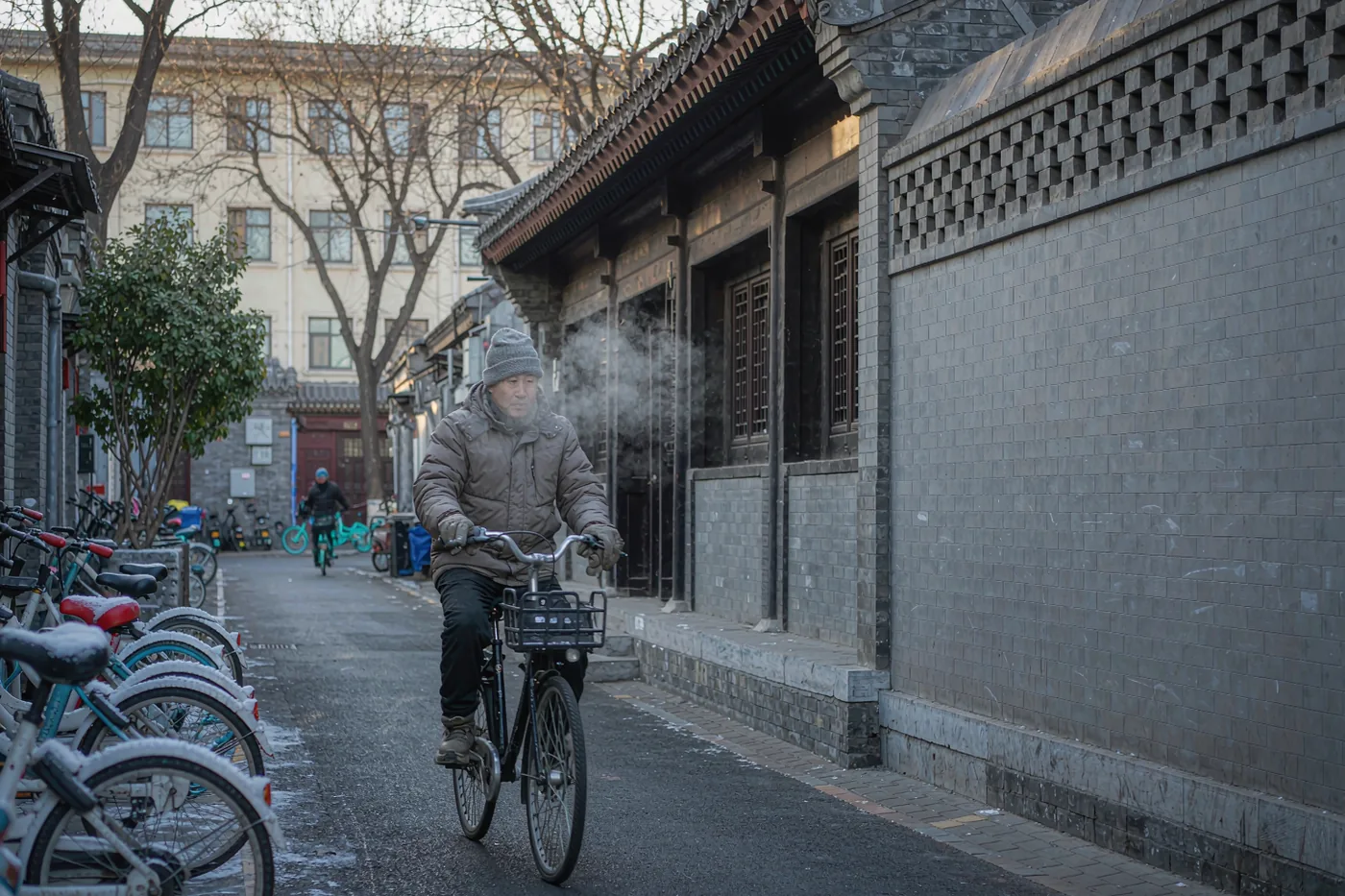
Beijing's shared bikes still run all winter — but frozen locks, icy lanes and confusing no-ride zones can trip up first-timers. Here's how to ride smart when it's below zero.
Yes, you can cycle in Beijing in winter — locals do it every day, and shared bikes from Mobike/Meituan, Hello and Didi/Qingju keep operating through the cold months. Riding is one of the best ways to cover the flat, grid-like streets around the hutongs and city parks. But sub-zero temperatures bring three real problems: stiff or frozen smart locks, numb fingers, and icy patches that send even careful riders sliding. This guide covers apps, deposits, cold-weather technique, and the zones where riding simply isn't allowed. Note that app prices, deposit rules and restricted zones can change, so [verify before travel] in the app itself.
Beijing's three main shared-bike operators all run through Chinese apps: Meituan Bike (orange/silver bikes), Hello Bike (blue/white), and Didi Qingju (green/blue). You'll need the app, a Chinese phone number and a scan-based payment method — Alipay or WeChat Pay. Tourist versions of Alipay and WeChat Pay now accept international cards, so a foreign card usually works [verify before travel]. Typical costs are roughly CNY 1.5 (about US$0.20) per 15–30 minutes, with weekly or monthly pass bundles from around CNY 10–25 (US$1.50–3.50) [verify before travel]. Deposits for foreign users have largely been waived or replaced by in-app credit checks, but policies differ by operator — [verify before travel]. If the app asks for real-name verification with a Chinese ID, choose the option for passport holders or try a different operator's app.
The most common winter failure is a smart lock that won't pop open because moisture has frozen inside the shackle. Don't yank it repeatedly — you can crack the mechanism and get charged for a ride that never started. Pick another bike; in deep cold, several bikes in a row may be frozen, so allow extra time at each stop. Once riding, remember that Beijing's winter air is dry and often well below -5°C (23°F); exposed fingers lose feeling in 10–15 minutes. Bring thin liner gloves that still let you tap your phone screen, and wear windproof layers — the windchill at a steady 15 km/h is far harsher than standing still. Check the rear wheel and brakes for ice before setting off, brake early and gently (rear brake first), and avoid painted road markings and metal drainage covers, which glaze over first. Bike-share bikes are single-speed or three-speed and heavy; on ice, keep your speed low and your feet ready to dab down.
Beijing restricts cycling more than most first-timers expect. Bikes are not permitted inside the Forbidden City complex or most imperial-park inner grounds — dismount and walk, or leave the bike at an outer gate. Several major arteries through the historic core are either pedestrianised or have strict no-cycling stretches, and enforcement changes street by street [verify before travel]. Both Chang'an Avenue and the square area around Tiananmen have security-imposed cycling restrictions and checkpoints [verify before travel]. Shared-bike operators also enforce geo-fenced no-parking zones: drop a bike inside a red zone on the app map and you'll be fined a few yuan per offence [verify before travel]. Bikes left carelessly — blocking subway exits or crosswalks — get impounded by city crews daily. The safest habit: park only in the white-line parking bays painted on the pavement, which the app will usually highlight when you end a ride.
The lakes district north-west of the Drum and Bell Towers is Beijing's classic short winter ride: hutong lanes, lakefront paths and plenty of bike-parking bays. When the lake freezes solid, it turns into an ice playground — cycling on the frozen lake itself is banned; the ice rinks are ticketed and seasonal [verify before travel].
The lane network between Gulou and the Drum Tower area is flat and dense with sights. The main Nanluoguxiang strip itself is heavily pedestrianised and often shoulder-to-shoulder — walk your bike through it and ride the quieter parallel hutongs instead. Street parking bays are frequent but fill up on weekends.
Wide, dedicated cycle and pedestrian paths make the Olympic park one of the easiest, safest winter rides in the city — great for nervous first-timers. Expect biting wind on open plazas; the park is often several degrees colder than the hutongs. Entrance to the park grounds is free; venues inside are ticketed [verify before travel].