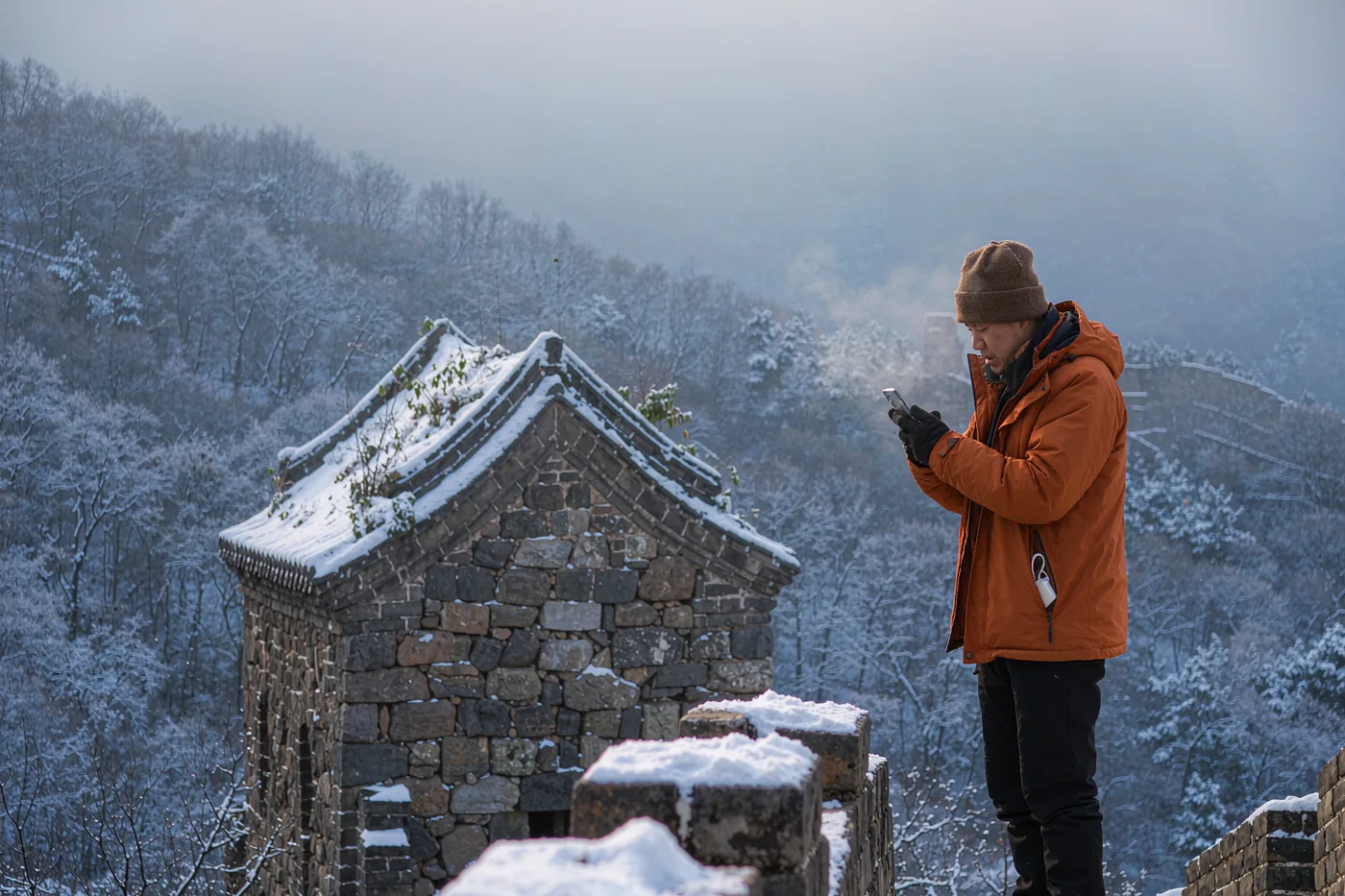
Explore Beijing / Winter Battery Drain in Beijing: Keeping Your Phone Alive at -10°C on the Great Wall and Beyond
Winter Battery Drain in Beijing: Keeping Your Phone Alive at -10°C on the Great Wall and Beyond
Beijing winters regularly dip to -10°C (14°F), and cold is the fastest way to kill a phone battery. Here's how to keep your phone, camera, and eSIM alive from the Great Wall to the hutongs.
5 min read · KOULING's Beijing Travel Guide
Lithium-ion batteries lose capacity sharply below freezing — at -10°C (14°F) a fully charged phone can drop to 30% in under an hour of outdoor use, even though the battery recovers once you warm it up. Beijing winter days are short (sunset around 5 pm [verify before travel]) and often bitterly dry and windy, so a dead phone isn't just inconvenient: it can mean losing your ride-hailing app, your translated directions, and your mobile payments all at once. This guide covers what actually works, tested logic you can apply anywhere in northern China.
Why Your Phone Dies So Fast in the Cold
Cold doesn't destroy your battery — it temporarily slows the chemical reactions inside it, so the voltage drops and your phone shuts down as if empty. Screens, GPS, and constant cellular searching in weak-signal areas (like remote wall sections) compound the drain. Three practical consequences: never trust a low-battery reading outdoors, keep the phone warm rather than trying to charge a frozen battery, and reduce active usage like video recording when you're outside.
Shutdown surprise — An iPhone may show 20% and die minutes later at -10°C; that reading is unreliable in the cold. Assume you have less than it says.
Charging warning — Charging a battery below 0°C (32°F) can cause long-term damage. Warm the phone to room temperature first, and expect slow or blocked charging if it's just come indoors from the cold.
Camera batteries — Dedicated cameras and power banks suffer the same drain. Power banks can also refuse to work when frozen — keep them inside your coat, not your backpack.
Practical Tactics That Actually Work
You don't need special gear — just habits. The single biggest win is keeping the phone against your body, not in an outside pocket. Everything else is about reducing active drain and having a backup.
Inner pocket — Carry the phone in an inside jacket pocket near your body heat. A cheap phone-specific hand-warmer pouch (about ¥20–50 / US$3–7 at markets [verify before travel]) is a popular local solution.
Power bank in the coat — Bring a 10,000–20,000 mAh power bank [verify airline rules if flying] and keep it in an inner pocket too — a frozen power bank may output nothing. One 10,000 mAh unit typically gives 1.5–2 full phone charges.
Flight mode outdoors — Between photos, switch to airplane mode or low power mode. GPS-heavy apps (maps, ride-hailing) are the heaviest drain; load offline maps before you leave the hotel.
Backup battery for cameras — If you're shooting seriously on the Wall, carry spare camera batteries in inner pockets and swap a warm one in when the cold one dies.
Gloves that work — Touchscreen-compatible gloves (about ¥20–60 / US$3–9 [verify before travel]) let you shoot without exposing bare hands — a comfort issue that also stops you fumbling and dropping the phone.
Mutianyu Great Wall
The most popular winter day trip, about 1.5–2 hours from central Beijing. Remote sections have weak signal, so your phone works harder searching for service — a major hidden drain. Toboggan rides and cable cars mean lots of time in the wind. Bring a fully charged power bank in your coat, not your bag.
Metro
No direct metro; take a tourist bus or private transfer from Dongzhimen [verify current routes before travel]
Opening hours
Roughly 8:00–17:00 in winter; cable car and toboggan may close in icy conditions [verify before travel]
Tickets
Entry plus cable car/toboggan around ¥140–¥200 (US$20–28) combined [verify before travel]
How long
5–7 hours including transfers
Summer Palace (Yiheyuan)
Kunming Lake partially freezes in deep winter, and the long lakeside walkways are exposed to wind — expect your phone to cool fast even on a short visit. This is a good half-day test of your cold-weather battery routine before committing to the Great Wall.
Metro
BeIBGongmen or Xiyuan station, Line 4 [verify current station exit]
Opening hours
Approximately 6:30/7:00–17:00–18:00 in winter season [verify before travel]
Tickets
About ¥20–¥30 (US$3–5) entry; through-ticket with inner sights around ¥50–¥60 (US$7–9) [verify before travel]
How long
2–4 hours
Shichahai Ice & Houhai Lakes
Frozen-lake skating and lakeside walks in the hutongs — easy to spend an evening here when it's dark and -10°C. Evening cold plus heavy photo/video use is the classic drain combo: set low power mode before you arrive.
Metro
Shichahai station, Line 8 [verify current station name]
Opening hours
Public areas open all day; ice rinks typically operate roughly 9:00–22:00 in season [verify before travel]
Tickets
Lake walk free; skating and equipment rental roughly ¥50–¥150 (US$7–21) [verify before travel]
How long
2–3 hours
Cold-Weather Battery Checklist
Charge to 100% overnight — Start every outdoor day full. Cold amplifies any existing battery degradation, so an old phone with 80% health will struggle most.
Download offline maps + screenshots — Save the day's routes, hotel address in Chinese, and metro maps as screenshots. This cuts GPS use and gives you a fallback if the phone dies entirely.
Two power banks, one rule — Both live in inner coat pockets. Expect roughly 60–70% of rated output in deep cold.
Warm, don't charge, a frozen phone — If it shuts down outside, warm it against your body for 10–15 minutes before restarting. Never leave it on a radiator or blast it with a car heater — sudden heat plus condensation is a screen killer.
Carry a paper backup — Your hotel's business card with the address in Chinese is free insurance when everything electronic fails.
Protect from condensation — Moving from -10°C outdoors to heated rooms causes condensation inside the phone. A sealed plastic bag for the phone indoors transition is a photographer's trick worth copying.