Explore Beijing / Trying Traditional Chinese Medicine in Beijing: Hospitals, Prices and Safety Rules
Trying Traditional Chinese Medicine in Beijing: Hospitals, Prices and Safety Rules
Where to try acupuncture, cupping and herbal medicine in Beijing without being taken for a ride: the flagship public hospitals, what registration involves with a foreign passport, real prices at both the ordinary and international counters, and the safety rules nobody tells you.
14 min read · KOULING's Beijing Travel Guide
Beijing has the deepest concentration of traditional Chinese medicine expertise in China, and a visitor can walk into a top-tier TCM hospital and be treated within days. The problem is not access — it is knowing which channel to use, recognising a real consultation when you get one, and avoiding the tourist-facing operators who sell packages rather than diagnoses. This guide is for curious first-timers and for travellers managing something chronic. It covers the flagship public hospitals, how registration works with a foreign passport, realistic prices at both the ordinary and international counters, what herbal medicine you can legally take home, and the warning signs that mean you should leave.
What TCM is honestly good for
Start here, because it decides everything else. Acupuncture has its strongest evidence base in chronic pain: pooled analyses of very large trial populations have found it outperforms sham needling, with benefit still measurable at twelve months. That is a real finding, not a placebo anecdote. Evidence is weaker and patchier for insomnia, irritable-bowel-type digestive complaints, period problems and stress-related symptoms, and the good TCM physicians will say so rather than promise. Nobody credible cures cancer, reverses diabetes or repairs a torn disc with needles. Two practical rules follow from that: get a conventional workup first for anything unexplained, and never stop a prescribed medicine because a practitioner told you to. Hospital TCM departments read western imaging and bloodwork — bring yours.
Pick your channel before you pick a place
There are four broad routes into treatment in Beijing and they are not interchangeable. Choosing the wrong one is the most common reason visitors come away disappointed — usually because they paid hospital prices for a spa experience, or expected English at a desk that has none.
Ordinary outpatient at a public TCM hospital (普通门诊) — Cheapest — prices are set by regulation — and the most authentic. Expect Chinese only, long waits, and a building handling thousands of patients a day. Right for you if you have some Mandarin, a working translation app, or a specific condition you want treated seriously.
Hospital international or VIP department (国际医疗部) — English, sometimes Japanese and Korean, booking by phone or email, shorter waits and help with registration. Costs several times the ordinary counter. The needles are identical; you are buying language and coordination. Best value for a first visit.
Private international clinic — Comfortable, reliably English, easy to book, and commonly ¥300–600 a session. Clinician quality varies enormously — check that practitioners hold a TCM physician licence. Fine for curiosity, weaker for a genuine medical complaint.
Hotel spa or bathhouse — This is leisure, not medicine. Tuina or a massage here can be thoroughly pleasant, but nobody should needle you in a spa room and no diagnosis is happening. Go for relaxation; do not go expecting treatment.
Guang'anmen Hospital — International Medical Department (广安门医院国际医疗部)
The flagship. Guang'anmen is the main hospital of the China Academy of Chinese Medical Sciences and sits at or near the top of Chinese TCM rankings, with particular strength in acupuncture alongside oncology, dermatology, diabetes and rheumatology. Its International Medical Department works by appointment, provides Chinese, English, Japanese and Korean, gives VIP patients priority so you skip the general queue, and follows up by phone or internet after your consultation. Treatments include herbal decoctions and concentrated granules, acupuncture, tuina, auricular (ear) stimulation, TCM iontophoresis and made-to-order cream formulas (膏方). It also keeps direct-billing agreements with roughly two dozen international insurers and brokers — the ordinary outpatient counter does not, so if you hold an expat policy this is the first number to call. Address: 5 Beixiange, Guang'anmen Nei, Xicheng District. Switchboard 010-83123311; international department +86-10-88001248.
Metro
Line 7 to Guang'anmen Nei (广安门内), then walk — confirm which exit faces the hospital on the day
Opening hours
Outpatient services follow a full appointment-slot system; the international department is appointment-only. ⚠️ 待人工确认 current session hours before travelling.
Tickets
Real-name appointment under your own passport. Ordinary registration roughly ¥50–300 by doctor seniority; the international desk is booked directly, not through the 114 platform. ⚠️ 待人工确认 — sources quote these prices very differently.
How long
Allow 1.5–2.5 hours for a first visit: card issue and registration, then consultation, then treatment if prescribed.
The other flagship hospitals
Three more are worth knowing, mostly for locational reasons. None of them advertise routine English on the ordinary floor, so use the international desk or bring someone who can translate.
Beijing Hospital of Traditional Chinese Medicine (北京中医医院) — 23 Meishuguan Houjie, Dongcheng. Metro Line 5 to Zhangzizhong Lu, or Line 6 or 8 to Nanluogu Xiang — about ten minutes on foot from either. Main line 010-52176677, service line 010-84712345. Its Mingyiguan (明医馆) specialist clinic sits at No. 61 on the same street, roughly 150 m south of the east gate, and books through the hospital's WeChat account. ⚠️ 待人工确认 the specialist-clinic booking route.
Dongzhimen Hospital (东直门医院) — 5 Haiyuncang, Dongcheng — the teaching hospital of Beijing University of Chinese Medicine, with a strong reputation in acupuncture and TCM neurology. Main line 010-84013276. ⚠️ Metro access unconfirmed — check the nearest station before you set off.
Xiyuan Hospital (西苑医院) — 1 Xiyuan Caochang, Haidian, also under the China Academy of Chinese Medical Sciences and known for TCM cardiology and geriatrics. Main line 010-62835678. Served by Xiyuan station ⚠️ (Lines 4 and 16 — 待人工确认). The sensible choice if you are based near the Summer Palace or elsewhere in the northwest.
Booking: what actually works with a foreign passport
Beijing's larger hospitals run non-emergency appointment-only registration (非急诊全面预约), so turning up unannounced usually does not get you seen. You book through the hospital's own app, WeChat account or mini-program, the Beijing unified platform at www.114yygh.com, or 010-114 by phone. The window is normally seven days rolling, and Guang'anmen's own guidance says each new day's slots are released at 09:15 — a booking agency quotes 15:00, so ⚠️ treat the exact release time as unconfirmed and check the app the day before. Leftover same-day slots open around 07:00, with morning registration closing near 10:30 and afternoon near 15:30. Registration is real-name: book under your own name and passport number, and carry the physical passport. A booking made in someone else's name is voided at the counter, and so is one where the contact number turns out to be dead. Your first visit usually means being issued a hospital card. Miss your number three times in a month and your booking privileges are suspended for a month. Note too that hospital international departments generally do not appear on the 114 platform — you phone or email them directly instead.
What a first visit actually is
The single most useful thing to understand is that the first appointment is a consultation, not a treatment. Nobody needles you until someone has taken your pulse and your history.
Registration first — Passport, hospital card, pay the consultation fee, collect a queue number. Budget 20–40 minutes if it is your first time at that hospital.
Consultation before anything else — A TCM physician takes your pulse at both wrists, looks at your tongue, and asks a long run of questions: sleep, appetite, bowel habits, sweating, whether you run hot or cold, period regularity, mood, energy. This is the diagnosis, not small talk — the entire prescription is built on your answers, so answer precisely.
Then treatment, sometimes — Acupuncture, cupping, tuina — or nothing at all. A good doctor reassesses after five or six sessions and will change plan or stop altogether if nothing is shifting.
Then the prescription — Herbs either as a raw decoction to simmer or as dissolvable concentrated granules. Ask for the granules: they are the only practical option in a hotel room.
Bring with you — A written list of every medicine and supplement using generic names, your allergies, and any recent imaging or lab results. Hospital TCM doctors do read western reports; a Chinese translation of your summary speeds the consultation up considerably.
Time budget — Roughly 1.5–2.5 hours for the first visit, 45–90 minutes for follow-ups. Do not pencil either into a morning when you need to check out or catch a train.
The treatments you will be offered
Most visitors get some combination of the following, often in the same session. None of them should be a surprise, so read this before you are lying face-down with someone reaching for the jar.
Acupuncture (针灸) — Hair-thin disposable needles, usually ten to twenty of them, left in place for 20–30 minutes. Expect a brief pinch going in, then a dull ache or spreading tingling known as de qi. Sharp pain is not normal — say so. Some practitioners add a mild current between needles (电针); decline it if you have a pacemaker or are pregnant.
Cupping (拔罐) — Glass or plastic cups suctioned onto the skin for five to ten minutes. The round bruises are the point and they last several days to a week. Harmless, but do not have it done on your back or shoulders two days before anything where either will be on show.
Tuina (推拿) — Firm medical massage along trigger points and meridian lines, anywhere from twenty to forty-five minutes. It is not a relaxation massage and it can genuinely hurt while it is happening. Tell the therapist to ease off, and say it early rather than gritting your teeth.
Moxibustion (艾灸) — Smouldering mugwort held near the skin or burnt on the needle handles. Warm and pleasant, extremely smoky, and the smell clings to your clothes for hours. Ask whether the room has extraction, and schedule it on laundry day.
Ear acupuncture and ear seeds (耳穴压豆) — Tiny seeds or studs taped to points on the ear, left in for several days and pressed by you a few times daily. Routinely given for insomnia, appetite control and travel nausea. Keep them dry.
Gua sha (刮痧) — Scraping the skin with a smooth-edged tool until petechiae surface. Ubiquitous in spas, also used in hospitals for colds and muscular pain. It looks alarming and it does not feel good — agree the pressure before the first stroke.
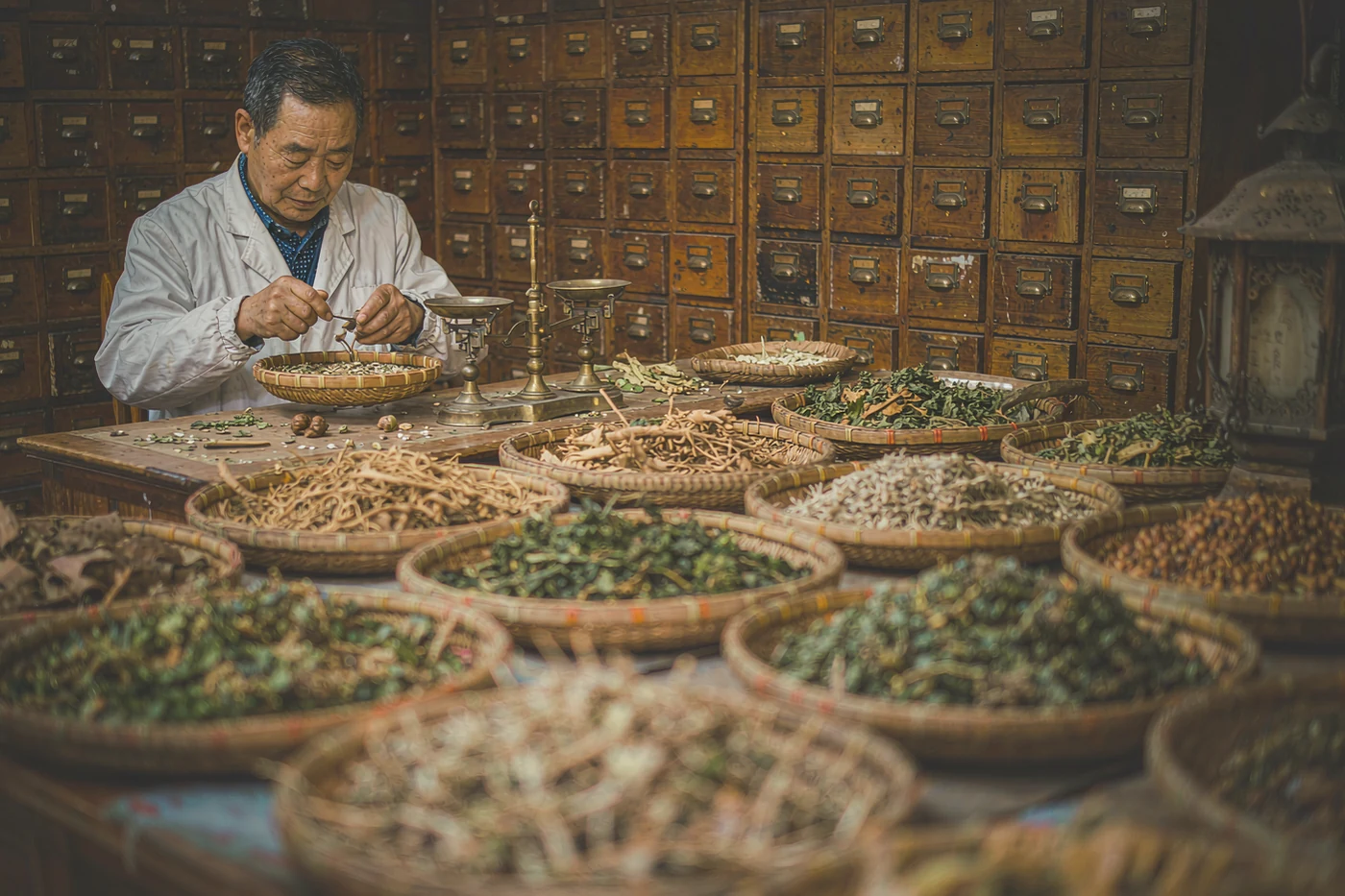
Herbal medicine, and getting it home
Herbs are where this gets genuinely complicated — and almost all of the difficulty happens at your own border rather than China's.
Two forms — Raw herbs (饮片) that you simmer into a bitter tea, or concentrated granules (配方颗粒, sometimes sold as 免煎颗粒) that stir into hot water. Granules cost more and are the sensible ask — you cannot boil anything in a hotel room.
What you will be handed — A formula of roughly eight to fifteen ingredients, taken daily, usually for one to two weeks before you return for reassessment. Ask exactly how long to take it and what should make you stop.
Interactions are real — Tell the doctor every prescription drug, over-the-counter medicine and supplement you take. The classic hazards are warfarin and other anticoagulants, antiplatelets, diabetes medication, diuretics and some psychiatric drugs. State pregnancy plainly and early.
Ask for the written formula — You want the ingredient list with weights, ideally bilingual. It is the only way your doctor at home can check what you are swallowing, and it is exactly what a pharmacist needs to spot interactions.
Taking herbs home — ⚠️ Several countries restrict importing unprocessed plant material or anything of animal origin, and some TCM formulas contain both — check your own country's rules before you fly. Sealed, commercially packaged granules from a hospital pharmacy, kept with the receipt and prescription, cause the least trouble; loose dried herbs bought informally are the most likely to be confiscated.
Do not buy herbs as souvenirs — Street-stall and market herbs come with no batch control, no dependable ingredient list and no way to check for contaminants. If you want something safe and giftable, buy it at a hospital pharmacy or a registered pharmacy chain instead.
What it costs and how you pay
Prices below are indicative ranges drawn from several published sources, and they disagree at the margins — treat them as budgeting, not as quotes.
Ordinary public outpatient — Registration or consultation typically ¥50–300 depending on doctor seniority; acupuncture ¥50–200 a session; cupping ¥50–150; tuina ¥100–400 for 45–60 minutes; one to two weeks of granules ¥100–400. ⚠️ 待人工确认.
International or VIP department — Commonly quoted at ¥200–1,000 for the consultation and ¥200–400 for an acupuncture session — several times the ordinary price for identical treatment. ⚠️ 待人工确认 with the hospital's own international desk; these numbers move.
What one visit costs you — Budget roughly ¥300–800 for a consultation plus one treatment plus a week of herbs on the ordinary channel, and several multiples of that through the international desk. Still a fraction of an equivalent course in Western Europe or North America.
Paying — Hospitals prepay at every step: registration, then treatment, then pharmacy. Cash still works, but Alipay and WeChat Pay dominate and international cards are frequently declined at ordinary counters. Sort your payment setup in advance and carry a backup.
Insurance — ⚠️ Most travel policies exclude complementary therapy outright, and those that cover acupuncture usually reimburse rather than direct-bill — you pay first and claim later. Only a handful of hospitals, Guang'anmen among them, keep direct-billing agreements, and those cover specific insurers and specific plans. Check the wording for acupuncture or complementary therapy before assuming anything.
Paperwork — Ask for an itemised invoice (发票) at every step and, at the international desk, a treatment summary in English. Insurers routinely demand both, and without them a claim usually just fails.
Safety rules worth insisting on
None of the following is difficult to enforce, and none of it is rude. Legitimate practitioners do all of this as a matter of course.
Fresh needles, opened in front of you — Acupuncture needles must be single-use, disposable and taken from a sealed packet you watch being opened. That is standard in Chinese hospitals and licensed clinics. If needles appear from a tray, a drawer or a jar, stop and ask.
Licensed practitioner, licensed premises — You want someone holding a TCM physician licence working in a registered medical institution that displays it. That distinction — not the décor, not the certificates on the wall in English — is what separates a hospital acupuncture department from a massage shop that bought a box of needles.
Never be pierced outside a clinic — Not a street foot-massage shop offering acupuncture, not a tout near Wangfujing or at the Great Wall selling a TCM experience, not a hotel-room call-out. None of these are regulated, and none of them should touch you with a needle.
Walk-out signals — Guaranteed cures; claims of reversing cancer or diabetes; pressure to prepay ten sessions or a large herb package; discouraging you from seeing your own doctor; telling you to stop prescribed medication. Real TCM physicians diagnose first, explain, and do not upsell.
Disclose these — Pregnancy; a pacemaker or implanted device, because electro-acupuncture is contraindicated; anticoagulants or a bleeding disorder, because cupping and gua sha bruise deliberately; diabetes, because burns and scratches heal badly; epilepsy; and every medicine you take.
Afterwards — Feeling tired, sore or briefly worse is common and settles within a day. Go to a hospital rather than back to the clinic — 120 for an ambulance — if you develop fever, spreading redness around needle sites, dizziness that will not settle, or pain that worsens instead of easing.
Match the channel to the reason — A real complaint calls for a public hospital department or its international desk; pure curiosity is better served by a reputable private or teaching clinic; a spa day is a spa day and not treatment.
Get diagnosed first — For anything unexplained, get a conventional workup before you travel and bring the results. TCM works best alongside a diagnosis, never instead of one.
Carry the physical passport — Registration is real-name and tied to your passport number; a photo on your phone will not get you a queue number.
Write your medicines down — Generic names, doses, plus allergies — ideally translated into Chinese on one card you can hand over at the consultation and again at the pharmacy.
Book the international desk days ahead — Phone or email several days out. Ordinary slots open roughly seven days before, and popular specialists can go within minutes of release.
Do your laundry before moxibustion — The smoke clings to everything. And leave two clear days between cupping and anything at which your shoulders or back will be photographed.
Assume insurance will not pay — Read the policy wording, then budget to pay out of pocket and claim afterwards if you turn out to be covered at all.
Leave with paper — Itemised invoice, the written formula for your doctor at home, and an English treatment summary.