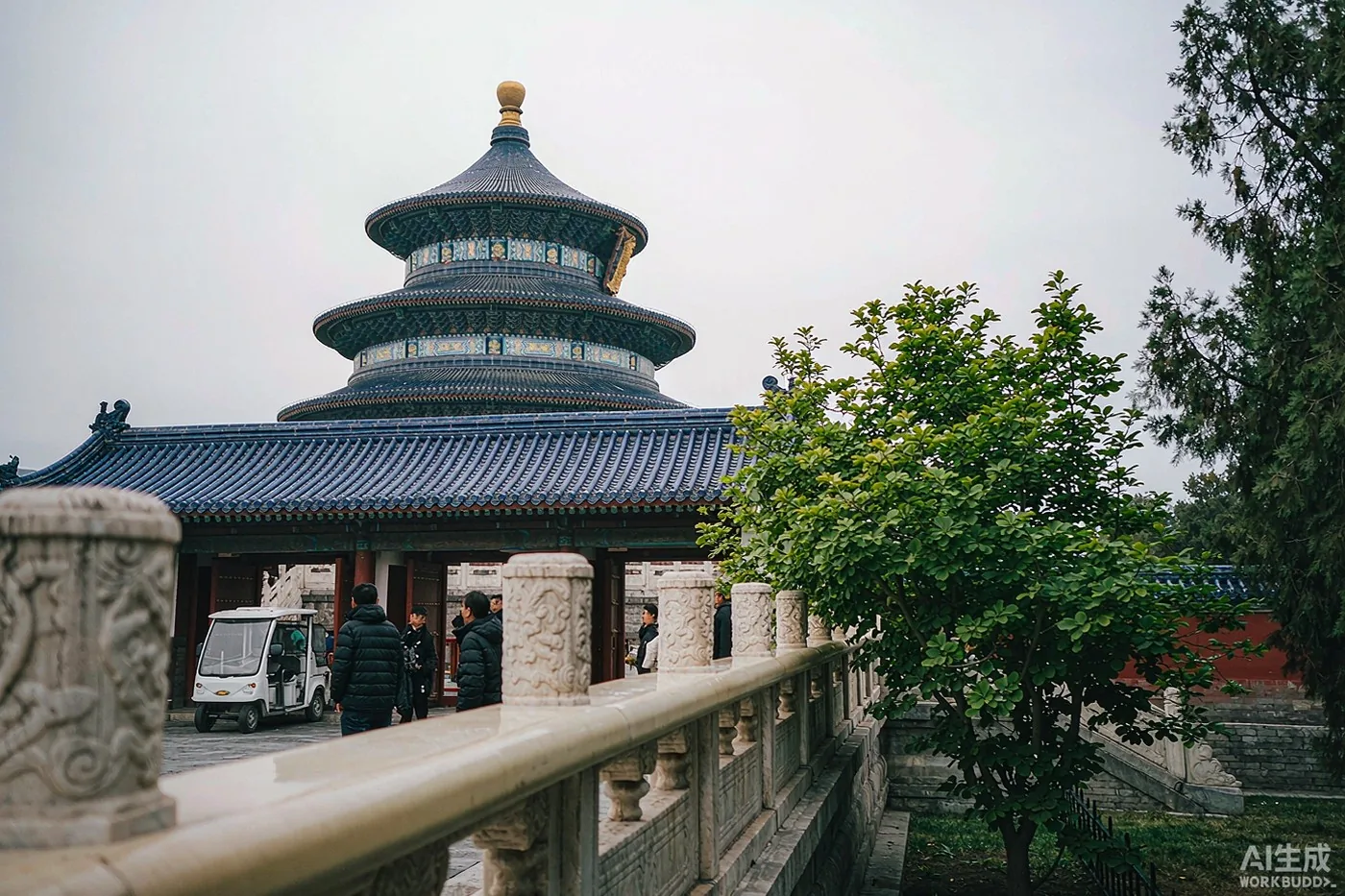
One of Beijing's most photogenic sites — and at 7am, one of its most alive. How to visit the Temple of Heaven park.
The Temple of Heaven is where emperors performed ceremonies for good harvests, and the park around it is now one of the best places in Beijing to watch ordinary city life. Come early and you will see tai chi, ballroom dancing, calligraphy on the pavement and card games under the pines.
The park opens early for locals exercising; the main buildings open later. Buying the through-ticket lets you into the Hall of Prayer for Good Harvests.
The Hall of Prayer for Good Harvests is the iconic triple-roofed circular building. From it, the long raised walkway runs south to the Circular Mound Altar and the Echo Wall — where sound travels along the curved surface, which is worth trying.
There are two tickets, and choosing wrong is the most common mistake. The park entrance ticket (around 10–15 RMB in low season, slightly more in peak season April–October) only gets you into the grounds — you can walk the Long Corridor and watch tai chi in the cypress groves, but the Hall of Prayer for Good Harvests, the Imperial Vault of Heaven, and the Circular Mound Altar all sit behind a second gate. The through ticket (lianpiao), roughly 28–34 RMB depending on season, covers all three buildings and is what almost every first-time visitor needs. If you buy the cheap ticket at the gate and change your mind, you can pay the difference at the building entrances, but queues there are slower. Foreigners can pay by cash or card at ticket windows, though the self-service machines mostly require Chinese payment apps — go to a staffed window if you need to. Main buildings close around 5pm (earlier in winter), and last entry is typically an hour before, so don't arrive at 4:30 expecting to see the interior.
The pre-8am park is one of Beijing's best free shows. Retirees claim it early: large groups dancing to portable speakers near the east gate, men writing calligraphy with water brushes on the paving stones, card games under the cypresses, and vigorous hacky-sack circles you're welcome to join. This is exercise culture, not a performance for tourists — nobody collects tips, and photographing individuals without a nod or a smile is considered rude; ask with a gesture and most will happily pose. By 9:30–10am the character changes completely: tour groups flood in from the east gate in waves, and the Hall of Prayer for Good Harvests platform becomes a shoulder-to-shoulder scrum until about 2pm. The practical play is to pick one experience. Want the buildings quiet? Arrive at 8am when the interiors open, see the three main structures first, then relax. Want the morning culture? Come at 7am, enjoy the park for ninety minutes, then view the buildings after 3pm when groups thin out. Trying to do both at 10am gets you the worst of each.
The Temple of Heaven pairs naturally with a half-day of nearby spots, all reachable without a car. Hongqiao Pearl Market sits directly across from the east gate — touristy and heavily focused on bargaining, but a legitimately convenient lunch stop, with a food court on its upper floor where dumplings and noodle bowls run 20–40 RMB. If you prefer haggling, treat the first quoted price as fiction and counter at roughly a third; walking away works. For something calmer, taxi or Didi ten minutes north to the Temple of Confucius and the adjacent Imperial College (Guozijian) in the hutong district around Yonghegong — a Line 5 ride away on the same metro line, getting off at Yonghegong station. Doing Temple of Heaven in the morning and the Confucius Temple after lunch makes a tidy Line 5 day. Photographers should also consider returning at dusk: the park's evening ticket is cheap, the cypress avenue empties out, and the hall's silhouette against a lit sky, shot from the east side, beats any midday frame.