Your foreign card pays shops but not people. How to split any dinner, repay a friend and handle red packets in China - with cash, timing and the right phrases.
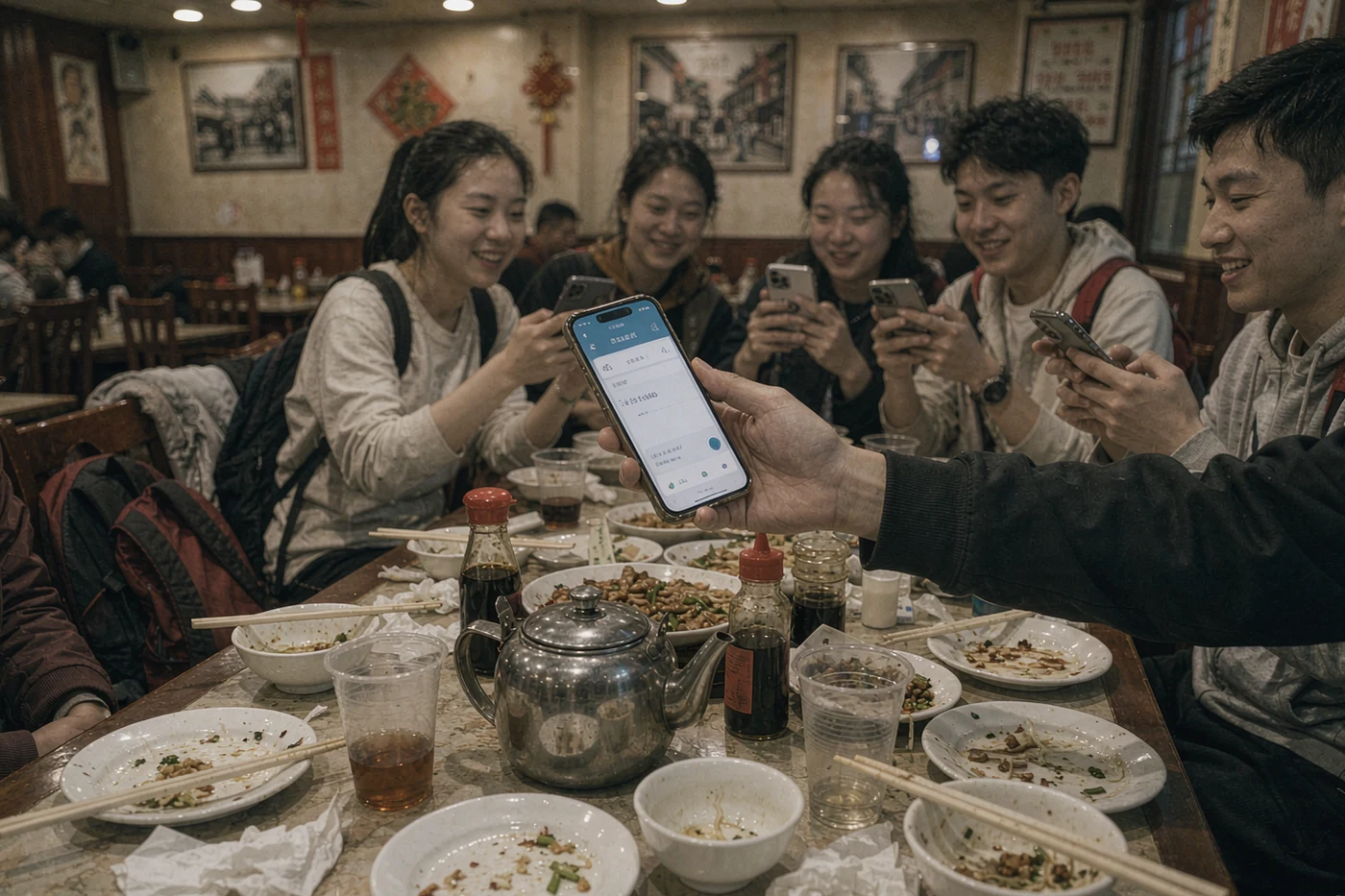
The scene plays out at almost every group dinner in China: the bill lands, someone grabs it, and the rest of the table immediately starts WeChat-transferring their share to whoever paid. You unlock your phone and discover the one thing your foreign card cannot do: send money to a person. Nothing is broken. For internationally linked cards, peer-to-peer transfers, red packets and wallet balance are switched off by design - merchant payments only. This guide covers what actually works: four workarounds that need nothing but cash and a bit of social grace, the phrases that make it smooth, and what changes once you open a Chinese bank account.
Both Alipay and WeChat Pay treat international cards as merchant-payment-only. You can scan a shop's QR code, be scanned at the till, pay inside mini-programs and ride-hailing apps - but you cannot send a transfer to a friend, send or grab a red packet, top up your wallet balance, or withdraw cash from it. The restriction is policy, not a glitch: no setting, app update or re-binding removes it. Tencent spelled out the scope when it opened its merchant network to international cards in 2023, and the Weixin Pay help centre states it plainly today. For the spending caps that do apply to foreign cards, see our separate guide on Alipay and WeChat payment limits. Group collection requests - the qunshoukuan feature locals use to split a dinner - belong to the transfer family, so expect those to fail with a foreign card too [verify].
Understanding the local script makes the workarounds easier. Among Chinese friends there are two common endings. One is qiangzhe maidan - a friendly wrestling match for the bill in which someone genuinely insists on treating the whole table; joining the tussle is polite, losing it gracefully is expected. The other is AA (go-Dutch): the payer collects everyone's share afterwards, almost always via a WeChat transfer or a group collection request. There is no separate splitting app in play - it all happens inside WeChat. If someone invited you out, assume they intend to pay; offering once is polite, insisting past that is not (our etiquette guide covers the inviter-pays rule). Your problem is only the second ending: the moment money genuinely needs to move from you to someone else.
Cash closes every gap the apps leave. Carry a stack of small notes - 10s, 20s and 50s, not just hundreds - because the share you typically owe runs between 30 and 150 yuan. When the payer waves you off or you cannot transfer, place the notes on the table or into their hand and say zhe gei ni: 'this is for you'. In a group of new friends, putting 100 yuan down against a 360-yuan bill for four is a perfectly normal move; nobody expects exact change, and the payer usually just rounds it. If they genuinely refuse - common when they invited you - do not force it; accept the treat and repay it with the next round of drinks or the taxi home. Where small notes come from: our cash-planning guide covers ATMs and sources.
The cleanest pattern when you cannot transfer: let the group's WeChat do the ordering, settle your share before you leave. Ask the payer what your share is, or read the bill on their phone, then hand over cash before walking out of the restaurant - promising to settle later at the hotel is unreliable and mildly awkward. Do the maths on your own phone; if the group rounds in your favour, let it stand and remember it for next time. At a long table the payer often totals dishes loosely rather than per person; offering a round number (100 yuan against a roughly 80-yuan share) is accepted happily. What you must not do is leave without settling: an unpaid share stands out precisely because everyone else settled theirs in three seconds on their phones.
Restaurants and shops are used to split payments, and every person can scan with their own app. Three ways it works: ask the cashier for fenkai fu (pay separately) and they will ring the bill in portions; or each person scans the table's order QR code and enters their own amount; or one bill, several tappings of different cards. Chains and mid-range restaurants handle this without blinking; a tiny family-run spot may prefer a single payment - fall back to workaround 1 or 2 there. The 3 percent foreign-card surcharge only kicks in above 200 yuan per transaction, so three payments of 100 yuan stay fee-free while one payment of 300 yuan costs an extra 9 - splitting at the till is also the cheapest way to pay, as our payment-limits guide notes.
Locals routinely order for each other: a friend books the Didi on their phone, a colleague buys the train ticket, someone grabs the Meituan group deal. When you cannot pay for something yourself, the local move is to simply ask - this is a perfectly askable favour: 'bang wo mai yixia, wo gei ni xianjin' - 'buy it for me and I will give you cash'. Repay immediately and in cash - same day, not next week. Watch the small services with built-in pay-for-me options: Didi has an ask-someone-to-pay feature [verify], and Taobao checkout has long offered daifu - both work even though your own card cannot move money person-to-person. The reverse also holds: if a local friend owes you, their transfer lands in a WeChat wallet - which your foreign-card wallet cannot receive. Ask them to hand you cash instead, or to count it against something you would have bought anyway.
Long-stay visitors and students can end this entire problem by opening a mainland bank account with their passport. Once a Chinese debit card is bound, the wallet behaves like a local's: transfers to friends, red packets, group collections, balance top-up and withdrawal all work. The official numbers: WeChat friend transfers are free, capped at 1,000,000 yuan per day and 100 transfers per day; a single red packet is capped at 200 yuan, with up to 200,000 yuan per day across all red packets when you pay from a card; money received into balance runs up to 1,000,000 yuan a day and 20,000,000 yuan a year. Your real ceiling is usually your own bank's per-card cap, not WeChat's. Opening the account requires an in-person branch visit and a working Chinese phone number; our guide on banking without a mainland number covers the current requirements.
Red packets (hongbao) are the small-denomination currency of friendship - but remember, a foreign-card wallet can neither send nor grab them, so this section matters once you have a Chinese card. In group chats, the lucky-draw red packet splits a random amount among whoever taps fastest: grabbing is expected, stakes are small, it is pure fun. One-to-one red packets are for occasions: birthdays, holidays, thanking someone's kid, softening an apology. Amounts follow number superstition: 8 for prosperity (8.88, 88 yuan), 6 for smoothness (66, 166 yuan), and avoid anything containing 4, which sounds like death. The hard cap of 200 yuan per packet is deliberate - a red packet is a gesture, not a payment method. The formal version at weddings runs by entirely different arithmetic; our Chinese-wedding guide covers the numbers.