Explore Beijing / Eating Around Niujie: Beijing's Halal Food Street
Eating Around Niujie: Beijing's Halal Food Street
Niujie is Beijing's Hui Muslim food street. Which shops are worth the queue, what to order at each, what things actually cost, the best hours to arrive, and how to order it in three words of Chinese.
10 min read · KOULING's Beijing Travel Guide
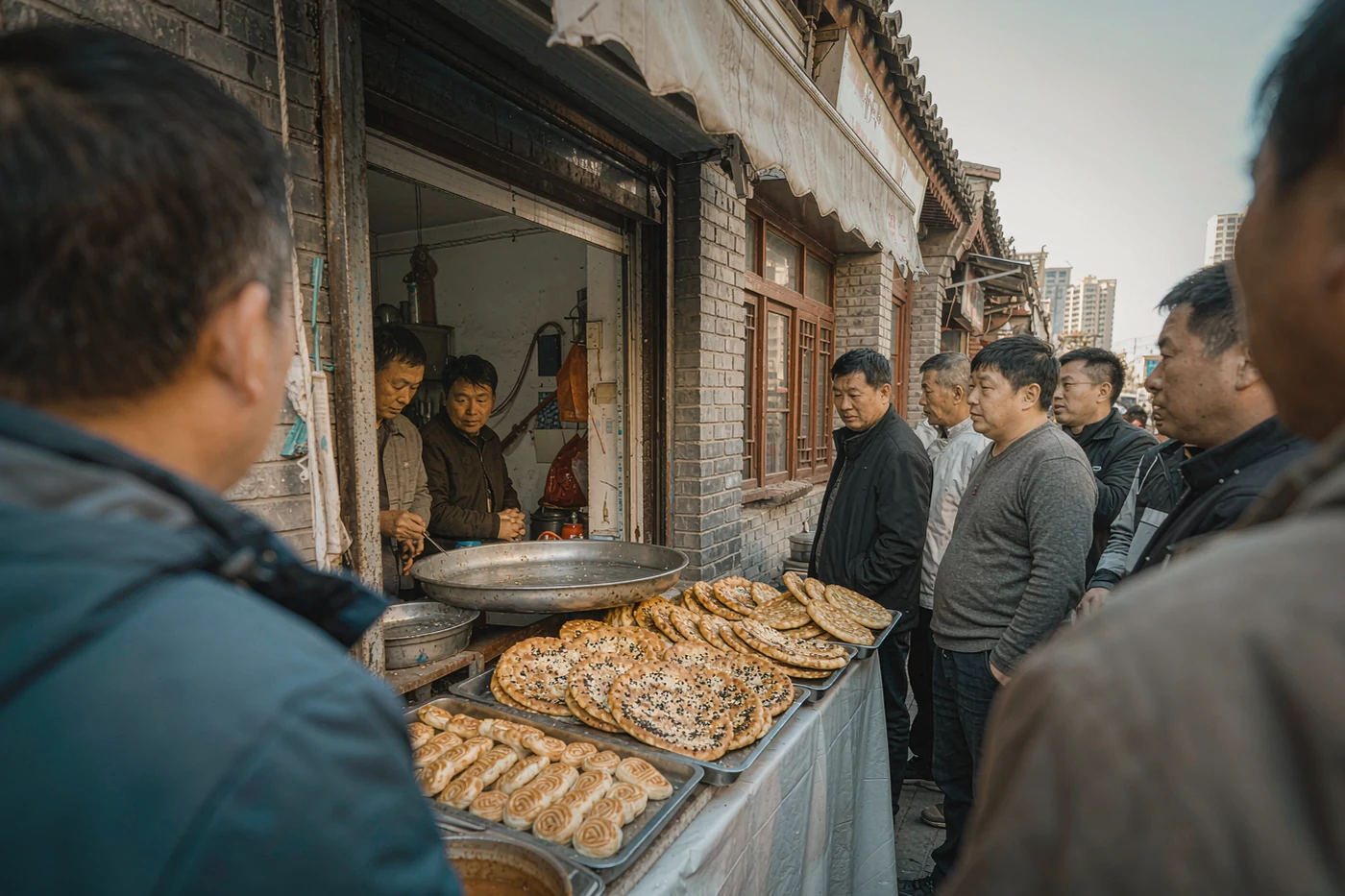
Niujie (牛街, literally Ox Street) is not a heritage-themed food court. It is a working Hui Muslim neighbourhood inside Beijing's southwest Second Ring Road where the ground floor of almost every building sells something to eat: buns from about 05:30, rice cakes by mid-morning, lamb hotpot until roughly 01:00. You come here for breakfast or a cheap lunch, not for a restaurant with a view, and the whole point is to walk and graze. This guide covers the three streets that matter, the shops worth queueing for, what things cost, when to turn up, how to order with three words of Chinese, and what is worth carrying home.
What kind of place this is
Niujie has been the centre of Beijing's Hui Muslim community for centuries; the Niujie Mosque at the north end dates back to the year 996. Everything sold here is 清真 (qingzhen, halal) — beef and lamb instead of pork, and the shops take that seriously rather than treating it as a theme. In practice: no pork anywhere, buns are beef or mutton, and the street smells of cumin and toasted sesame. It is also a residential area. People live above the shops, children cycle past on their way to school, and nobody is performing for visitors. That is exactly why it is good.
No pork, anywhere — Halal here is a real, regulated designation. Beef and mutton replace pork in every local dish, including the ones you may know in a pork version elsewhere.
The two characters to look for — 清真 (qingzhen) on a shopfront or awning means halal. Green signage is the usual cue.
It is somebody's neighbourhood — Keep your voice down near the mosque, ask before photographing people, and do not treat shop doorways as public space.
Getting there, and which street to start on
Take Metro Line 19 to Niujie station and leave by exit D2 — the food begins about 300 metres to the south. Three streets matter and all of them are inside a ten-minute walk of each other, so the order you do them in is about queues, not distance.
牛街 Niujie, the main street — The north-south spine. The halal supermarket at No. 5 and Hongji opposite it are both here. Start here and branch out.
输入胡同 Shuru Hutong — The lane one block east. Manji's sesame bakes and Baoji's douzhi live here: cheaper, less photographed, much shorter queues.
教子胡同 Jiaozi Hutong — A little further south-east: Shi's pies and Xiangyunxuan. Worth the extra ten minutes if you want to sit down rather than graze.
If Line 19 is not on your route — Caishikou (interchange of Lines 4 and 7) sits right beside the Niujie area, and Guang'anmennei on Line 7 puts you on the east side within a 10-15 minute walk.
Start inside: the halal supermarket at No. 5 Niujie
If you only have an hour, spend it here. The 牛街清真食品超市 at 5 Niujie opened in 2003 and is still the largest halal food supermarket in the city; its ground floor is a ring of counters — rice cakes, date cakes, electric-grilled skewers, braised meats, pastries from other cities — all under one roof. It solves the queue problem: instead of walking to four shops, you walk four metres.
白记年糕 Baiji rice cakes — Glutinous rice cakes sold by weight, around ¥20 per 500g. The 驴打滚 lüdagun rolled in soybean powder and the 桂花芝麻糕 osmanthus-sesame cake are the two to get. Reported hours roughly 08:00-20:00 [verify].
伊宝荷叶甑糕 Yibao — Lotus-leaf-wrapped zenggao: glutinous rice layered with very dense red-date paste, plus a smooth 芸豆糕 kidney-bean cake. Around ¥33 per person's worth; roughly 07:00-19:00 [verify].
景泰马记电烤串 electric-grilled skewers — Mutton skewers at about ¥10 each, heavy on cumin and chilli powder. The ritual is eating them standing on the pavement. Roughly 08:30-20:30 [verify].
月盛斋 Yueshengzhai — Fried 松肉 songrou beef rolls and sesame-coated lamb meatballs — the savoury counter locals queue at for takeaway.
The supermarket itself — Hundreds of halal sausage varieties plus Tianjin and Beijing pastry brands you will not find in a normal supermarket. The best place on the street to buy things that travel.
The famous queue: 洪记小吃店 Hongji
Directly opposite the supermarket. Hongji has been making Beijing halal snacks since 1991 and it is the shop with the longest line on the street — 50 minutes is not unusual at weekend breakfast, and visitors have reported waiting that long for a bun. Whether it is worth it depends on your patience: the beef bun is genuinely good and the queue is genuinely long. If the line is round the block, cross to Shuru Hutong instead and come back on a weekday.
牛肉包子 beef bun — About ¥2.5 each. Thin skin soaked through with fatty juice — the thing the queue is actually for. Buy three and eat them standing up.
黄米面炸糕 fried millet-flour cake — Crisp shell, sweet red-bean filling. Better than it sounds and best eaten hot, straight out of the fryer.
驴打滚, 门钉肉饼, 麻酱爆肚粉 — Hongji also stocks the wider Beijing snack list in one place — useful if you do not want to walk to six separate shops.
Hours — Reportedly about 05:30-21:30, which makes it one of the few options on the street for a very early start [verify].
Shuru Hutong: where locals actually queue
One block east of the main street, 输入胡同 is narrower, cheaper and far less photographed than Niujie itself. Two shops here are worth the detour, and a third is a short walk further on Jiaozi Hutong. If you only do one side street, do this one.
满记烧饼 Manji shaobing, No. 3 Shuru Hutong — Sesame bakes: about ¥1 for a plain salt-and-pepper one and about ¥5 for the beef-filled version, which comes out of the oven audibly crisp. The fried chicken leg is the other local pick. Reported hours about 06:00-20:00 [verify].
宝记豆汁 Baoji douzhi, No. 27 Shuru Hutong — Douzhi is fermented mung-bean juice and the most divisive drink in Beijing — sour, faintly funky, an acquired taste. A cup costs about ¥3. Buy one cup for the table before committing to anything larger.
清真石记馅饼 Shi's pies, No. 4 Jiaozi Hutong — Beef with scallion, chive or fennel at about ¥8 each, plus ¥2 millet porridge and about ¥15 lamb-offal soup. Eat in rather than walking — the pies leak.
If you want to sit down: a real meal
Everything above is breakfast and snacks. For an actual lunch or dinner the street has several sit-down rooms, and the price per person jumps accordingly. Book or arrive early for the hotpot rooms at weekends.
聚宝源铜锅涮肉 Jubaoyuan, 5-2 Niujie — The street's benchmark copper-pot lamb hotpot, around ¥105 per person. The clear broth, the sesame sauce bar and the sweet pickled garlic are the point. Reported hours about 10:30 to around 01:00 [verify].
紫光园 Ziguangyuan, Niujie / Nanheng Xijie corner — Around ¥70 per person. Its 奶皮子酸奶 milk-skin yoghurt — about ¥8 a cup, ¥15 for two — is the thing people carry out the door, and the 糖火烧 sugar-fire-bake is worth taking away.
祥云轩 Xiangyunxuan, Jiaozi Hutong — 门钉肉饼 door-nail pies with thin skin and a lot of juice; vinegar-braised eggs and cabbage tofu are the usual sides. Around ¥68 per person [verify].
Hand-pulled beef noodles — Several halal noodle houses along and just off the main street do Lanzhou and northwest-style beef noodle for well under ¥50 — the cheapest hot meal on the strip [verify current names and hours].
How to order with almost no Chinese
Most of these counters have no English and no picture menu. You point — and pointing is genuinely enough. Five phrases make it smoother, and all of them are short enough to say badly and still be understood.
这个 — zhège — This one. Point at the tray and say it. Works at every counter on the street.
多少钱 — duōshǎo qián — How much. Most shops will hold up fingers or turn a phone calculator screen towards you.
在这儿吃 / 带走 — zài zhèr chī / dàizǒu — Eat here / take away. Say it before they bag it.
扫码点餐 — sǎomǎ diǎncān — Scan to order. In sit-down restaurants the table will have a QR code; the menu opens in your browser and you pay in the same flow.
Bring small notes — Cash still works at the small stalls and they prefer small bills. A ¥2.5 bun is an awkward purchase with a ¥100 note.
What it costs
Two very different budgets share this street, and it is worth deciding which one you are before you arrive because the gap is about triple.
The snack crawl — About ¥30-40 per person buys a bun, a skewer, a rice cake, a sesame bake and a cup of douzhi. This is the version most visitors should do.
The sit-down meal — Around ¥100 per person at Jubaoyuan, about ¥70 at Ziguangyuan. Cheap by capital-city standards, but three times the crawl.
Payment — Alipay and WeChat Pay are accepted almost everywhere and foreign cards can now be linked to both. Prices and hours in this guide were compiled in 2026 and they drift — treat every figure as a band, not a quote [verify].
When to go
Timing changes this street more than any other food area in Beijing. The same 200 metres can be a quiet local breakfast or a 50-minute queue depending on the clock and the day.
07:00-09:00 on a weekday — The best window. Buns and rice cakes are fresh out, queues are short, and the street is doing what it does rather than serving visitors.
Weekend mornings — Expect Hongji's line to run 30-50 minutes. If you hate queueing, go straight to Shuru Hutong instead — Manji and Baoji move far faster.
Friday lunchtime — Avoid it. This is the main prayer time: many shops close or slow down, and the mosque area is at its busiest and least visitor-friendly.
Late evening — The hotpot rooms run late, but the snack counters wind down from about 19:00-20:00. For snacks, come early rather than late [verify].
Mistakes visitors make
Four things go wrong here repeatedly, and all four are avoidable with about thirty seconds of planning.
Treating it as a photo set — People live and pray here. Photograph food, not faces. Stay out of the mosque's prayer areas — non-Muslims are generally not admitted to the prayer hall, so treat the mosque as something you walk past respectfully rather than tour.
Committing to douzhi — Buy one cup before deciding whether you like it. Most visitors do not, and that is fine — it is a local taste, not a test of anything.
Arriving at 13:00 expecting breakfast — The famous breakfast shops are at their best before 09:00 and some sell out. The street does not close, but the interesting part of its day is early.
Filling up at the first shop — The entire point is five small things from five places. Two beef buns will ruin the rice cakes for you.
What to take home
The supermarket's dry and vacuum-packed counters are the only part of this street designed to travel. Two caveats: check whether your home country permits meat imports before buying anything with beef or lamb in it, and buy on your last full day rather than your first.
Vacuum-packed 酱牛肉 braised beef — From the supermarket's cooked-meat counter. Travels well and is the most reliable gift from this street.
Pastries from Guishunzhai and Dashunzhai — Old Tianjin and Beijing brands stocked inside the supermarket that are hard to find anywhere else in the city.
Halal sausages — Hundreds of varieties; the pine-nut and garlic ones are local picks. Vacuum-packed ones travel, fresh ones do not.