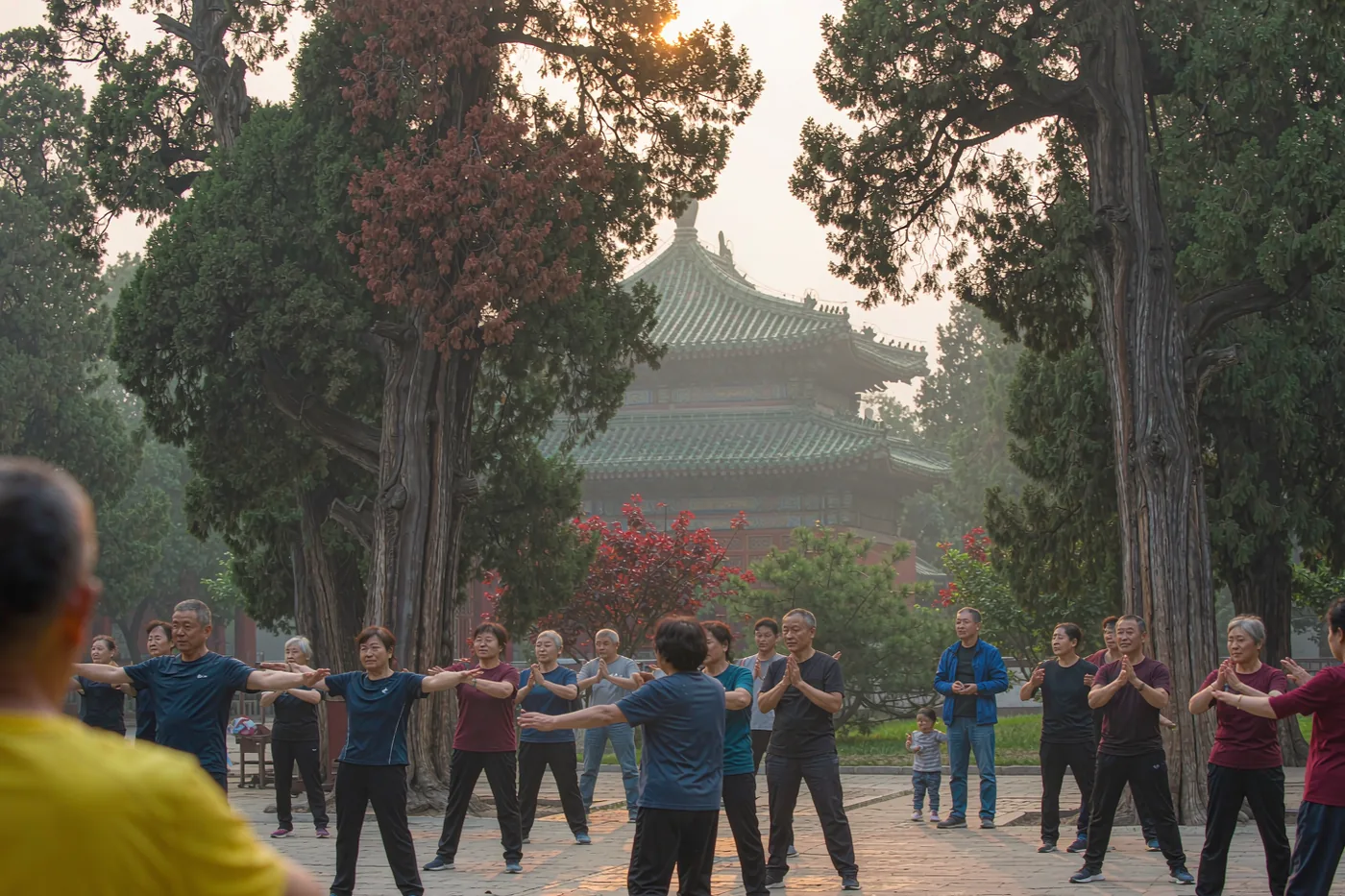
From free morning groups in city parks to paid English-language classes, here's how first-time visitors can learn tai chi in Beijing — plus realistic prices in CNY and USD.
Tai chi (taijiquan) was born here, and Beijing is one of the easiest places on earth to try it. You'll see practitioners gliding through the city's parks every morning — and the barriers to joining are lower than you'd think. Some groups are free, some charge modest fees, and a handful of studios teach in English. If you're staying in Beijing for a week or more, learning the opening movements of a Yang- or Chen-style form is one of the most memorable things you can do with your mornings. Prices and class availability change often, so always confirm current details before you commit [verify before travel].
In most large parks, tai chi groups gather between roughly 6:00 and 9:00 in the morning — earlier in summer, later in winter. Many are informal: a regular crowd follows a lead practitioner, often with music playing from a portable speaker. Some groups are genuinely open to newcomers and won't ask for money; others are de facto classes for regulars and may expect a small contribution of around CNY 10–30 (about US$1.50–4) per session if you join repeatedly. The etiquette is simple: stand at the back, mirror what everyone does, don't talk during the form, and ask before taking photos. If you'd like real instruction, look for the practitioner who wanders the rows correcting posture — that's the teacher, and a polite greeting (ni hao) plus a smile goes a long way. English is hit-or-miss; a translation app helps [verify before travel for any group's current arrangements].
If you want structured teaching, Beijing has three tiers. Private one-on-one lessons with an experienced teacher typically run CNY 300–600 (roughly US$40–85) per hour, and some teachers offer outdoor sessions in a park as part of the lesson. Small-group courses at martial arts schools or community sports centers cost around CNY 100–250 (US$14–35) per group class, or roughly CNY 800–2,000 (US$110–280) for a multi-week beginner package. Finally, a few studios and independent teachers cater to expats and visitors and can teach in English — search for 'tai chi English class Beijing' and contact them via WeChat or email before you arrive, since schedules shift and summer heat or winter cold can move sessions indoors. As a rule of thumb: never pay a large sum upfront for a 'master course' you found on the street or through an unsolicited offer, and confirm the total price, number of sessions and cancellation policy in writing [verify before travel].
You don't need a uniform for a first lesson — loose trousers, a breathable t-shirt and flat shoes with flexible soles are fine (dedicated tai chi shoes cost CNY 50–150 / US$7–21 if you get hooked). Bring water and, in summer, a hat and sunscreen; in winter, warm layers, since outdoor practice continues year-round. Expect the first sessions to feel slow and slightly frustrating: tai chi is built on weight-shifting and relaxation rather than strength, and the movements look deceptively simple. A good teacher spends as much time on standing posture and breathing as on the form itself. Most beginners learn the first 8–16 movements of a 24-movement simplified Yang form in their first week — enough to feel real progress and a genuine reason to keep practicing back home.
The classic tai chi setting and the most atmospheric park in the city. Every morning, hundreds of locals practice here — tai chi, sword forms, dance and qigong — under cypress trees near the east gate area. Visitors are welcome to join the outer groups; arrive early and observe a few minutes before stepping in.
A compact, leafy park in the Chaoyang district popular with both locals and expats. Morning tai chi and qigong groups gather near the main open areas, and the neighborhood's international character means you may well find an English-speaking practitioner or teacher here.
Next to the Forbidden City, this imperial lake park pairs morning tai chi with superb scenery — jade island, willows and pagoda views. Groups practice along the lakeshore paths in the early morning, before the tour buses arrive.