Explore Beijing / Invited to a Chinese Home in Beijing: Gifts, Shoes at the Door, and Dinner Etiquette
Invited to a Chinese Home in Beijing: Gifts, Shoes at the Door, and Dinner Etiquette
Being invited to a local home is the highlight of many first-time visits to Beijing. Here's what to bring, when to take off your shoes, and how to be a gracious dinner guest.
7 min read · KOULING's Beijing Travel Guide
If a Beijing friend or colleague invites you to their home, say yes — it's the single best window into daily Chinese life you'll get on a first trip. Hospitality is generous and your hosts don't expect perfection, but a few small gestures (a thoughtful gift, taking your shoes off at the door, a polite toast) will earn real warmth. Here's everything you need to know before you knock on the door.
What to Bring: Safe Gifts
You don't need to spend much — thoughtfulness matters far more than price. Something from your home country is the classic choice and almost always lands well. Bring the gift unwrapped or in simple wrapping, hand it over with both hands when you arrive, and don't be surprised if your hosts set it aside to open later rather than in front of you.
Specialty food or drink from home — Nice tea, coffee, chocolate, cookies, or a bottle of wine from your region. Good quality wine (roughly US$15-30 / CNY 100-220 at home) is a safe, welcome choice.
Fruit — A beautiful box of fresh fruit is a traditional, always-appropriate gift. Buy it the same day; premium fruit shops in Beijing sell elegant gift boxes.
Something for the children — If your hosts have kids, a small book, puzzle, or souvenir from your country is a lovely touch.
Flowers or a small plant — Fine for most hosts, though some older hosts associate certain flowers with funerals — fruit or food is the safer bet if you're unsure.
What NOT to Bring: Taboos to Avoid
A few gifts are unlucky in Chinese culture because of how their names sound. Your hosts will forgive an honest mistake, but avoiding these shows cultural respect.
Clocks — Giving a clock ('song zhong') sounds like attending a funeral — the single biggest gift taboo.
Umbrellas — 'San' sounds identical to 'separation,' so umbrellas suggest splitting up.
Knives or scissors — Sharp objects imply cutting off the relationship, and can feel like a request for payment in return.
Sets of four of anything — Four ('si') sounds like 'death.' Stick to pairs or eights — eight is lucky.
Very expensive gifts — An extravagant gift can embarrass hosts who feel they can't reciprocate. Keep it modest and warm.
At the Door and Around the Home
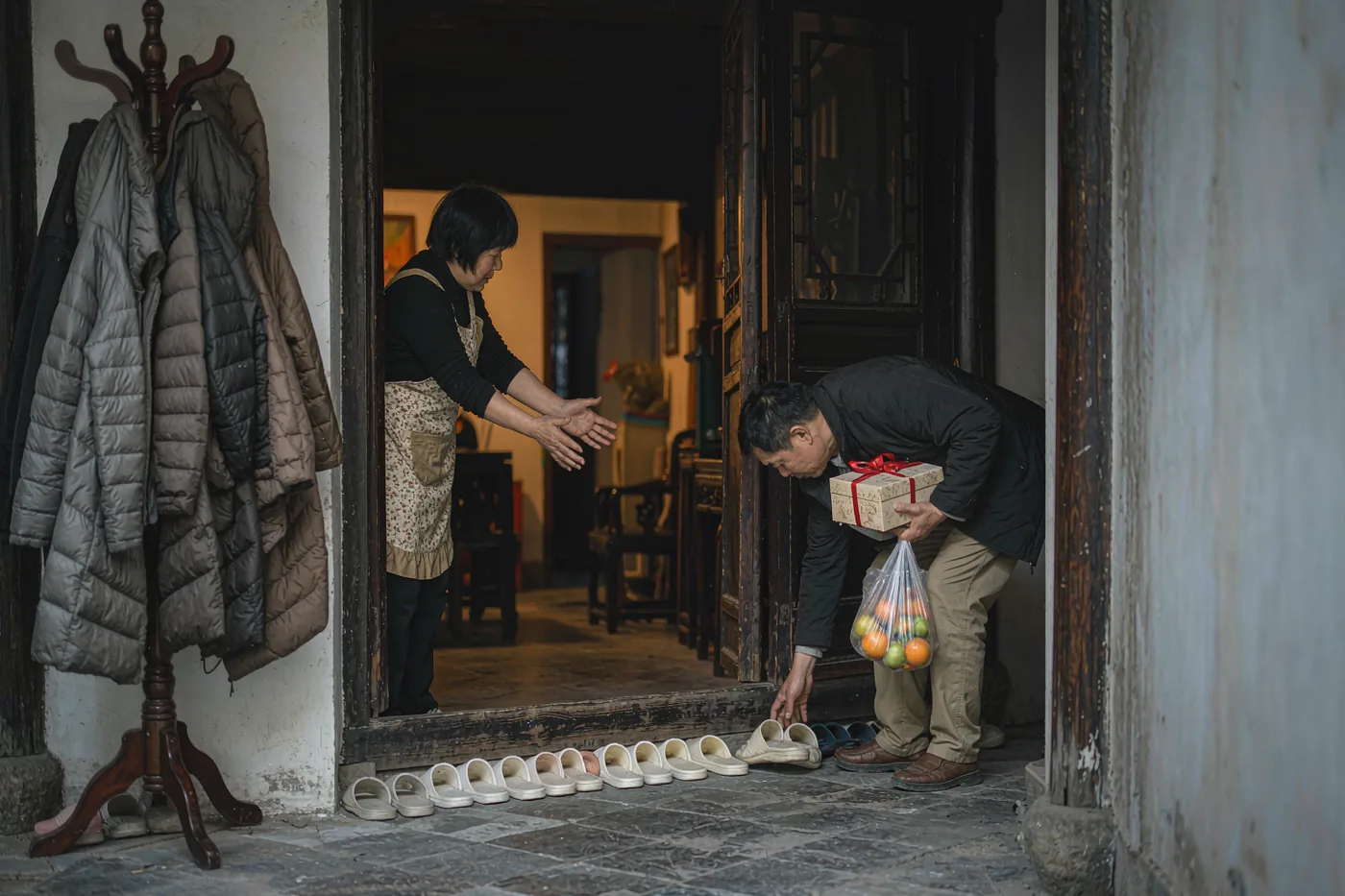
Chinese homes are kept meticulously clean, and street shoes track in dust — so expect to take your shoes off at the entrance. Your host will usually offer slippers (often separate indoor slippers, plus a second pair for the bathroom). Accept them; barefoot is generally fine too, though socks are more polite if you're wearing shoes without socks, plan ahead. Compliment the home warmly when you enter, and don't wander into bedrooms or the kitchen uninvited.
Remove shoes at the door — Do it without being asked if you see shoes lined up at the entrance — it signals you understand.
Use the offered slippers — Many homes keep separate slippers for the bathroom. Swapping is normal, not fussy.
Arrive on time, but not early — Arrive within about 10 minutes of the stated time. Showing up early can catch hosts mid-preparation.
Bring a small gift for the host, presented with both hands — Receiving and giving with both hands is a sign of respect throughout China.
Dinner Etiquette: Toasting, Chopsticks, and Seating
Home dinners in Beijing are a parade of dishes, usually far more food than the group can finish — leave some on the table, as clearing every plate can look like your host didn't provide enough. The host seats the most honored guest facing the door, but as a foreign guest you'll likely be guided to a seat; just follow directions. Expect warm hospitality, lots of food pushed onto your plate, and probably some toasting.
Never stick chopsticks upright in rice — It resembles funeral incense. Rest them on your bowl or the chopstick rest instead.
Toast properly — When toasting with baijiu or beer, hold your glass slightly lower than your host's or an elder's as a sign of respect, and say 'ganbei' (dry cup) — you're expected to drain it. Sipping is acceptable if you say so with a smile and tap lightly. Pace yourself; toasts can come fast.
Let the host serve first — Start eating when the host invites everyone to begin. Serving food to others with your own chopsticks is a kindness, not a breach.
Try everything, even a little — Refusing a dish outright can disappoint. Take a small taste and compliment it — 'hao chi' (delicious) goes a long way.
The fruit and tea course ends the meal — When fruit or tea appears, the meal is wrapping up. Don't rush off immediately; a little chat after dinner is part of the ritual.
Learn two phrases — 'Xie xie' (thank you) and 'wo chi hao le' (I'm full) will delight your hosts more than any gift.
Quick Practical Tips
Wine and gifts: carry a bag — A simple tote or gift bag keeps the bottle and fruit presentable on the metro ride over.
Bring cash or set up mobile payment for a thank-you gesture later — It's not customary to pay or tip at a home meal, but inviting your hosts out for a follow-up meal is a gracious reciprocation. Most places now prefer mobile payment (Alipay/WeChat Pay); foreign cards work on Alipay's international version [verify before travel].
Dress casually neat — Smart-casual is right. Avoid anything too formal unless it's a festival occasion like Spring Festival.
Dietary restrictions: mention them in advance — Hosts will happily accommodate allergies or restrictions — but tell them a day or two ahead, not at the table.
Send a thank-you message afterward — A short WeChat message with a photo of you together, or a follow-up dinner invite, completes the exchange gracefully.
Where to Buy a Gift: Wuming Art Fruit & Premium Fruit Shops
A premium fruit box is the most foolproof gift if you're shopping the same day. Look for an upscale fruit shop — chains and boutique fruit stores are everywhere in Beijing — and ask staff to assemble a gift box (they're used to it). Budget roughly CNY 100-200 (about US$15-30) for a presentable box.
Metro
Widely available citywide; most residential neighborhoods have a premium fruit shop within walking distance — confirm the nearest one on a maps app.
Opening hours
Typically about 09:00-21:00 [verify before travel].
Tickets
No entry fee; expect roughly CNY 100-200 (US$15-30) for a gift box [verify before travel].
How long
15-30 minutes to pick and box a gift.
Where to Buy a Gift: Imported Goods Supermarkets
For Western wine, chocolate, or home-country treats, head to an imported-goods supermarket such as an Olé or BHG Premium — both have multiple Beijing locations, including near major shopping centers. Staff can help you choose; wine in the CNY 100-250 (US$15-35) range is well received.
Metro
Olé has locations in central shopping malls (e.g., near the Oriental Plaza / Wangfujing area — confirm current store and nearest station on a maps app) [verify before travel].
Opening hours
Generally 10:00-22:00, matching mall hours [verify before travel].
Tickets
Free entry; budget CNY 100-300 (US$15-45) for wine or chocolates [verify before travel].
How long
20-40 minutes.
Flowers: Beijing Flower Markets
If you decide on flowers or a small potted plant, Beijing's flower markets offer far better value and selection than street florists. Go earlier in the day for the freshest stock, and avoid white or yellow chrysanthemums, which are associated with funerals.
Metro
Several flower markets serve the city; the most convenient one depends on where you're staying — confirm the current location and nearest station on a maps app, as markets have relocated over the years [verify before travel].
Opening hours
Roughly 08:00-18:00; some close earlier than expected [verify before travel].
Tickets
Free entry; small bouquets or plants from about CNY 30-100 (US$5-15) [verify before travel].