Getting fibre into a Beijing flat: which carrier actually reaches your building, what 300M really costs, the documents a foreigner needs, install day, the contract clauses that bite, and how to close the account before you leave the country.
Your lease is signed, the flat is empty, and the first thing you actually need is not furniture — it is an internet connection you can take a video call on. Home fibre in Beijing is fast and, by Western standards, cheap. But the process has a shape most foreigners do not expect: the account is real-name registered to your passport, the price depends on which carrier is physically wired into your building, and leaving early costs real money. This guide walks the whole loop — picking an ISP, the paperwork, install day, the clauses that bite, and how to close the account on the way out. Package names and prices move constantly, so treat every number here as a typical range to confirm at your own address on the day you order.
Before you compare prices, find out which carriers physically reach your flat. Plenty of compounds — especially 2000s-era 小区 — have only one carrier's fibre in the riser, and some newer buildings have exclusivity deals with whoever wired them. Ask the 物业 (the property management office downstairs), your landlord or agent, or a neighbour in the lift. This one question decides the whole conversation. If a line is already installed, ask whether it can be transferred into your name (过户) or reconnected (重装) rather than newly wired — that is often same-week instead of a fresh install. And if your lease is under about six months, do not install at all: a 5G CPE box or your phone's hotspot carries no contract and no cancellation trip.
Three carriers matter: 中国电信 China Telecom, 中国联通 China Unicom and 中国移动 China Mobile. The old rule of thumb is 南电信北联通 — Telecom in the south, Unicom in the north — and in Beijing Unicom's fixed-line network is still what locals pick for stability, while Telecom frequently runs the cheapest headline annual packages and Mobile is the most aggressive on price with the most variable real-world performance. All three are perfectly fine for streaming and video calls if the line into your flat is clean. What you should decline are resellers — companies that buy bandwidth wholesale and re-sell it under names like 长城宽带 or 宽带通. Their prices look unbeatable and their international routing is usually the actual problem, which no domestic speed test will show you.
There are two shapes of product. 单宽带 (single broadband) is prepaid, usually a year at a time, with no mobile attached — commonly quoted somewhere in the ¥480–¥900 per year range for 200–500 Mbps depending on carrier and promotion. 融合套餐 (a converged bundle) ties the broadband to a new mobile number and bills monthly, typically ¥79–¥149 per month for 300M–1000M with data and minutes included. On top of that, expect an installation or 调测费 of roughly ¥0–200 — often waived on promotions and longer contracts — and a refundable deposit on the 光猫 and any IPTV box. These are typical ranges quoted by Beijing carriers and their agents in 2026; the same speed can differ by hundreds of yuan between promotions, so confirm the exact package at your address. ⚠️ 待人工确认
Broadband is a real-name service: the account is registered to one person, and that person carries the contract. A passport is accepted as the ID. You will also need proof you live at the address — your 租房合同 rental contract, or in some cases the landlord's property certificate — and you will need a working mainland mobile number, because the technician calls it and the verification codes go to it. If you have not got a Chinese SIM yet, do that first; there is no route around it for a fixed line. Then bring the passport, the lease, and either a Chinese-speaking friend or a translation app. The carrier's official app handles most of the flow online if you would rather not stand in a shop.
You can start the order without leaving the flat. Call the carrier hotline — 10000 for Telecom, 10010 for Unicom, 10086 for Mobile — or use the carrier's official app or WeChat mini-program, or their flagship stores on JD and Tmall, all of which check coverage by address and book a technician slot. What you should avoid are the small third-party kiosks in electronics markets and malls: those are usually agents working on commission, selling bundles whose terms you will not fully follow in Chinese. If you want a human, go to a carrier-owned 营业厅 — the big branded store, not a phone shop with a carrier logo in the window — and take your documents with you.
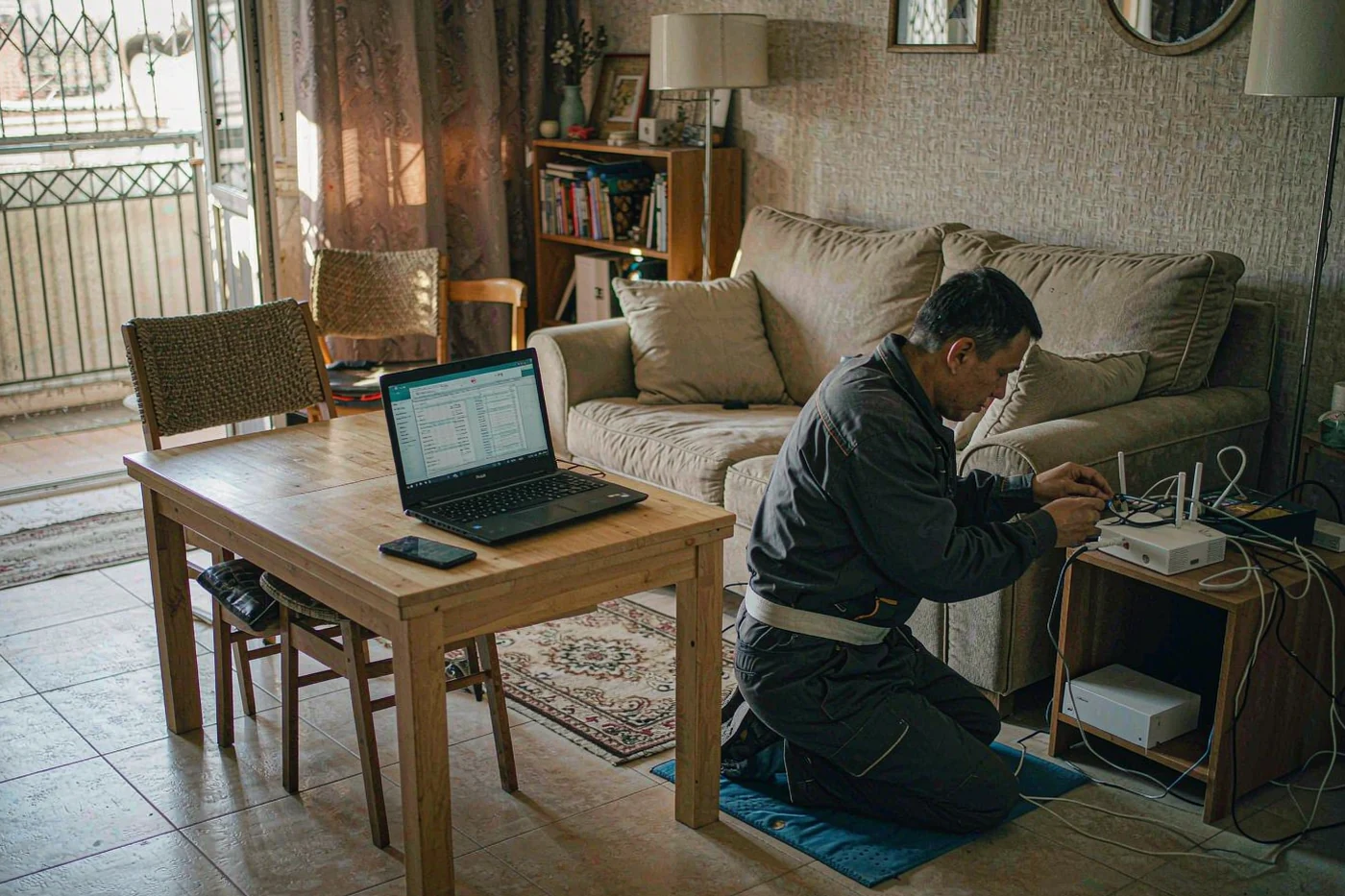
From booking to working internet is usually one to five working days. The technician phones first — this is exactly why the mobile number matters. On the day he runs fibre from the building riser to a wall socket, which can mean a small hole through a wall or a window frame (clear that with your landlord before, not after, if you care about your deposit), mounts the 光猫 — the optical modem, sometimes a combined modem-and-router gateway — powers it up and registers it to your account. Higher tiers often include a Wi-Fi 6 gateway; entry tiers may come with a basic box that struggles with Beijing's thick concrete walls. Be there, and do not let him leave until you have tested the line.
Two things surprise people. The first is upload. Entry packages often cap upstream at a fraction of the download figure — around 30 Mbps is a commonly quoted number on cheap tiers — and that is the figure which decides whether your video calls, large uploads and remote desktop actually work. If you work from home, buy on the uplink and not on the headline number. The second is coverage. The free gateway is one box placed wherever the fibre enters, usually inside a cabinet or behind the television. In a Beijing flat with 20–30 cm concrete walls, one box rarely covers the whole place. A decent router of your own is cheap: TP-Link, Xiaomi and Huawei Wi-Fi 6 models in the ¥150–400 range are on JD everywhere with next-day delivery, and a mesh pair is the usual answer for a three-bedroom. One more thing worth knowing before you plan anything clever: home lines generally do not hand you a public IPv4 address. ⚠️ 待人工确认
The standard commitment is 12 or 24 months. Some carriers also sell multi-year price-lock packages — two, three or even five years — which are genuinely cheaper per month if you are certain you are staying that long. Pin down three things in writing before you pay: the 合约期, the 违约金 you owe if you end early, and the price the plan renews at after the promotional period. A converged bundle also ties the broadband to your mobile number: stop paying the phone and the broadband goes off with it. And watch for auto-renewal — annual packages often roll into another term rather than simply ending.
Leaving the country is where this gets expensive, because a fixed-line account in your name does not close by itself and is very hard to close from abroad. There are three exits, in ascending order of cost. 移机 — if you are only moving within Beijing, the carrier relocates the service to the new address for a flat fee, usually far less than breaking the contract. 过户 — transfer the account to your landlord or the next tenant at a carrier store; they take on the contract and you walk away clean. 销户 — cancel outright: return the 光猫, the set-top box, the remote and the cables to a carrier-owned 营业厅, settle any balance and collect your deposit. Whichever you pick, do it while you are still in China and not in your final week: the store visit, the equipment check and the refund all happen in person, and you want the receipt in your hand.
If this was useful, these cover the questions that usually come next: