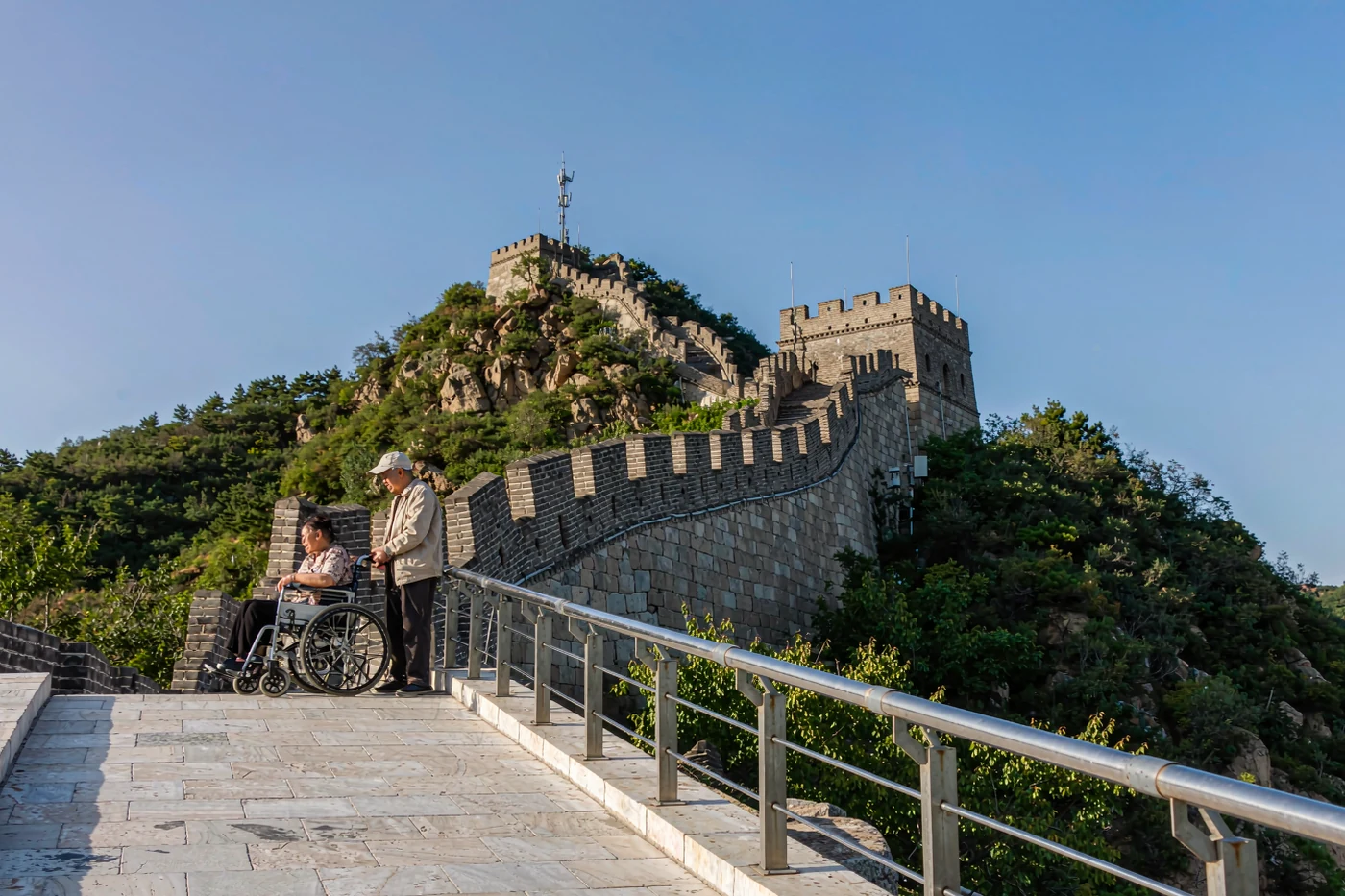
Explore Beijing / The Great Wall With Limited Mobility: Which Sections Actually Work
The Great Wall With Limited Mobility: Which Sections Actually Work
Badaling and Mutianyu have genuine step-free routes: lifts, funiculars, accessible shuttles and free wheelchair loans. Which stretches really work, what it costs, and how to plan the day.
12 min read · KOULING's Beijing Travel Guide
The Great Wall is the one Beijing sight nobody wants to skip, and the one that most often defeats anyone who walks slowly, uses a wheelchair or travels with someone who does. Start with two facts. Two sections have been rebuilt with genuine step-free routes, so on a good day a wheelchair user can stand on the wall itself and look down the ridgeline. And the standard tour-bus day gets almost every practical choice wrong — wrong gate, wrong cable system, wrong stretch of wall. This guide sets out the two routes that really work, the sections to cross off your list, and how to book, time and kit out the day so nobody in the group ends up watching from the car park.
Three separate obstacles, not one
People plan for the wall itself and get caught out by everything around it. There are four stages to this day and each one needs a decision made in advance.
Car park to ticket gate — Private cars stop at remote car parks at both Badaling and Mutianyu. The free transfer shuttles are step-free and usually the best option, but you have to know they exist.
Getting up onto the wall — This is the lift and cable decision. Badaling has both an aerial cable car and a rail-based ground funicular; only one of them works well. Mutianyu has an enclosed gondola and an open chairlift.
Moving along the top — Restored brickwork, uneven surface, steps of wildly different heights and almost no handrails. The genuinely flat stretches are short and you need to know where they start and end.
Getting back down — The wall is linear, not a loop. Every step-free option here is an out-and-back, so budget roughly the same energy and time for the return even though it feels like you are redoing nothing new.
Badaling — the most step-free-friendly choice
Badaling is the busiest and most rebuilt section, which is exactly what you want here: it has a vertical lift, a rail-based ground funicular and the clearest documented wheelchair route on the wall. It also has its own high-speed rail station, so you skip hours of road traffic. It is never quiet — go on a weekday and arrive at opening to get the aide distance you need.
Metro
High-speed train from Qinghe or Beijing North to Badaling Great Wall station; free shuttle from the car parks; bus 877/880/919
Opening hours
Peak season (1 Apr–31 Oct) roughly 06:30–16:30; off-season (1 Nov–31 Mar) roughly 07:30–16:00 — check current times before you go
Tickets
Entry around CNY 35–40; one-way cable car or ground funicular around CNY 100; combined entry plus return around CNY 180 (verify at booking)
How long
Half day — 3 to 4 hours gate to gate
Badaling's step-free route, stage by stage
This is the sequence the two access upgrades were built for. Show it to a member of staff at each stage — they will point you the right way, and the route is signed in Chinese characters.
Visitor service centre — Borrow a wheelchair here. Loan is free after you register your ID and leave a refundable deposit — sometimes cash only, so carry a few hundred RMB. Stock is limited and goes early in the day.
Accessible entrance — A flat, step-free approach to the ticket check, separate from the main queues. Seniors and disabled visitors can use the priority lane with ID, which also works for the companion pushing the chair.
Vertical lift to the East Platform — A dedicated accessible lift gets you up off the plaza. If it is out of service, the fallback is a designated accessible ramp near the Wangjing Stone — a real push, not a substitution. Ask before you commit.
South-line ground funicular — Not a hanging gondola: a rail-based cabin that runs to South Tower 4 in a few minutes. Wheelchairs roll straight in and can be secured, so there is no transfer out of the chair.
South Tower 4 and the Hero Stone — The gentlest usable stretch and the photo everyone wants. For wheelchair users this is realistically the end point, and it is enough — you are standing on the Great Wall.
Where to stop going further — Past South Tower 4 the southern line returns to steps and gradients, and everything beyond North Tower 4 gets steeper still. Treat the funicular top as the limit rather than negotiating it on the day.
Return the same way — Reverse the route and ride back down. Allow 30 to 45 minutes of slack before the last entry checks, and check the funicular's closing time when you buy tickets.
Mutianyu — the gentler crest, harder logistics
Mutianyu is greener, better preserved and far quieter than Badaling, and its upgrades are serious: an accessible shuttle that takes a wheelchair unfolded and straps it in, and an enclosed gondola up to Tower 14. The catch is logistics. There is no metro or train, and the road journey runs about 70 to 90 minutes each way from central Beijing. Once you are up, the usable flat window is short but beautiful.
Metro
No metro or train — tourist coach, private car or Didi; accessible shuttle runs from the car park to the entrance
Opening hours
Peak season (16 Mar–15 Nov) roughly 07:30–18:00 weekdays, 18:30 weekends; off-season roughly 08:00–17:30 — ticket sales stop an hour before closing
Tickets
Entry around CNY 40–45; gondola around CNY 100 one-way and CNY 140 return; bundles with shuttle and return gondola around CNY 200 (verify at booking)
How long
Full day — 8 to 9 hours door to door
Mutianyu's workable route — and three things to refuse
Mutianyu sells three ways up and down, run by separate operators whose tickets do not transfer. Only one of them suits limited mobility, and choosing wrong costs you the day.
Accessible shuttle bus — Runs between the car park and the entrance. Wheelchairs board unfolded and are strapped in rather than folded into a boot. Tell staff at the car park and they will bring it round.
Enclosed gondola, not the chairlift — Buy the western line (cable car to Tower 14): a closed cabin with your feet inside. The eastern line's open chairlift leaves your feet dangling and cannot be boarded by most people who need the chair.
The toboggan is off the table — The famous slide down requires transferring, bracing and braking yourself on an open track. Cross it off and descend the way you came, even though everyone else is doing it.
Tower 14 toward Tower 15 — The gentle stretch along the crest with the classic view. Beyond Tower 15 the ridge climbs and the steps get serious, so turn around there.
Same-cabin return — Come back to Tower 14 and ride down. There is no loop route and no step-free way off the crest at the far end.
Sections to cross off the list
None of the following publishes a step-free route, so assume steep, uneven steps with no lift and no ramp. If a driver or a ticket seller suggests one of them as easier, the honest answer is that it is closer, not easier.
Juyongguan — Closest to the city and often sold as the easy option. It is fully restored but short and steep with no lift — harder to work with than Badaling once you are on it.
Jinshanling and Gubeikou — The best walking for strong legs: part-restored, part-wild, long distances between towers, no assistance of any kind. Rule them out for this trip.
Jiankou — Collapsing wild wall with exposed drops, not open to casual hiking; rescues happen most years. Do not attempt it under any circumstances.
Simatai — The night-tour section is steeply stepped and dimly lit, with no step-free alternative published. Save it for another visit with different companions.
Huanghuacheng water wall — Famous for sections running into the reservoir: slippery stone, dam crossings and uneven ground. Not advertised as accessible and not a realistic substitute.
Booking, documents and the words that unlock help
Both sections use real-name reservation tied to your travel document, and both release daily quotas. Sorting paperwork the night before removes most of the friction at the gate.
Book with your passport — You can usually reserve several days ahead on the official mini-programs or via the big travel platforms. One ticket per ID per day, and you need the physical passport at the gate.
Expect to pay for the companion — Concession and free-entry categories are largely written for PRC residents and specific groups such as people with disabilities holding local certificates. Do not assume a foreign passport qualifies — ask at the ticket office instead.
Four phrases worth screenshotting — Wheelchair 轮椅, accessible route 无障碍通道, accessible lift 无障碍电梯, priority lane 绿色通道. Showing the characters beats attempting the tones.
Phone ahead the day before — Numbers change, so check them on the official listing: Badaling and Mutianyu each publish an enquiry line. Ask one question — is the accessible lift or funicular running tomorrow? A lift outage changes the entire plan.
Bring cash and ID for the loan — The free wheelchair loan needs registration plus a refundable deposit, which some counters take in cash only. A few hundred RMB in notes solves it.
Getting there without exhausting everyone
The journey is where accessibility usually breaks down, not the wall. Rank your options by how much standing, queueing and carrying they involve rather than by headline travel time.
High-speed train to Badaling — Qinghe to Badaling Great Wall station takes roughly 20 to 25 minutes, Beijing North about 30 to 40. The stations are new and step-free, which makes this the least tiring option — but you still need a shuttle or short road transfer at the far end.
Bus 877 from Deshengmen — Cheap and direct, no lift assistance and long queues, plus a walk at the far end. Reasonable for slow walkers with a strong companion, poor for wheelchair users.
Tourist coach to Mutianyu — Several operators run fixed morning departures from central Beijing; some put latest availability discounts on mini-programs. Ask specifically whether they can carry a folded wheelchair and where exactly the drop-off is.
Hire a car for the day — The most controllable choice: roughly CNY 600 to 900 for a sedan covering 8 hours and 100 km. You set the departure time, you own the boot space, and you can cut the day short without hunting for a bus.
Timing the day so nobody runs out of legs
The Wall sits several degrees below city temperature, is far windier than anything between buildings, and has nowhere to shelter. Plan backwards from the weakest walker, not the strongest.
Arrive at opening — Both sections get their quietest hour in the first 60 to 90 minutes. Group arrivals land late morning and change everything about how much space you have to move.
Avoid weekends and Golden Weeks — Skipping the first week of October and the May holiday matters more than any other single choice you make about this day.
Map the accessible toilets — Accessible stalls sit at the visitor centres, the cable stations and the main viewing platforms — not up on the wall. Work your route around them.
Layers and warm hands — Exposed stone, wind and no shade or shelter. Even in autumn, gloves and a windproof outer layer make the difference between an hour and a morning.
If the wall itself is not possible
Sometimes the answer is that the crest is out of reach that day. All is not lost — the Great Wall still delivers from the ground, and there are genuinely good alternatives within the same trip.
China Great Wall Museum at Badaling — Free, indoors and on flat ground inside the Badaling complex, covering how the wall was built, garrisoned and supplied. Check current opening before you go — it has closed for refurbishment for long stretches.
Watch from the valley floors — The lower plazas and staged viewing areas at both sections give you the full ridgeline without climbing a single step, and they photograph extremely well.
Exoskeleton climbing aids — Badaling has been trialling wearable robotic exoskeletons to help visitors with limited leg strength manage steeper stairs. Availability, eligibility and price shift constantly — ask at the visitor centre or check official channels. ⚠️ 待人工确认
Send one person up — Agree a fixed meeting point with benches, hot water and accessible toilets, then let whoever can climb go at their own pace. Base plazas at both sections work well for this split.
What to pack that you would not bring on a normal Wall trip
Cushion and grip gloves — Brickwork is hard and vibrates under small wheels, and the ramps are long. A padded cushion plus proper gloves makes the difference between tolerable and miserable.
Tyre pump and puncture kit — There is no repair service at either gate, and a flat kilometres from the car park ends the day immediately.
Sun cream, hat and wind layer — Full exposure on the ridge with nothing to duck behind. The wall runs several degrees cooler than Beijing but bakes harder in direct sun.
Water, snacks and any medication — Options up top are few and expensive. Carry what you need and check the pharmacy situation the night before.
A second pair of hands — Plan for one or two helpers, not one. Pushing a chair along brick and steps, managing bags and finding the next stage is beyond a single companion.
Screenshots, not spoken Chinese — Save the characters for what you need on your lock screen. Showing them to staff moves things along far faster than trying the tones and hoping.