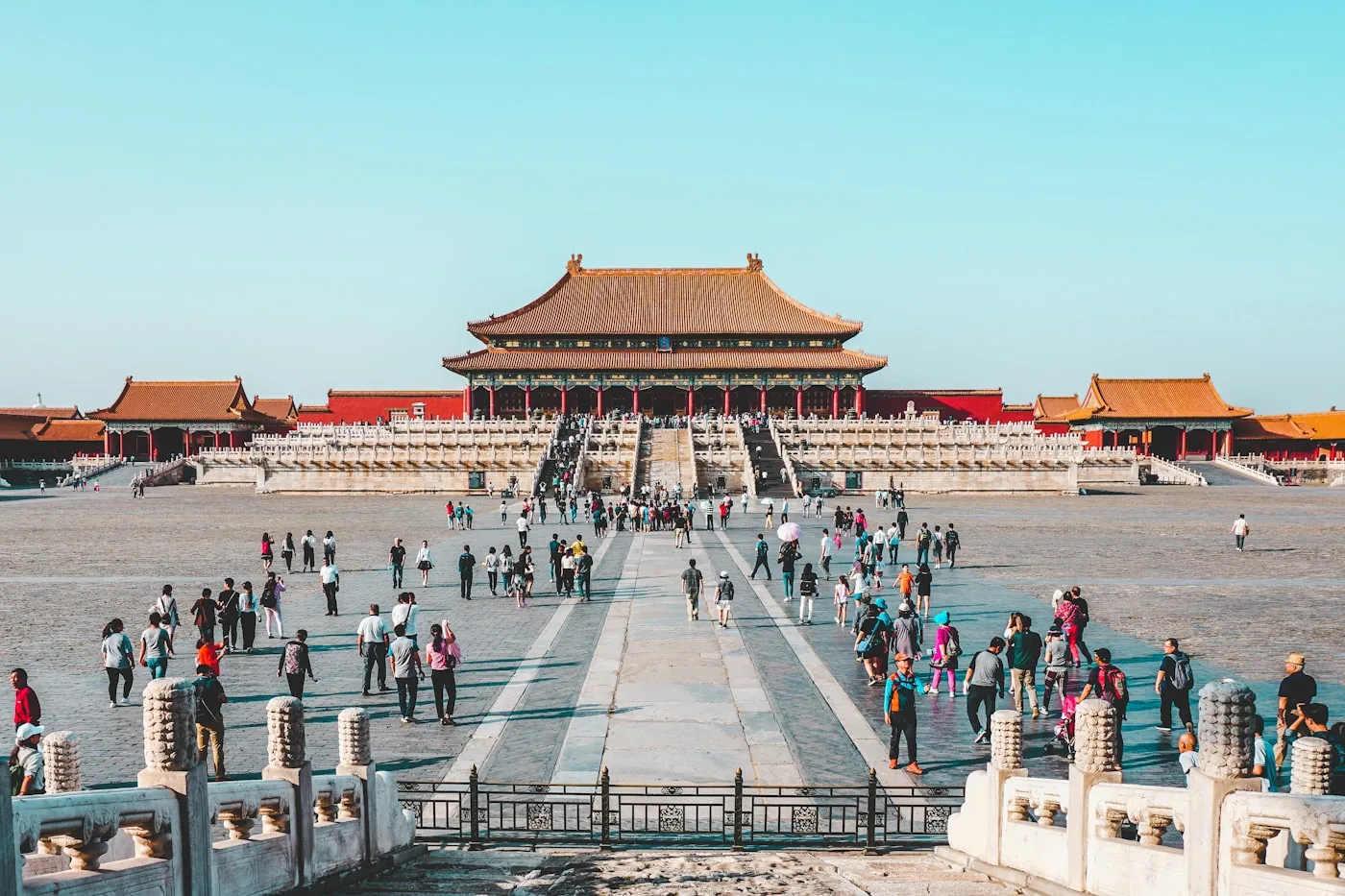
How to visit the Forbidden City: tickets, entry gate, the one-way route and how long to allow.
The Forbidden City was the imperial palace for 24 emperors across almost 500 years, and it is the single most visited sight in Beijing. It is also one of the few places where a bit of planning genuinely changes the day — tickets sell out and the route is one-way.
You enter from the south, walk north through the complex and exit at the north gate. Plan what you do afterwards around that.
Enter at the Meridian Gate (午门), cross the inner courtyards to the Hall of Supreme Harmony — the largest and most famous hall — then continue through the inner courts to the Imperial Garden and out at the Gate of Divine Prowess. The Palace of Heavenly Purity and the Treasure Gallery are worth the detour.
Tickets are released up to seven days in advance on the official WeChat mini-program (故宫博物院) or website, and they sell out fast — weekend and holiday slots often go within hours of release at 8pm Beijing time. Foreign visitors without WeChat Pay or Alipay can still book online: the site accepts international cards, and you enter your passport number, which is also your ticket. There is no paper ticket; at the Meridian Gate you walk through a dedicated passport-check lane for foreigners, usually faster than the QR-code lines. Standard adult entry is 60 yuan April to October and 40 yuan November to March. The Treasure Gallery and Clock Gallery inside cost an extra 10 yuan each and can be added at booking or bought inside. If you arrive without a booking, do not queue at the gate — walk to the Meridian Gate ticket office, where a small number of same-day foreign passports are sometimes accepted, but treat this as a last resort.
The standard ticket covers the central axis from the Meridian Gate to the north gate, including the three great halls and the Inner Court. It does not automatically include the two paid side galleries. Of these, the Treasure Gallery in the Palace of Tranquil Longevity (10 yuan) is worth the money for its jewellery, imperial seals and the Nine-Dragon Screen nearby; allow 30–45 minutes. The Clock Gallery is skippable unless you have a particular interest in European automatons. Other free extras worth knowing: the Ceramics Gallery in the Martial Valor Hall (Wuying Dian) on the west side is rarely crowded, and the small Gallery of Historic Architecture near the east gate shows how the palace was built. The forced one-way route means you cannot loop back to the south side, so make gallery decisions before you pass the Hall of Preserving Harmony — most paid galleries sit in the northeastern quarter, and doubling back is not permitted.
The palace admits visitors from 8:30am and the first hour is the calmest: tours from outside the city rarely arrive before 10am, and day-trippers from Shanghai or overnight trains flood in around 10:30. If you cannot get an early slot, aim for the last admission window (after 2pm in high season, around 3:30pm off-season) — the courtyards noticeably empty by 3:30 and the light turns warmer for photography. Mondays are closed, so Sunday afternoon and Tuesday morning carry overflow weekend crowds. Avoid the first week of October (National Day) and the Labour Day week entirely; during these periods the courtyards are shoulder-to-shoulder and the side galleries develop queues of their own. Winter, though cold, is the most forgiving season: January weekday mornings can feel almost private, and patches of snow on the golden roofs are a photographer's prize. Check the official site for occasional full-day closures around major state events.
If you found this useful, these cover the next question most visitors ask: