Explore Beijing / Cooking in Your Beijing Rental: What Short-Term Kitchens Actually Have (and Where to Buy Everything)
Cooking in Your Beijing Rental: What Short-Term Kitchens Actually Have (and Where to Buy Everything)
Most Beijing short-term rentals have a bare-bones kitchen: a two-burner induction or gas hob, a kettle, and not much else. Here's what to expect, plus where to buy cookware, cooking oil and everyday staples.
6 min read · KOULING's Beijing Travel Guide
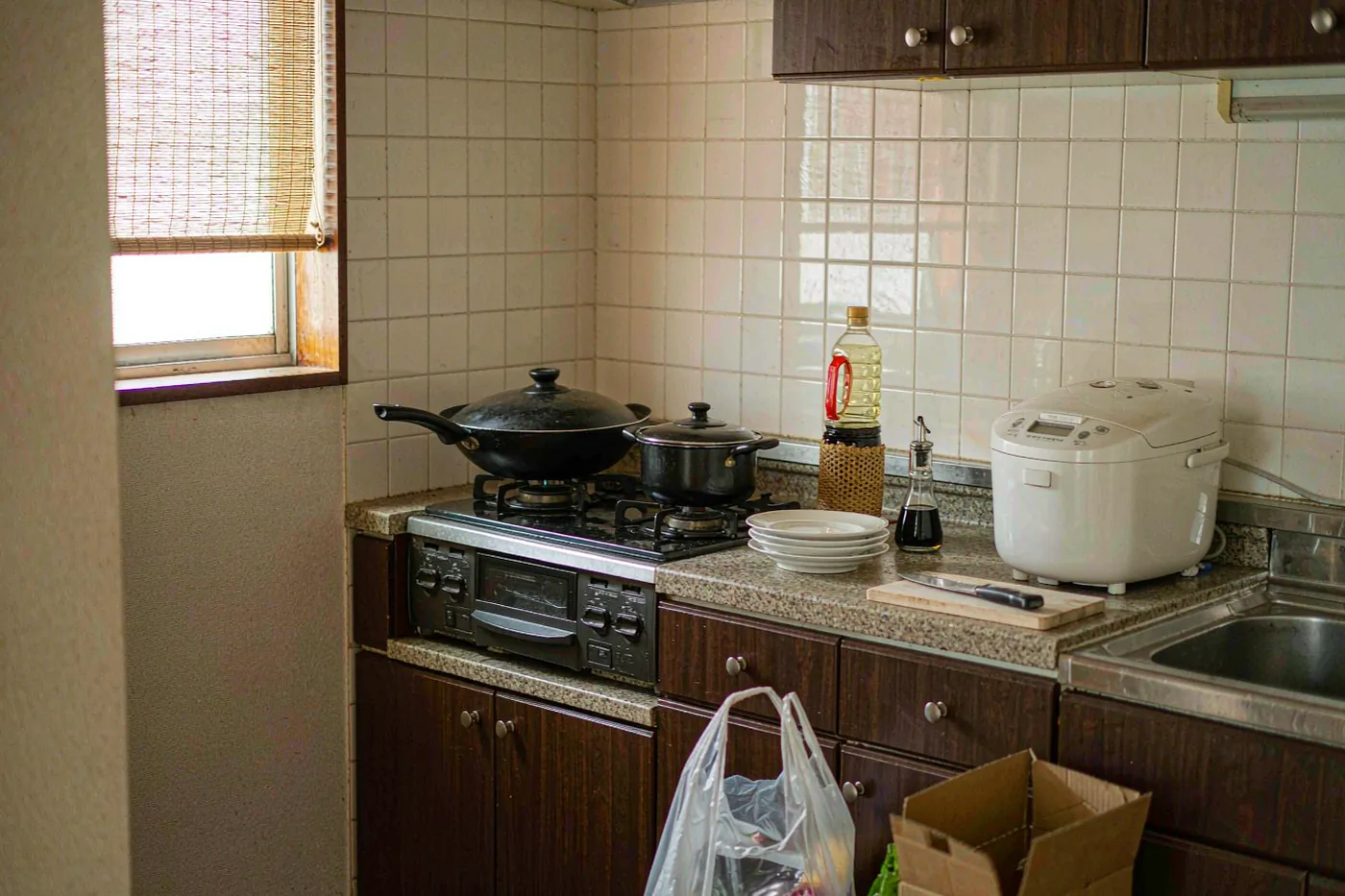
If you're staying in Beijing for more than a week, cooking even a few meals at home saves money and gives your stomach a break from restaurant salt and oil. But temper your expectations: a 'kitchen' in a Chinese short-term rental often means a counter with a two-burner induction or gas hob, a range hood, a kettle, and a rice cooker — and frequently no pots, no pans, or a single battered wok. This guide covers what you'll typically find, what to buy first, and where to shop, from supermarket chains to delivery apps.
What a Typical Beijing Rental Kitchen Actually Has
Most apartment rentals aimed at stays of a week or more include the built-in basics but little in the way of cookware. Don't assume anything — ask your host or hotel-serviced apartment front desk before you shop. Typical inventory:
Two-burner induction or gas hob — Induction is common in newer buildings; gas is common in older ones. If you've never cooked on induction, note that pans need a flat, magnetic base.
Range hood — Chinese cooking generates serious smoke. Always switch the hood on before you start, or you may trip a smoke alarm or annoy the neighbours.
Kettle and rice cooker — These are near-universal. A rice cooker can also steam vegetables and boil eggs, which stretches thin cookware further.
Mismatched or minimal cookware — Expect one wok or one pot at best, sometimes none. Plates, bowls and chopsticks are usually provided; knives, cutting boards and utensils often are not.
Small fridge — Single-door fridges are the norm. Plan to shop every two or three days rather than doing one big weekly haul.
No oven, no microwave (sometimes) — Ovens are rare in Chinese homes. Microwaves appear in serviced apartments but are not guaranteed — check photos or ask [verify before travel].
Your First Shopping Trip: What to Buy and Rough Costs
Your starter kit can cost well under CNY 200 (about US$30) if you keep it simple. A supermarket like Hema (盒马), Walmart China, or a local hypermarket such as Wumart (物美) or BHG will cover everything in one trip. Local wet markets and neighborhood fruit-and-veg stalls are cheaper for produce [verify before travel]. Rough price guides:
Basic cookware set (wok or pan + pot) — CNY 100–150 (US$14–21) for serviceable basics at a supermarket or on JD.com/Taobao. Non-stick pans are widely available.
Cooking oil — A bottle of sunflower or blended oil runs about CNY 20–40 (US$3–6). Peanut and rapeseed oil are also standard. Skip 'cold-pressed' boutique oils unless you want to pay for them.
Rice and noodles — A 2–5 kg bag of rice is roughly CNY 15–40 (US$2–6); a pack of fresh noodles costs just a few yuan.
Soy sauce, vinegar, salt, sugar — Basic condiments are cheap: CNY 5–15 (US$1–2) per bottle. Light soy sauce (生抽) and Chinkiang black vinegar (香醋) cover most needs.
Eggs, vegetables, tofu — Eggs run around CNY 10–15 (US$1.50–2) for ten; seasonal vegetables are often CNY 2–8 (US$0.30–1.10) per 500 g; tofu is a few yuan a block [verify before travel].
Knife and cutting board — CNY 30–60 (US$4–9) combined if the apartment doesn't have them. A basic Chinese cleaver is genuinely the most useful single tool here.
Shopping Without Speaking Chinese
Self-catering is very doable for non-Chinese speakers, especially in Beijing. A few habits make it painless:
Use screenshot translation — Show a translated shopping list on your phone, or photograph product labels and let a translation app read them. Staff at big supermarkets are used to pointing, not chatting.
Try the delivery apps — Meituan (美团) and Ele.me (饿了么) deliver groceries and takeout; JD.com and Taobao are best for cookware delivered next-day. Most require a Chinese phone number and a local payment method [verify before travel].
Set up mobile payment first — Alipay and WeChat Pay both accept international cards now, and small markets may not take cash comfortably. Set this up before your first shop [verify before travel].
Look for Hema and Sam's Club — Hema (盒马) stores have clear pricing, fresh seafood, and in-app English-friendly interfaces in some districts. Sam's Club membership warehouses suit longer stays [verify before travel].
Mind the plastic-bag charge — Bring a reusable bag or pay a small fee (usually CNY 0.2–1 / under US$0.15) per bag — cash may be awkward for such small amounts.
Hema (盒马) Supermarket
Alibaba's fresh-food chain is the easiest one-stop shop for first-timers: wide aisles, clear prices, ready-to-cook meal kits, and produce priced per box. Stores cluster in residential and shopping districts across the city; confirm the nearest branch and its hours in the app [verify before travel].
Metro
Multiple branches across Beijing; check the nearest station on a map app before heading out [verify before travel].
Opening hours
Typically 09:00–22:00, but hours vary by store [verify before travel].
Tickets
Free entry; groceries typically CNY 30–80 (US$4–11) per person for a simple meal's ingredients.
How long
30–60 minutes for a full shop
Wumart (物美) or Local Hypermarket
Wumart is a mainstream Beijing supermarket chain with locations in most residential areas — good for pantry staples, oil, cleaning supplies and cookware at slightly lower prices than premium chains. Staff rarely speak English, so bring your translated list. Some branches include a small homeware section [verify before travel].
Metro
Branches are neighborhood-based; confirm your closest location and line on a map app [verify before travel].
Opening hours
Commonly 08:00–22:00; varies by store [verify before travel].
For the freshest, cheapest produce, eggs and tofu, a neighborhood wet market beats any supermarket — vendors routinely sell to foreigners with nothing more than pointing and a calculator. Go in the morning for the best selection, bring small bills or mobile payment, and expect slices of English conversation to be rare but gestures to work fine. Ask your host or front desk for the nearest 菜市场 [verify before travel].
Metro
Usually a short walk or e-bike ride from residential blocks; confirm location locally [verify before travel].
Opening hours
Typically 06:00–18:00, winding down by late afternoon [verify before travel].
Tickets
Free entry; vegetables CNY 2–8 (US$0.30–1.10) per 500 g, eggs about CNY 10–15 (US$1.50–2) for ten [verify before travel].
How long
20–40 minutes
Kitchen Survival Tips for First-Timers
Buy the wok, skip the rest — One good wok handles stir-fry, boiling, steaming (with a rack) and frying. A cheap pot covers rice and soup. That's 90% of Chinese home cooking.
Ventilate aggressively — Open a window and run the range hood on high. Beijing apartments often have sensitive smoke alarms and thin walls — your neighbours will notice a smoky stir-fry.
Season lightly at first — Restaurant food in China is saltier and oilier than home cooking. When recreating dishes, use about half the soy sauce you think you need and adjust.
Drink bottled or boiled water — Tap water is not considered drinkable in China. Use your kettle (most have a boil function) or buy big CNY 2–4 (under US$1) bottled water jugs.
Learn three lifesaver phrases — '这个多少钱?' (How much is this?), '有…吗?' (Do you have…?), and showing a photo of what you want will get you through almost any market.
Check the gas valve if you have a gas hob — Some rentals require you to turn a valve on before cooking and off afterward. Ask your host to demonstrate on day one.