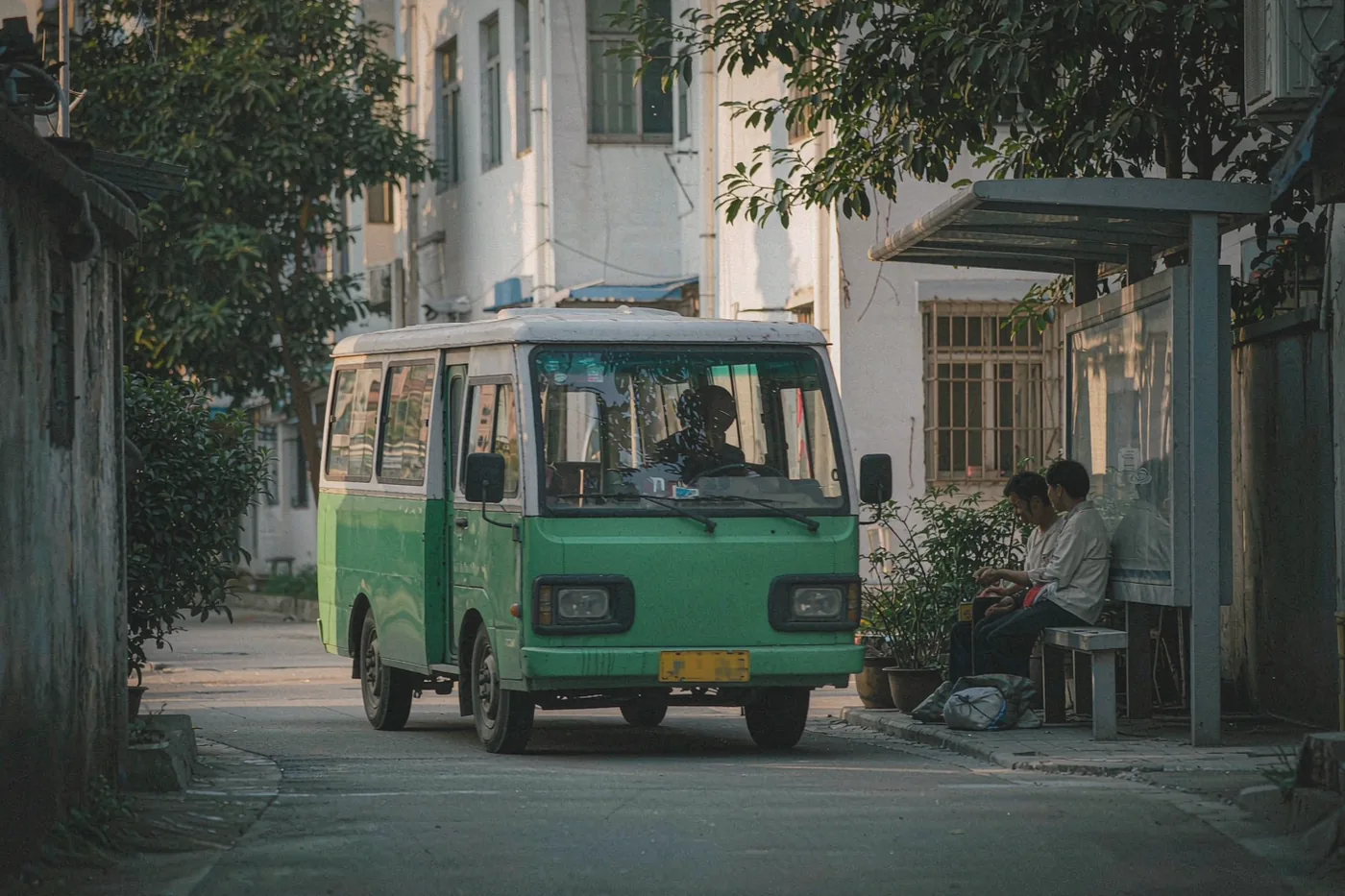
Explore Beijing / Riding Neighbourhood and Community Minibuses in Chinese Cities
Riding Neighbourhood and Community Minibuses in Chinese Cities
Small community shuttles — often called 'weixunhuan' or micro-circulation buses — plug the last-kilometre gaps that metro lines can't reach. Here's how first-time visitors can hop on with confidence.
4 min read · KOULING's Beijing Travel Guide
Beyond the gleaming metro system, Chinese cities run a second, quieter network: short neighbourhood buses known as 微循环巴士 (micro-circulation buses) or community minibuses. They wind through hutongs, residential compounds and market streets that trains can't reach, typically costing just 1–2 CNY (roughly $0.15–$0.30). For visitors, they're a cheap, fascinating window into everyday local life — but they work a little differently from the buses you may know at home.
What Exactly Is a Community Minibus?
These are small vehicles — often 8- to 20-seat electric shuttles — running short loop routes of a few kilometres around a metro station, a market, or a cluster of residential blocks. Routes are numbered like ordinary buses or given local nicknames, and stops are usually simple unmarked poles or shared stops with regular bus lines. They exist precisely because the big buses and trains skip the narrow streets, so expect tight turns, short hops and a very local crowd of retirees, schoolkids and shoppers.
Size and feel — Small electric vans or minibuses; on popular routes you may stand, squeezed in with locals.
Route length — Loops are typically 2–5 km (1.2–3 miles), taking 15–30 minutes end to end.
Fare — Usually 1–2 CNY (about $0.15–$0.30); some cities accept transit cards and mobile payment, others are cash-only [verify before travel].
Who rides — Mostly residents doing daily errands — you'll rarely see other tourists, which is part of the charm.
Finding Routes and Stops
Unlike metro lines, community minibus routes are poorly documented in English, so a little preparation goes a long way. Your best tools are Chinese map apps, which show real-time bus positions, and the route signboards at the stops themselves.
Map apps — Amap (Gaode) or Baidu Maps show nearby bus routes and live vehicle locations; set the app to bus mode and zoom into your neighbourhood. English support is limited, so save your destination in Chinese characters.
Stop signs — Look for small yellow or green signs listing several short routes with loop diagrams. Route numbers are often low or letter-prefixed and differ from regular bus numbering.
Ask locally — Compound guards (show them your destination on your phone), shopkeepers, or a hotel front desk can tell you which loop passes nearby. Have your destination written in Chinese.
Timing — Headways vary from 5 to 20 minutes by city and time of day; service often winds down early, around 19:00–20:00 [verify before travel].
Boarding, Paying and Riding Etiquette
The mechanics are simple once you've done it once, but a few habits will make the ride smoother for you and everyone else.
Flag it down — At unofficial stops, raise your hand as the shuttle approaches — drivers only stop if someone is waiting or alighting.
Payment — Many shuttles take the city transport card, or QR-code payments via Alipay/WeChat; some small vans are cash-only with exact change [verify before travel]. Board at the front on most routes.
Seating — Offer your seat to elderly passengers — this is strongly expected, and younger riders will routinely stand for seniors.
Alighting — Say or shout 'dao le' (到了吗, 'are we there?') toward the driver near your stop, or press the bell if fitted; drivers may not stop at minor poles otherwise.
Peak hours — Around 07:30–09:00 and 17:00–19:00 shuttles fill with commuters; mid-morning and early afternoon are the relaxed times to ride.
Cities and Neighbourhoods Where Minibuses Shine
Community shuttles are most useful where streets are narrow and metro stations sit a 15-minute walk apart. A few kinds of places where visitors genuinely benefit:
Old hutong districts (Beijing) — Short shuttle routes thread lanes that full-size buses can't enter; useful around areas like the Drum Tower and Nanluoguxiang fringes [confirm current routes locally].
Old town quarters (e.g. Suzhou, Xi'an) — Micro-loops connect metro stations to canal-side streets and city-wall gates [verify current routes].
University and market areas — Campus towns and wholesale markets often run free or 1 CNY internal shuttles [verify before travel].
New residential districts — In newer suburbs, shuttles link apartment blocks to the nearest metro — handy if you're staying outside the centre.
Related Beijing guides
If you found this useful, these cover the next question most visitors ask:
Have a backup — Minibuses can be infrequent or rerouted; know the walking route to a metro station as a fallback — loops rarely exceed a 15-minute walk.
Screenshot your stop — Save the Chinese name of your stop and destination; drivers and fellow passengers can't help with English addresses.
Small notes only — If paying cash, use 1 CNY coins or notes; drivers don't carry change for larger bills.
Mind the rush — Avoid 07:30–09:00 if you dislike close quarters; the shuttles get genuinely packed.
Keep your card handy — Tap or scan when boarding, and hold on — acceleration in these small electric vans is brisk.
Off-peak exploring — A mid-morning loop ride is one of the cheapest city tours you can take at 1–2 CNY (under $0.30).