How to book, check in and board a Chinese domestic flight with a foreign passport: counter check-in, the 20 kg baggage standard, the new no-bag fare traps, and the liquids rules.
Flying from Beijing to Xi'an, Chengdu or anywhere else inside China with a foreign passport is completely normal - millions of segments are flown this way every year. But the failure points are specific, and none of them are obvious until you are standing at a counter: the booked name must match the passport character for character, the self-service kiosks often cannot read a foreign document, and since 2025 a growing share of cheap fares ship with no checked baggage at all. This guide walks the whole chain - booking, counter check-in, security, baggage - with the numbers that matter. For batteries and power banks at security, see our dedicated guide; for making a connection, see the transfer guide.
When booking, pick passport as your document type and enter the number exactly as printed, letters included. The name must match the passport exactly - not a nickname, not a shortened form, not transposed surname and given name. A mismatch is the commonest reason a foreign passenger is refused at check-in, and it cannot be fixed at the desk; the ticket has to be reissued. On Chinese booking forms the field is usually labelled 证件号码 (document number): that is where the passport number goes. Two practical notes: enter your surname in the surname field even if the form seems to expect a different order - what matters is that each name sits in its own field as printed in the passport's machine-readable zone; and keep a screenshot of the confirmation showing the passport number, because ground staff will ask for it when the app shows only a Chinese ID mask. Global platforms like Trip.com handle passports smoothly; the Chinese airline apps (Air China, China Eastern, China Southern) accept them too, but some WeChat mini-program booking flows require a mainland ID or phone number - book through the app or website instead.
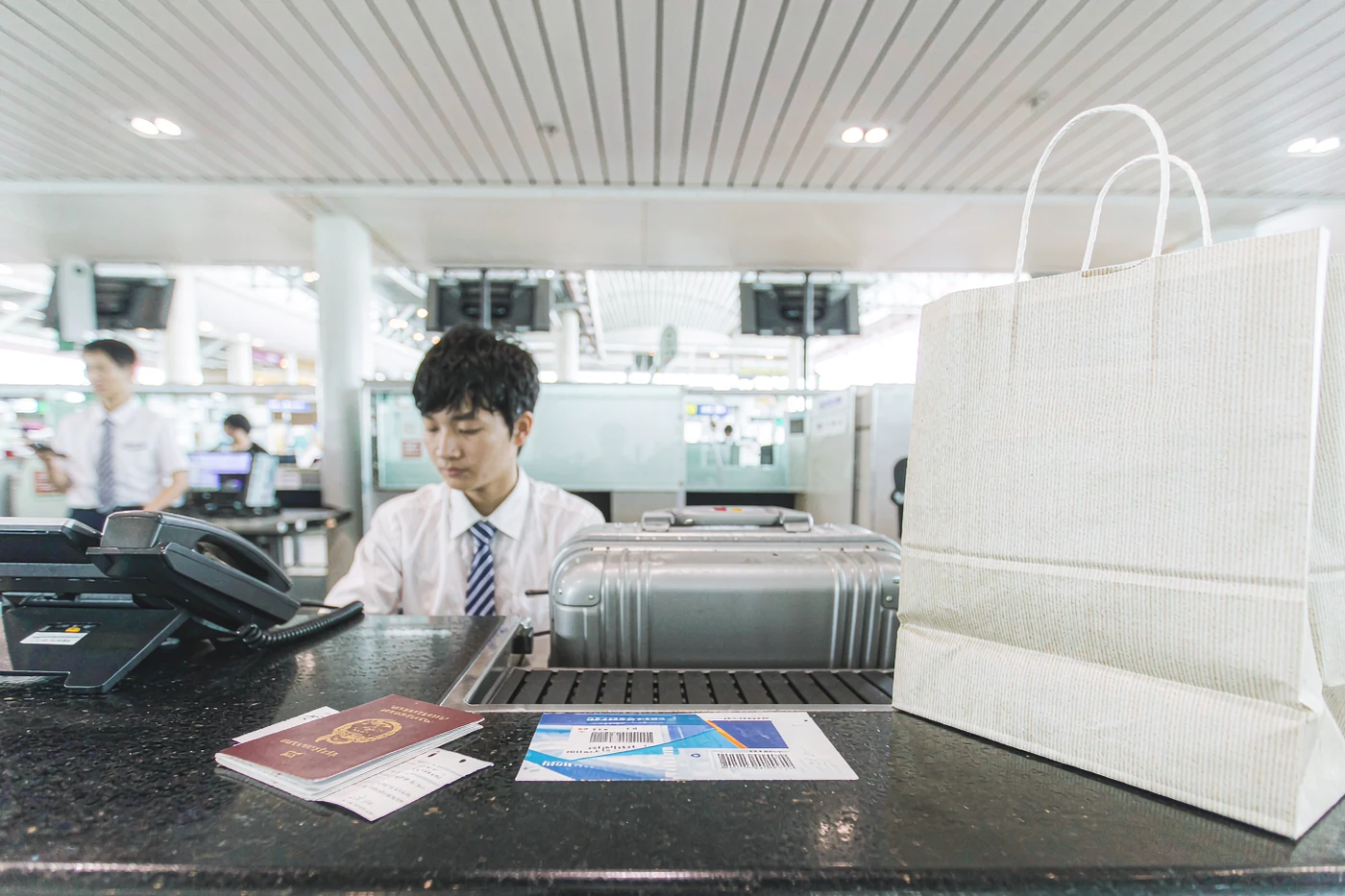
Treat the staffed counter as the default, not the fallback. Self-service kiosks at many airports cannot process a foreign passport, and online check-in is similarly unreliable for non-Chinese documents - the airline app may let you check in but still refuse to issue a usable mobile boarding pass. The reliable path: go to the check-in counter with the physical passport, get a paper boarding pass, and check any bags at the same time. Allow an extra fifteen minutes for the queue. A photo, photocopy or scan of the passport is not accepted - the physical document is what you check in with, clear security with, and board with. Counters for the full-service carriers typically open about two hours before departure and close 40-45 minutes before [verify] - the exact cut-off varies by airport and airline, so confirm the number printed on your confirmation.
For a domestic departure, two hours before is the planning floor, not padding. The stages that eat time with a passport: the check-in queue (self-service is not an option for you), a manual document check at security, and walking distances that at Beijing's two airports run long. Boarding usually begins about 30 minutes before departure and gates close roughly 15 minutes before. Two timing habits worth copying from frequent flyers: book the earliest departure of the day you can tolerate, because delays cascade through the day and morning flights are markedly more reliable; and build extra buffer around Golden Week and Chinese New Year, when every queue doubles. If you are connecting from an international arrival, budget separately - our transfer guide covers that arithmetic.
At security you present the passport and boarding pass together; the inspector checks them manually, you walk through the metal detector, and your carry-on bags go through the X-ray. It is slower than the ID-card lane locals use, which is exactly why the two-hour floor exists. The item rules that catch foreign visitors out: liquids are banned from the cabin on domestic flights, with one narrow exception - personal travel cosmetics in containers of 100 ml or less, one piece per type, presented in a separate bag for an open-bottle check. Anything liquid over that limit goes into checked baggage, so buy water and drinks airside after security, not before. Lighters and matches are banned from both the cabin and checked baggage - smokers genuinely lose the lighter at the checkpoint. Power banks must travel in the cabin, never checked, and since June 2025 must carry a CCC mark [verify] - our power-bank guide covers that in detail. Walking poles, knives and multi-tools are cabin-prohibited but travel fine in a checked bag.
The standard free checked allowance on Chinese domestic flights runs on total weight, not the piece system you may know from transpacific routes: economy 20 kg, business 30 kg, first class 40 kg per passenger. Because it is a weight system, one large suitcase is fine - the usual single-piece limit is 50 kg and 40 x 60 x 100 cm (China Southern's published figure; carriers vary slightly). Infant fares carry no free allowance. Two things to remember: the allowance is per passenger, so a couple can pool 40 kg across two cases; and overweight charges at the airport are steep, so if you know you are over, buying extra allowance online in advance is cheaper than the counter price [verify]. This 20 kg baseline is also the reference point for the next section - because not every fare includes it any more.
Since spring 2025, Chinese airlines have rolled out differentiated baggage fares (行李差异化), and this is the single biggest recent change for anyone comparing prices. Budget carriers led: Spring Airlines and Lucky Air (祥鹏) now include only a small free cabin bag on their cheapest fares - roughly 20 x 30 x 40 cm and 7 kg [verify] - with checked bags sold as paid add-ons bundled to the fare tier. What surprises visitors is that even full-service airlines sell discounted bundles on some routes with little or no checked allowance, so the cheapest fare on the screen is not automatically the 20 kg fare. The consequences are visible at the gate: 20-inch cases marketed as carry-on get refused on these fares because they exceed the small-bag size, and travellers report being charged roughly 180-200 yuan [verify] for forced gate-side checking. The fix is cheap and boring: at booking, look for what the fare includes - a line like 托运行李额 (checked baggage allowance) - and if you plan to check a bag, buy the allowance online then. Airport and gate prices run higher.
On standard full-service fares, economy passengers may take one cabin bag of up to 7 kg measuring no more than 20 x 40 x 55 cm; first and business cabins usually allow two pieces, sometimes at 8 kg (China Southern's published numbers; check your airline). At the counter and security you will see metal test baskets in exactly that footprint - if your bag does not fit, it gets tagged and checked, and on a no-bag fare that means paying. A small handbag, laptop bag or camera bag generally travels free in addition to the cabin bag on full-service carriers [verify]. Practical triage: chargers, full-size toiletries, anything sharp or over 100 ml goes into the checked case; passport, cash and cards, electronics, medication and power banks stay with you. Weigh your bag the night before - 7 kg is less than it sounds once a laptop, camera and a water bottle are in.
A last-mile summary of the item rules that differ from what you might expect at home. In the cabin: passport and documents, cash and cards, all electronics, all lithium batteries and power banks (never checked), medication, and cosmetics under 100 ml per container. In the checked bag: knives and multi-tools, sports gear including trekking poles and umbrella-type pointed items, aerosols, and every liquid over the cabin limit. Banned from both: lighters, matches, flammables, and loose lithium batteries in the hold. E-cigarettes travel in the cabin only and are not allowed to be used onboard [verify]. If you are carrying duty-free liquids bought overseas and transferring to a domestic flight, keep them sealed in the security bag with the receipt - unsealed bottles are confiscated at the domestic checkpoint.