China's domestic airlines enforce some of the world's strictest rules on power banks and lithium batteries, including new CCC certification requirements. Here's how to pack your electronics so they don't get confiscated at security.
If you're hopping on a domestic flight within China — Beijing to Xi'an, Shanghai to Chengdu, or anywhere else — be aware that Chinese security checkpoints apply some of the strictest battery rules in the world. Power banks without valid CCC certification markings have been banned outright since mid-2025 [verify before travel], and even a compliant power bank can be rejected if the printed capacity ratings are worn off or unreadable. This guide explains exactly what you can carry on, what you must check (or leave behind), and how to avoid the frustrating experience of watching a pricey power bank disappear into the confiscation bin.
Since China made CCC (China Compulsory Certification) mandatory for lithium-ion power banks, airlines and airports have been rejecting units that lack the CCC mark or fall under recalled batches. For Western visitors this is the single biggest gotcha: a perfectly good Anker, Mophie, or Samsung power bank bought in the US, UK, or EU usually does not carry the CCC mark, because certification is only applied to units sold in China. Security staff at airports like Beijing Daxing and Shanghai Pudong have been actively checking for the mark on the casing or packaging [verify before travel for the latest enforcement level]. In practice this means: bring a power bank bought in China (with CCC printed on it), or plan to buy one on arrival — they cost roughly CNY 60–200 (about USD 8–30) at convenience stores, JD.com, or airport electronics shops. If you rely on a foreign power bank, carry it anyway and be prepared that it may be confiscated.
The core rule mirrors international standards but is enforced more strictly. All lithium batteries and power banks must go in your carry-on — never in checked luggage. The limits are based on watt-hours (Wh): batteries up to 100 Wh are allowed without approval; batteries between 100 Wh and 160 Wh require airline approval arranged in advance; anything over 160 Wh (or unlabeled) is prohibited. Most consumer power banks are 10,000–20,000 mAh, which works out to roughly 37–74 Wh at 3.7 V — comfortably under 100 Wh. Spare camera, drone, and laptop batteries follow the same Wh rules, and each spare should have its terminals protected (original packaging or tape over the contacts). Drones are a particular gray area: spare drone batteries over 100 Wh need airline approval, and some airlines cap the number of spares [verify with your specific airline before flying].
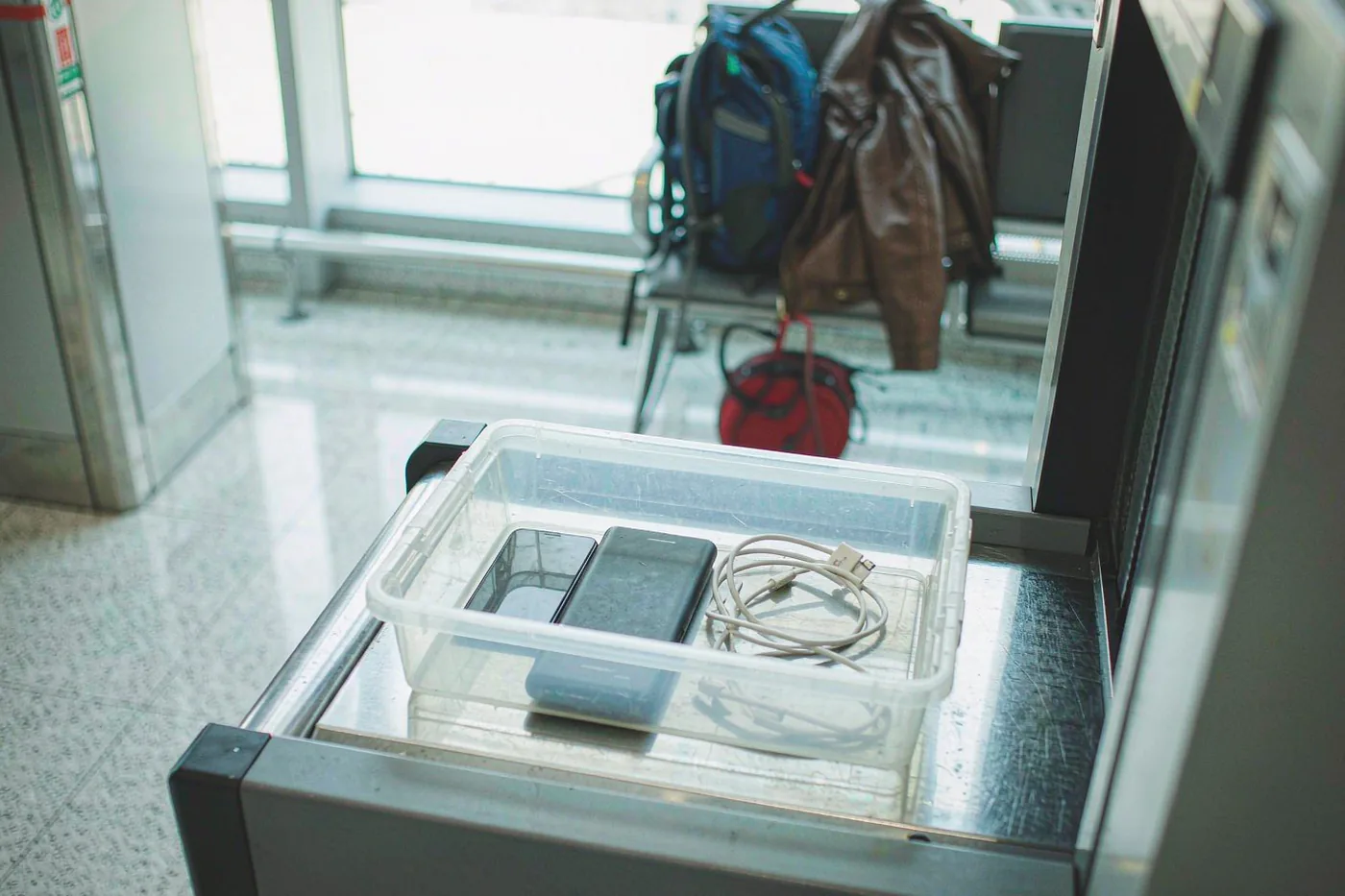
At Chinese domestic security, you'll place phones, laptops, cameras, and power banks in the trays. Officers may pull your power bank aside to read the markings, and some airports use devices that check whether the unit is on a recalled-batch list. Devices like laptops usually just go through the X-ray, though occasional enhanced screening applies. E-cigarettes and vapes are carry-on only and cannot be used anywhere inside the terminal [verify current rules on e-cigarette carriage]. If security deems a power bank non-compliant, you generally have three options: hand it over to the confiscation bin, return it to a friend or hotel, or use the airport's mail/lock service if offered — but don't count on mailing being available at every airport [verify service availability]. Budget 15–20 extra minutes for security at busy hubs like Beijing Capital (PEK), Beijing Daxing (PKX), and Shanghai Hongqiao (SHA).
The older of Beijing's two airports, serving most domestic carriers including Air China. Security here is thorough; have your power bank's CCC markings visible and ID/passport ready — foreign passports are checked manually at many domestic counters and checkpoints.
The star-shaped mega-hub south of the city, used heavily by China Eastern and China Southern. It's farther from downtown, so build in extra travel time, but security and check-in flow efficiently. Power bank spot-checks apply here just as at PEK.
If your foreign power bank gets confiscated — or you want to play it safe from day one — CCC-marked power banks are easy to find. Options include JD.com (fast same/next-day delivery in Beijing), Xiaomi stores (widely certified), Miniso, and convenience/electronics shops at the airport and around major stations. Expect roughly CNY 60–250 (USD 8–35) for a solid 10,000–20,000 mAh unit. Check the housing for the CCC logo and legible capacity ratings before paying.
If you found this useful, these cover the next question most visitors ask: