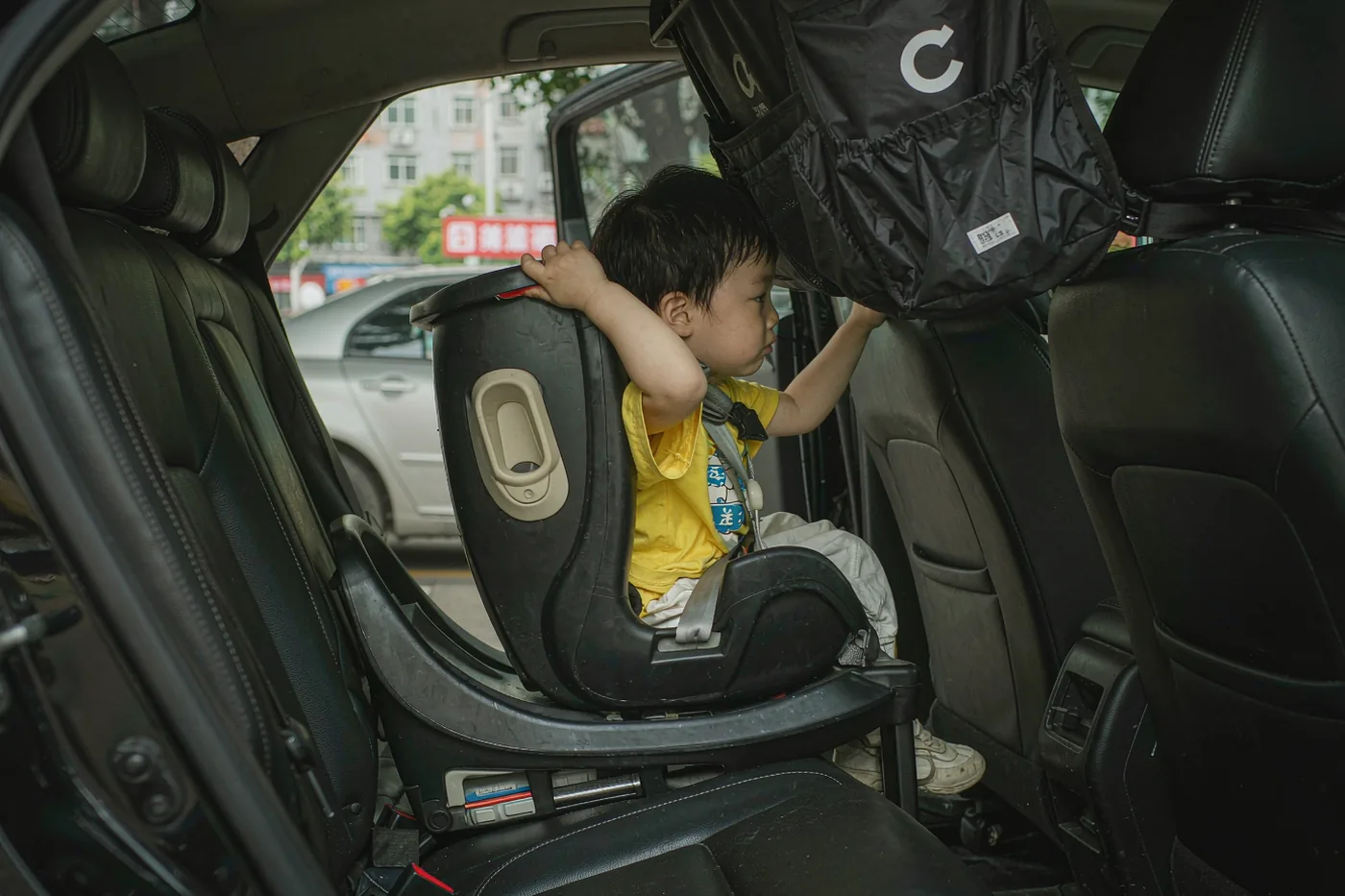
Explore Beijing / Child Car Seats in Beijing Taxis and Didi: The Rules, What Drivers Actually Have, and Your Options with Kids
Child Car Seats in Beijing Taxis and Didi: The Rules, What Drivers Actually Have, and Your Options with Kids
Beijing taxis and Didi cars almost never carry child car seats, so families need a plan. Here's what the law says, what to realistically expect, and your four best options.
6 min read · KOULING's Beijing Travel Guide
If you're visiting Beijing with a baby or toddler, one question comes up fast: how do we get around without a car seat? The honest answer is that the law is ambiguous in practice, and virtually no taxi or Didi (China's Uber equivalent) driver carries a child seat. This guide explains the rules, what you'll actually encounter, and how to plan so you're not making a stressful decision curbside with a tired two-year-old.
What the Law Actually Says
China has national safety standards recommending that children use age-appropriate restraints in private vehicles, and some Chinese cities have made child seats mandatory for private cars in local regulations. Beijing's enforcement, however, focuses on private vehicles — taxis and ride-hailing cars are effectively treated as a gray area, and drivers are not required to provide or install a child seat. In practice you will never be fined as a passenger, and drivers will not refuse a fare because you have a child. Translation for travelers: the law won't supply you a seat, so you need to bring your own or adjust your plans. Regulations do change — check current Beijing rules [verify before travel].
Taxis — No driver-supplied child seats, no requirement to have one. Kids can legally ride on an adult's lap, though it is far from the safest option.
Didi (ride-hailing) — Same reality. Didi once offered a limited child-seat car type in some cities; availability in Beijing is inconsistent at best. Confirm in the app [verify before travel].
Private cars — If you hire a private car with driver (chartered car service), you can and should request a child seat in advance — most services can supply one if asked when booking [verify before travel].
What You'll Actually Encounter
Expect a standard Beijing taxi or Didi car with two ISOFIX-equipped rear seats in many newer vehicles, but no child seat in the trunk. Chinese-made cars sold in the last decade commonly have ISOFIX anchor points, which matters if you bring your own seat or a portable harness. Drivers are generally patient and family-friendly — many are parents themselves — but almost none will have English skills, so have your destination written in Chinese characters. Do not expect the driver to install your seat for you; bring your own know-how.
ISOFIX availability — Common but not guaranteed in taxis and older ride-hailing cars. Belt-installed seats are the safer bet for compatibility.
Language — Save your hotel name and destinations in Chinese in your notes app, or use a translation app. Pin destinations on an offline map to show the driver.
Trunk space — A convertible seat plus luggage can fill a standard sedan trunk. If you have a stroller plus a car seat plus suitcases, request a larger car type on Didi or book a van for airport runs.
Your Four Realistic Options
There's no perfect answer, but families visiting Beijing generally choose one of these four strategies. Weigh them against your child's age, how much you'll move around, and your budget.
1. Bring a portable seat — A lightweight travel seat (for example, an inflatable booster or a foldable harness-style restraint such as the mifold or RideSafer vest) fits in luggage and works with a standard seatbelt. This is the best safety-per-kilo option for toddlers and up. Check airline baggage allowances [verify before travel].
2. Book private transfers with seats — Airport transfer services and English-speaking private car hire can provide a child seat if requested when booking, typically for an extra fee of roughly CNY 50–150 (US$7–21) per ride [verify before travel]. Best for airport runs and day trips.
3. Rely on the subway — Beijing's metro is clean, cheap (roughly CNY 3–9 / US$0.40–1.30 per trip depending on distance [verify before travel]), stroller-accessible at most stations, and eliminates the car-seat problem entirely. This is how most local families with toddlers get around.
4. Ride without a seat, eyes open — Many visiting families do short, slow city rides with a child on a lap. It's common, it's what locals do, and it's legal — but it is objectively the least safe option and we don't recommend it for highway or airport trips.
Practical Tips for Riding with Kids in Beijing
Install before you get in — Hail the car, then take a minute to fit your seat with your child outside the vehicle when possible. Drivers rarely object, though some may cancel if you take too long — a polite gesture or a small wait helps.
Use the Didi app's notes field — You can add a message to the driver in Chinese, such as '请稍等,我安装儿童座椅' (please wait, I'm installing a child seat), which sets expectations before pickup.
Skip car seats for the airport express — The Airport Express train and the Daxing Airport Express serve both major airports and need no seat at all. If your hotel is near a metro line, the train beats a car for cost and reliability [verify before travel].
Bring a car seat on flights? Check your seat fare — If you bought a seat for your child on the plane, you can often use an FAA/airline-approved car seat onboard — which means it's already with you for ground transport. Confirm with your airline [verify before travel].
Keep a plan for pickups — Taxi stands at attractions like the Summer Palace can have long queues at closing time. Pin your hotel on an offline map and know your metro station as a fallback.
Beijing Capital International Airport (PEK)
The main international gateway, about 25–30 km (16–19 mi) northeast of the city center. If you arrive exhausted with a jet-lagged toddler and luggage, this is the one journey where pre-booking a private transfer with a child seat is worth every yuan.
Metro
Airport Express train from Terminal 3 and Terminal 2 to the city; connects with Lines 2 and 10 at Sanyuanqiao and Dongzhimen [verify before travel]
Opening hours
Airport operates 24/7; Airport Express roughly 06:00–23:00 [verify before travel]
Tickets
Airport Express train around CNY 25 (US$3.50) one way; private transfer with child seat roughly CNY 250–450 (US$35–65) [verify before travel]
How long
Airport Express to Dongzhimen about 20–25 minutes; car 40–70 minutes depending on traffic
Beijing Daxing International Airport (PKX)
The newer mega-airport south of the city, striking architecture and generally less crowded. The Daxing Airport Express train and high-speed rail connections make it genuinely doable without a car — handy when no car seat is available.
Metro
Daxing Airport Express to Caoqiao (Line 10/19 interchange) [verify before travel]
Opening hours
Airport operates 24/7; Airport Express roughly 06:00–23:00 [verify before travel]
Tickets
Airport Express around CNY 35 (US$5) one way [verify before travel]
How long
About 19–30 minutes to Caoqiao by train; 50–80 minutes by car depending on traffic
Beijing Subway (Metro Network)
Your car-seat-free lifeline. More than 20 lines cover essentially every major sight — the Forbidden City, Temple of Heaven, the Summer Palace — and children under a certain height ride free. Escalators and elevators exist at most stations, though some older entrances are stairs-only, so a lightweight folding stroller helps.
Metro
The network itself; key tourist interchanges include Dongdan, Xidan, and Wangfujing [verify before travel]
Opening hours
Roughly 05:00–23:00, varying by line [verify before travel]
Tickets
Distance-based, roughly CNY 3–9 (US$0.40–1.30); children under 1.3 m (about 4 ft 3 in) ride free with a fare-paying adult [verify before travel]