Turkey to go, embassy Christmas markets, chamber galas and midnight mass: how Beijing's expat holiday season actually works, and what to book before it sells out.
Christmas and Thanksgiving are not public holidays in mainland China. December 25 is an ordinary workday — in 2026 it falls on a Friday — with banks, visa counters and the metro all running normally. Yet Beijing's expat scene celebrates both properly: hotel buffets with a real carving station, embassies running charity markets, chambers of commerce throwing gala dinners, and churches packing out for midnight mass. The catch is that everything books early and almost nothing takes walk-ins. This guide covers how the season actually works: where the turkeys come from, which markets are worth a ticket, and what to arrange before the crowds do.
Thanksgiving is the fourth Thursday of November — November 26 in 2026 — and restaurants build the whole week around it, with most dinner sets running roughly November 24 to 30. Christmas works differently: December 24 and 25 are the two big dinner nights, but the run-up is where Beijing shines, because markets and light displays start in mid-November and run into early January. And since the 25th itself is a workday, the real party energy lands on the weekend nearest each date — which is exactly how the hotels price their Christmas Eve seatings.
There are three realistic price points, and all of them were on offer last season, so treat the numbers as shape rather than promise. First, the buffet: western bistros and hotel cafes charged roughly RMB 240–400 per adult in 2025 for all-you-can-eat turkey, ham, sides and pie — Home Plate in Sanlitun, The Orchard and several hotel restaurants all ran them [verify]. Second, the sit-down set dinner: five-star hotel dining rooms priced two-person Thanksgiving menus around RMB 1,000 [verify]. Third, the whole-bird takeaway, which is the move if you are hosting at home — see the next section.
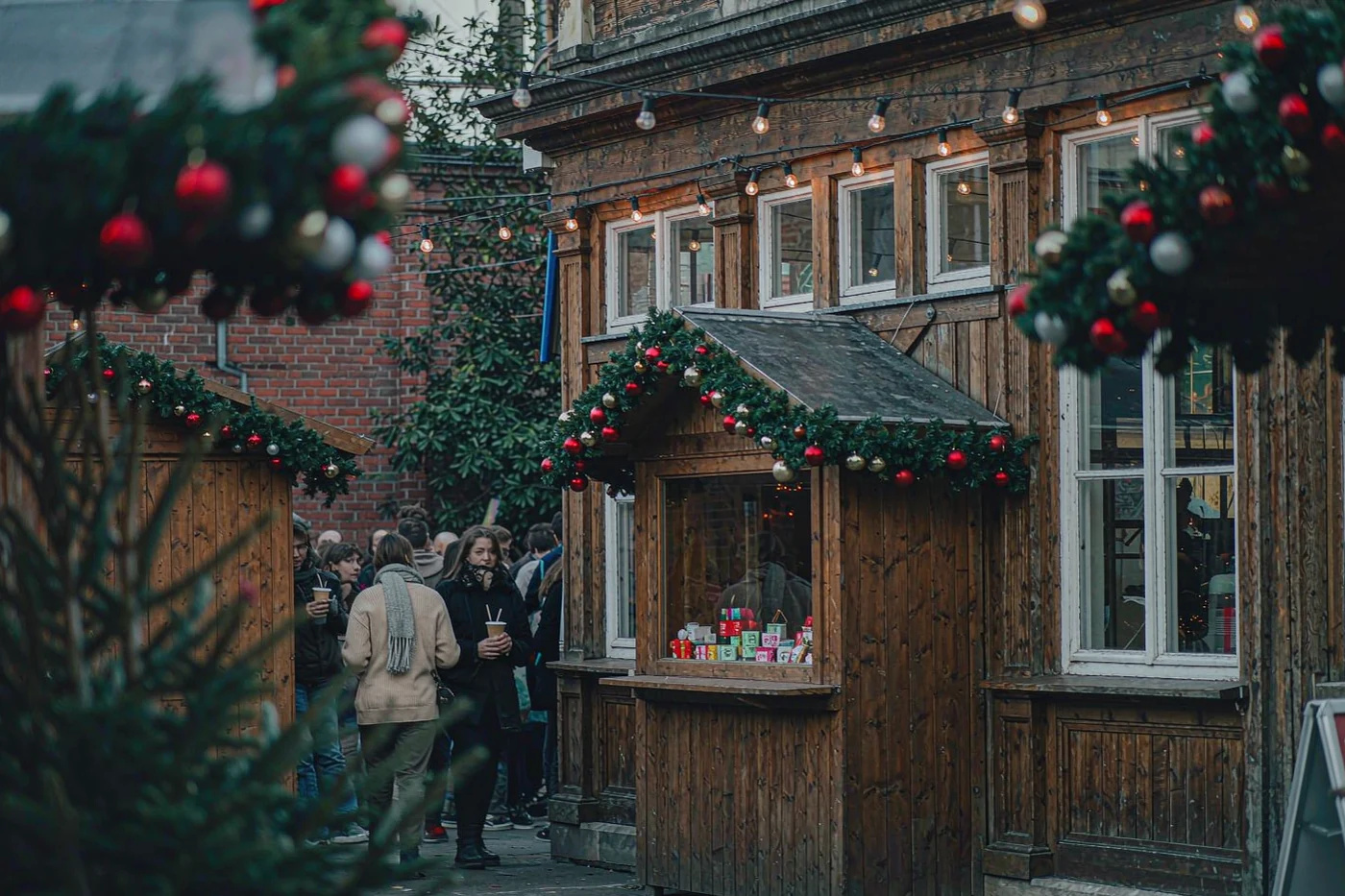
Beijing's Christmas markets cluster in two orbits. The embassy-and-chamber orbit is smaller, ticketed and atmospheric: the German Embassy's charity market near Liangmaqiao charged about RMB 140–160 last season, the Italian Embassy cultural centre runs a one-day market with entry around RMB 30, and Maison FLO on Xiaoyun Road turns its grounds into a French village on December weekends [verify]. The mall orbit is free and bigger — recent seasons saw a German-themed market at Fangyuanli IDMall, a wine-focused market on level 3 of WF Central near Wangfujing, and a weekend market at the Grand Summit (官舍) mall at Liangmaqiao [verify]. Dates move every year, so check the roundups that The Beijinger and That's Beijing publish in late November.
The single biggest expat night of the season is the chambers' gala circuit. Last December the British and Canadian chambers co-hosted a Christmas dinner at The St. Regis with a turkey-and-ham carving buffet, live bands and a Santa's grotto — RMB 800 for members, RMB 1,280 standard [verify]. The Swedish chamber runs a Lucia celebration with a julbord buffet, the Swiss chamber does a raclette night at the Kempinski, and the Italian chamber throws an aperitivo evening. These are the easiest way to spend the holiday itself among people, and they genuinely sell out — one year the gala's market tickets went in 25 minutes. Follow the chambers' WeChat accounts from early November and buy the day registration opens.
December 24 is the expensive night: five-star hotels price their Christmas Eve seatings at a premium and most require prepayment. December 25 dinner is calmer and often cheaper, and Christmas Day brunch is the expat-family default. If you have not booked by mid-December, your realistic options narrow to western restaurants in Sanlitun, Liangmaqiao and Wudaokou, plus whatever walk-in slots the big hotel cafes hold back. One useful quirk: because the 25th is a workday, plenty of restaurants stretch their festive menu across the whole week, so a Tuesday dinner can cost noticeably less than the 24th [verify].
The four historic Catholic churches — East Church on Wangfujing, North Church at Xishiku, South Church at Xuanwumen and West Church at Xizhimen — light up their facades and trees in early to mid-December, and all four hold Christmas Eve and Christmas Day masses. Midnight mass is free but ticketed at some parishes, with passes distributed in advance and queues on the night [verify]; arrive 45–60 minutes early or you will be watching on the outside screen. For services in English, see our guide to English-language church services. Away from the churches, the light displays are free and genuinely good: the malls of Sanlitun, Wangfujing and Solana stage elaborate tree installations from mid-November.
If you are travelling with children, Universal Beijing Resort's winter festival is the season's biggest single production: recent editions ran from mid-November into early January, with a 22-metre Christmas tree, themed shows in the Harry Potter zone and park tickets from about RMB 282 [verify]. It is the most overtly Christmassy thing in Beijing that requires no planning beyond a ticket.