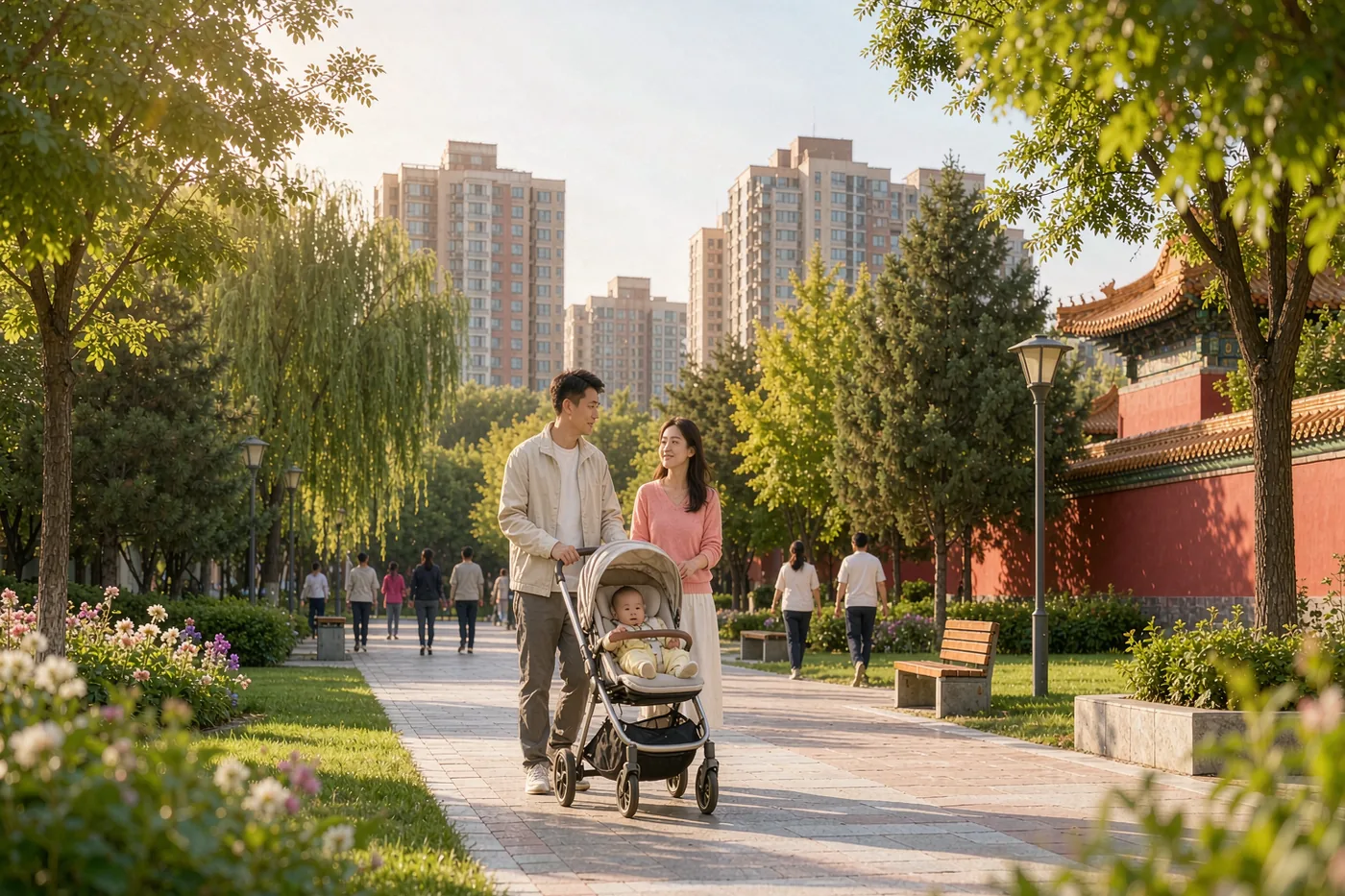
The baby-specific logistics the general kid guides skip: where nursing rooms actually are, buying formula in Beijing, hot water for bottles, and which sights a stroller can really handle.
Beijing is genuinely workable with a baby or toddler — flat city, wide metro gates, parks that rent strollers — but the details matter more here than with older kids. Where can you actually breastfeed? Which sights have changing tables (and which pretend)? Can you buy your usual formula brand, and how do you sterilize in a hotel room? This guide covers the baby-specific layer that the general kid itineraries skip, so you can plan days around naps instead of around accidents.
The single best facility in the city is inside the Forbidden City: a free baby care room inside the Longzongmen gate on the central axis, just south of the small building that once housed the Grand Council. It opened in 2018 and has three private nursing booths, a baby changing table, a milk warmer holding water at about 45°C, and a hot-and-cold washbasin — the one place where feeding, changing and warming a bottle are all possible mid-route. Most other big sights are thinner: the Summer Palace's dedicated nursing room sits at the East Gate visitor centre, outside the park proper, while inside you rely on basic toilets [verify]. Large shopping malls (SKP, APM, the big Wangjing and Daxing malls), both airports, and Universal Beijing Resort all have proper nursing facilities — check the mall directory or park app for the floor [verify]. Smaller sights and hutong areas may have nothing at all.
Changing infrastructure splits cleanly by venue type. Large malls and airports have proper folding tables in the women's (and often a family) washroom. Big parks increasingly offer a third-style family washroom with a changing counter, but older public toilets — which is most of what you find along hutongs and at mid-size sights — have nothing: no table, sometimes no counter space at all. A folding changing mat lives permanently in your daypack and turns any clean floor or bench into a workable spot. Pack more diapers than you think you need; they are easy to buy (every supermarket and convenience store stocks them, and Hema or Meituan delivery can restock the hotel), but not always easy to buy exactly where you are stuck.
You will not need to pack a week of formula tins. Beijing's shelves carry the international brands Chinese parents buy — Aptamil (爱他美), Wyeth Illuma (启赋), Mead Johnson, Abbott, a2, plus domestic Feihe and Junlebao — usually in several stages per brand. Expect roughly ¥200–450 for a standard 800–900 g can of the mainstream import lines, with premium organic and goat-milk formulas at the top of that range [verify]. Three channels matter: neighbourhood supermarkets (Wumart, Jingkelong) for instant buys at list price; mother-and-baby chains for promotions — always ask what activity is running, discounts of ¥20–50 a can are normal; and Sam's Club or Hema for bulk and imports. Mainland stores do not enforce the two-can limit that applies when leaving Hong Kong, but quantity caps are not uniform across retailers [verify]. Note the stage numbering follows the Chinese system; if your baby is on a European stage 2, show a photo of your current tin to the shop assistant and let them match it.
Hot water is the easy part — Chinese restaurants and cafes hand out free boiling water on request (say 要热水 or show the phrase), and every hotel room has an electric kettle, so night feeds run on boiled-then-cooled water. Our drinking-water guide covers the WHO 70°C mixing rule and which bottled water suits formula. For sterilization in a hotel room, microwave steam bags weigh nothing and work in any microwave; a travel bottle brush and a flask round out the kit. If you are out all day, the Forbidden City's milk warmer is the standout, but plan as if no sight will have one: a thermos of water at feed temperature plus pre-portioned powder in a dispenser solves every outing.
Beijing ranks well, with two caveats: historic doorways have raised thresholds you will lift the stroller over, and the big imperial sites are simply enormous — distances that look short on a map are a toddler's whole afternoon.
The subway handles strollers well: wide gates at every station, elevators at most (a few older entrances are stairs-only), and off-peak cars have room to park a folded stroller. Security checks are the friction point — at busy times staff may ask you to fold the stroller and carry the baby through the scanner arch. Taxis and Didi do not come with child seats; how families actually handle that, from pre-booked transfers with seats to the subway-first strategy, is covered in our car-seat guide. For one airport run with a jet-lagged toddler, a pre-booked car with a seat is the single best yuan you will spend.
Almost every bad day with a baby in Beijing traces back to one of these assumptions.