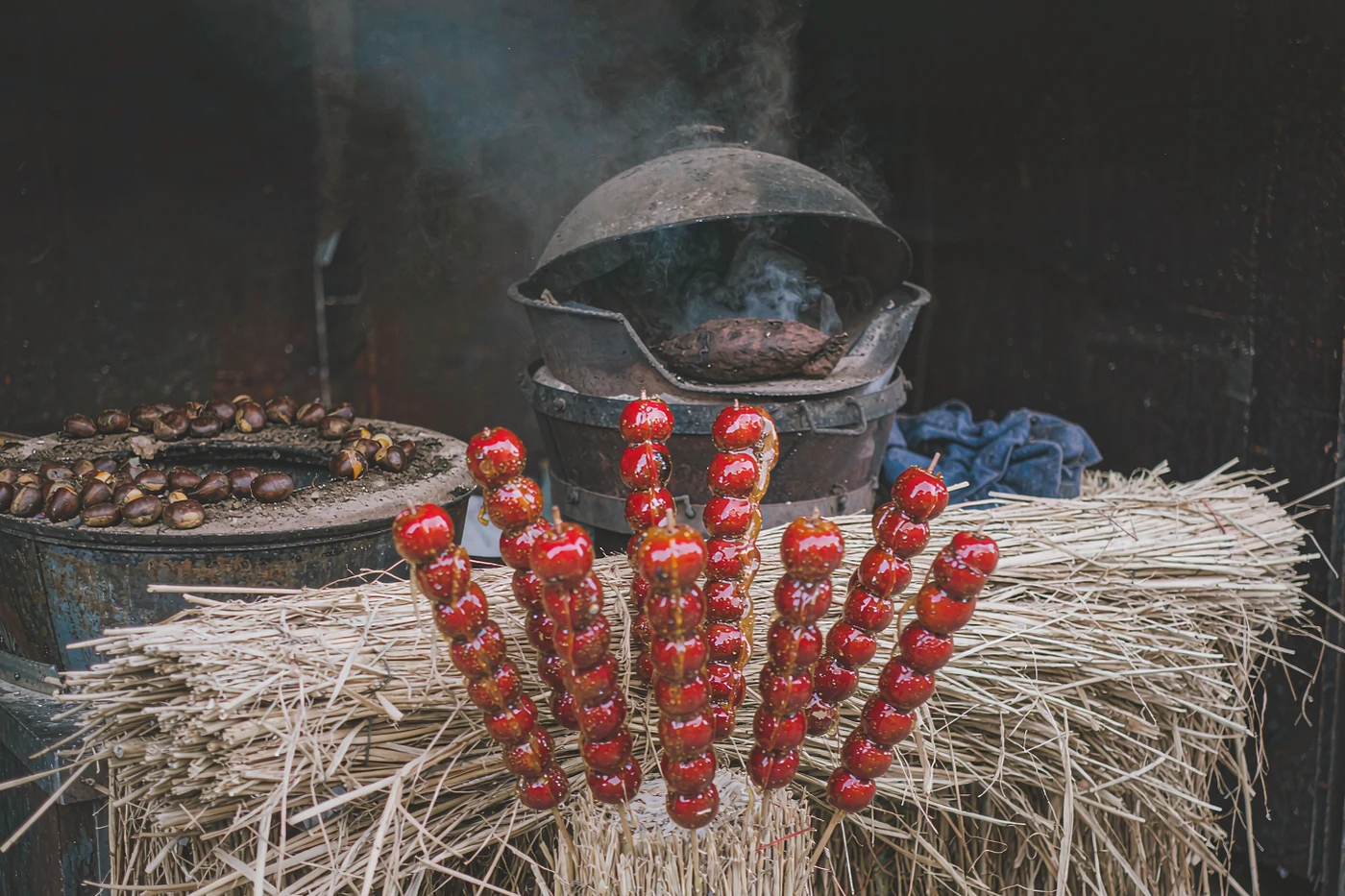
Explore Beijing / Beijing Winter Street Snacks: Tanghulu, Chestnuts and Sweet Potato
Beijing Winter Street Snacks: Tanghulu, Chestnuts and Sweet Potato
Tanghulu, sugar-roasted chestnuts, roasted sweet potato and jar-roasted pear: what winter street food to try in Beijing, what it should cost, and how to pick a good stall.
6 min read · KOULING's Beijing Travel Guide
From early November to late March, Beijing's street corners quietly change their menu. Where summer stalls sold cold noodles and iced tea, winter brings out steel-barrel ovens of roasted sweet potato, rotating woks of sugar-roasted chestnuts, and skewers of tanghulu that gleam like glass. These snacks cost a few yuan, warm your hands as much as your stomach, and are one of the cheapest ways to eat the way locals do. This guide covers what to try, what it should cost, where to find stalls, and how to pick a good one.
Tanghulu: the winter classic
Tanghulu (糖葫芦) is Beijing's most iconic cold-weather snack: hawthorn berries threaded on a bamboo skewer, dipped in hot sugar syrup that hardens into a thin, glassy shell. You crack through the sugar with your teeth, then hit the tart fruit underneath — sweet and sour at the same time. The classic version is nothing but hawthorn on a stick, and it is the one to try first.
Classic hawthorn — about ¥5–15 per skewer from street carts, more inside major tourist zones [verify]
Other fruits — grapes, strawberries, kiwi or mandarin segments, usually ¥10–20 [verify]
Stuffed versions — hawthorn split and filled with red-bean paste or glutinous rice — a little pricier
The new tanghulu wave (and when to skip it)
Since 2024, trendy shops have piled milk skin (naipizi), thick-strained yogurt, mochi, chocolate and fruit like Shine Muscat grapes onto tanghulu, turning it into a dessert skyscraper. A basic milk-skin version runs about ¥25–40 and elaborate builds can reach ¥60–70, with queues of an hour or more at viral shops [verify]. They photograph beautifully, but many locals find them cloying after two bites. Try one if you are curious — but the plain hawthorn skewer remains the better snack.
Sugar-roasted chestnuts (tangchao lizi)
Chestnuts are roasted in a rotating wok with black sand and syrup, then sold by the jin (500 g) in kraft paper bags. Beijing chestnuts come mostly from Huairou and Qianxi, north of the city, and are prized for being sweet, floury and easy to peel. Eat them while hot: fresh from the drum the shell slips off cleanly, and the texture is unbeatable. Several shops have roasted chestnuts at the same corner for twenty years or more, and each draws a winter queue.
Qiulixiang 秋栗香 — Di'anmen West Street at the Di'anmen crossroads, near Jingshan and Houhai — the most famous; about ¥18–19 per jin [verify]
Wang Laotou 王老头炒货 — Tiantan East Road near Yutingqiao — traditional sugar-glazed shells; about ¥25 per jin [verify]
Meilixiang 美栗乡 — 93 Xi'anmen Street, near Xisi and the Xishiku church area
Xiaojie Lizi 小街栗子 — Chaonei South Small Street near Chaoyangmen — a locals' favourite for soft, sweet flesh
Roasted sweet potato (kaohongshu)
The steel-drum sweet potato oven is winter Beijing's most reliable smell. Honey varieties such as mishu and yanshu roast into a molten, syrup-oozing flesh rather than a dry, starchy one. Vendors sell by weight or by piece; you point at one in the drum and it comes wrapped in foil or paper. It doubles as a hand warmer — which is exactly why locals buy it.
Typical price — roughly ¥5–10 per jin or ¥5–8 per piece [verify]
What to look for — ask for mishu (蜜薯) — soft and syrupy; drier varieties taste like mashed starch
Best timing — school gates around 4–5 pm and busy street crossings have the freshest turnover
Jar-roasted pear and other hot things on carts
The newest cart trend is guanguan kaoli (罐罐烤梨): a whole pear slow-stewed in a lidded glass jar with rock sugar, red dates and white fungus, served steaming. Locals swear by it for a dry winter throat. Around it you will find the rest of the winter-cart lineup: oden-style skewers bobbing in broth, roasted corn on the cob, crispy rice-cake sticks, and renaibao — a warm rice cone topped with cream that became a winter fad on short-video apps.
Jar-roasted pear — about ¥10–15 per jar [verify]; sweet, soupy, genuinely warming
Oden skewers — radish, kelp and fish balls in hot broth, about ¥2–5 per skewer [verify]
Renaibao 热奶宝 — warm glutinous-rice cone with cream filling, around ¥8–12 [verify]
Where to actually find winter stalls
Street vending in Beijing is regulated, so carts cluster where foot traffic is steady and permits tolerated. Prices near major sights run higher than on residential corners, sometimes by double. The same walk that takes you past hutong alleys will usually pass at least one chestnut shop or sweet potato barrel.
Hutong streets — Nanluoguxiang and the lanes around Houhai and the Drum Tower mix snack carts with long-standing chestnut shops
Qianmen and Dashilan — the pedestrian streets south of Tiananmen Square, busy all winter
Subway exits and markets — cart operators stake out station entrances, school gates and the approaches to wet markets
Spring Festival temple fairs — if you visit around Chinese New Year, miaohui fairs concentrate every winter snack in one place — at higher prices
Ordering without Chinese
Point and hold up fingers — most stalls are pick-up-and-pay; gesturing works fine
Say zhe ge (这个) — 'this one' — the two syllables you will use most at a cart
Scan the QR — vendors display a personal Alipay or WeChat QR code; scan it with Alipay, type the amount the vendor shows you, confirm. Small cash notes usually work too [verify]
Watch the scale — chestnuts and sweet potato are sold by weight; the vendor weighs your bag in front of you
How to pick a good stall
A few signals separate a great cart from a disappointing one. Turnover matters more than anything: a barrel that empties several times a day is roasting fresh stock, while one with a lonely pile has been sitting for hours. For chestnuts, a rotating drum in front of you beats pre-bagged product every time.
High turnover — freshly roasted or freshly dipped beats kept-warm every time
Registration QR — many districts require vendors to display a registration QR code on the cart — a decent sign of legitimacy
Glossy, not sticky — good tanghulu has a thin, glassy shell that cracks; a tacky coating means old syrup
Hot is non-negotiable — chestnuts and sweet potato lose their magic within the hour — buy small and eat now
Worth knowing
Season window — street snack season runs roughly from early November (Lidong) to late March; tanghulu carts thin out as soon as it warms
Mind the sugar — the syrup shell shatters into sharp little shards — napkins are essential, and keep it away from your down jacket
Chestnuts are filling — they are starchy and sit heavy; half a jin shared between two people is plenty before dinner
Bin the stick — skewers and shells go in the bin, not the gutter; carts usually sit near one