Explore Beijing / Vending Machines in Beijing: How They Work and How to Get a Refund
Vending Machines in Beijing: How They Work and How to Get a Refund
QR payment, smart open-door cabinets, typical prices, and the exact refund steps when a machine takes your money and gives nothing back.
7 min read · KOULING's Beijing Travel Guide
Sooner or later, a Beijing day runs through a vending machine: a cold tea in a subway concourse after a long ride, a bottle of water in a hospital corridor, a midnight snack from the cabinet in your hotel lobby. Machines sit inside nearly every subway station hall, most hotels, office towers, hospitals and scenic-area entrances — and almost none of them take cash. Most foreign visitors' problems come from one of three moments: the door will not open, the can does not drop, or the charge looks wrong. This guide covers both machine types, what things should cost, and exactly how to get your money back when something goes wrong.
Where you will find them
You are rarely more than a few minutes' walk from a machine. The most reliable places:
Subway stations — Most station halls have one to three machines behind the fare gates or beside the escalators — you walk straight past them after security.
Hotel and apartment lobbies — A fridge-style smart cabinet in the corner is standard, which is handy for late-night water and snacks.
Hospitals, office towers and campuses — Corridors and lift lobbies; the fresh-coffee machines live in these buildings too.
Scenic-area entrances and big parks — Present but priced higher than street level — check the tag before you scan.
Train stations and airports — The priciest machine locations in the city; buy before you arrive if you can.
Two machine types that work completely differently
Beijing runs two very different machines side by side, and knowing which one you are facing changes both how you buy and what can go wrong:
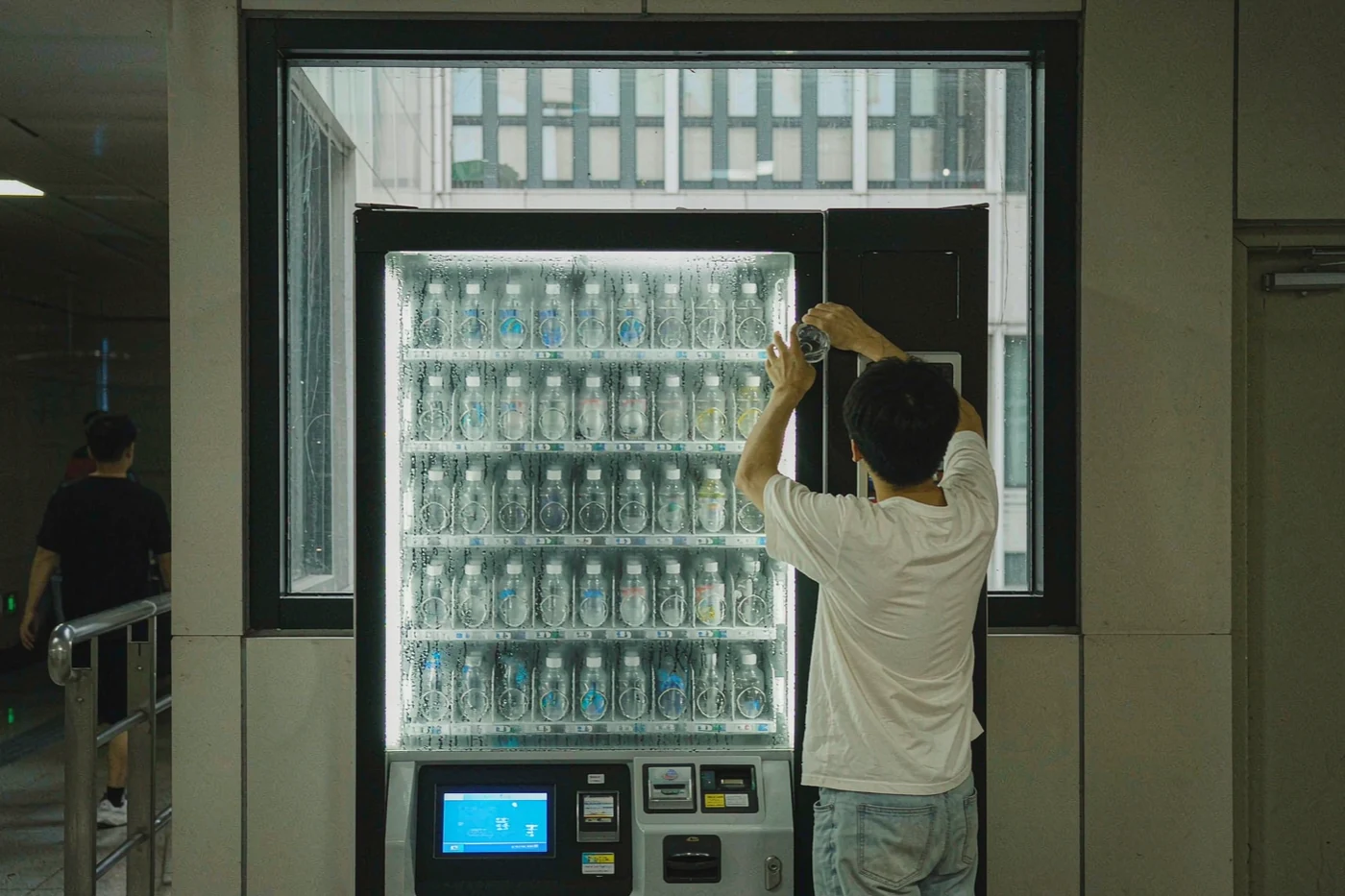
Classic spring machine (自动售货机) — Glass front, metal coils, a pickup hatch at the bottom. You tap a code, pay, and the item drops. Typical failure: the item gets stuck on the coil (卡货).
Smart open-door cabinet (智能开门柜) — A fridge-style cabinet. Scan to unlock, take what you want, close the door, and the system charges you automatically by weight and camera recognition. Typical failure: a miscounted item or a door left ajar.
Fresh-coffee machines (现磨咖啡机) — Cup coffee from a bean-to-cup unit, mostly in offices and hospitals. Payment works the same as the classic machine.
Choose on the screen, then pay — Tap the product on the touchscreen or key in the code printed under the row, then scan the QR code that appears with WeChat Pay or Alipay.
Wait for the drop — The item falls into the hatch within a few seconds. Lift the flap at the bottom and take it.
Cash still works on some older units — Notes must be flat and undamaged — feed them in one at a time; coins go into the coin slot. If you overpay, press the coin-return button (退币).
Do not count on cash — Many newer machines and every smart cabinet have no cash slot at all. A working WeChat Pay or Alipay is effectively the entry ticket.
Using a smart open-door cabinet
The open-door cabinet is the machine that confuses first-time visitors most, because nothing drops and nothing is rung up at the moment you take it. The flow is:
Scan and authorize once — Scan the sticker QR with WeChat or Alipay. First use asks you to enable small-amount password-free payment (免密支付) with a spending cap — that authorization is what makes the door open.
Take what you want — Weight sensors and cameras log what you remove. If you change your mind, put the item back on the same shelf spot before closing the door.
Close the door fully — A door left ajar cannot settle the order and is the top cause of billing errors. Wait for the click.
Nothing taken means no charge — You can open the door, browse, and close it empty-handed — the visit settles at zero.
What things should cost
Machine prices sit one notch above supermarket prices, and the gap widens further in stations, airports and scenic areas. On Beijing Subway, a bottle of Master Kong tea typically goes for about 4–4.5 元 where the same bottle costs 3–3.5 元 at a convenience store; premium teas and NFC juices run 6–8 元 [verify].
Bottled tea and soft drinks — About 4–4.5 元 on subway machines versus 3–3.5 元 at a convenience store; fruit teas and NFC juices 6–8 元 [verify].
Bottled water — Around 2–3 元 at street level; 4–5 元 in scenic areas and airports [verify].
Snacks — Instant noodles and biscuits roughly 4–6 元 [verify].
Cup coffee — Vending-machine coffee runs about 10–16 元 a cup [verify].
Same drink, different price — even one metre apart
A Beijing Evening News survey in July 2026 found machines from different operators sitting in the same subway concourse charging different prices for the identical bottle: 4.00 versus 4.39 元 at Beixinqiao station on Line 5, with gaps of typically 0.2–0.5 元. Each machine posts its own business licence — rents and supply chains differ, so prices do too. Operators told the paper they will refund a price gap if you call the hotline printed on the machine, which is worth one call when the difference is large.
Compare before you scan — If two machines stand near each other, glance at both price grids — the same drink is often cheaper on one of them.
Ask for the difference back — Call the sticker hotline, mention the same station and the two machines, and request the price-gap refund.
If you pay and nothing comes out
A swallowed payment is rare but happens, usually with a stuck item on a spring machine. What you do in the first minute decides how easy the refund is:
Do not shake or tip the machine — These units weigh over 200 kg and can tip over on you, and shaking is treated as damage you caused. Call instead.
Photograph the evidence — The operator's name, service phone and device number are printed on the body. Shoot the empty pickup hatch with the screen time visible.
Screenshot your payment — The WeChat Pay or Alipay order page is your only receipt — machines give no paper tickets.
How to get a refund, in order
Work down this list; the first two steps resolve almost every case:
Call the sticker hotline first — Give the device number, the time and your payment screenshot. Operators confirm the failed drop from backend logs and refund to the original payment method — typically within 24 hours to a few working days [verify].
WeChat dispute route — 服务 → 钱包 → 账单 → the order → 对订单有疑惑 (report a problem with this order), then attach your screenshots.
Alipay dispute route — 我的 → 账单 → the order → 投诉. The platform forwards it to the merchant with a deadline; cases usually close in 1–3 working days [verify].
Escalate with 12315 — If the sticker is missing or the operator stalls, call 12315 or file in the 12315 mini-program — the national market-regulation complaint line.
The law is on your side — Under the Civil Code, completing payment forms the purchase contract; failing to deliver is breach, so you can demand the item or your money back [verify].
Disputing a smart-cabinet charge
Billed for something you did not take? Open the order in the operator's mini-program: it lists what was charged and links the door-opening video the cabinet recorded — evidence beats argument there. Most mischarges come from items returned to the wrong shelf spot, which the system reads as a second take. Submit the dispute in the same mini-program and the charge is reviewed against the video.
Check the item list first — Prices of 6.00 versus 6.28 元 for the same bottle happen between operators; make sure the complaint is about the item, not the price.
Put returns back exactly — Returning a product to a different slot is how double charges happen — same shelf spot, same facing.
Face recognition is not for visitors — 刷脸 (face-pay) machines require a mainland ID-linked account; as a visitor, always use the QR route.
Prices must be posted — National pricing rules in force since July 2022 require operators to display prices clearly where the goods are shown, and forbid charging anything never displayed [verify].
Restocking is uneven — A popular slot may show empty while the machine works fine; refills run on restocking routes with no fixed schedule.
Keep the order page — If anything goes wrong later, the payment-app order page plus the machine's device number is all customer service needs.