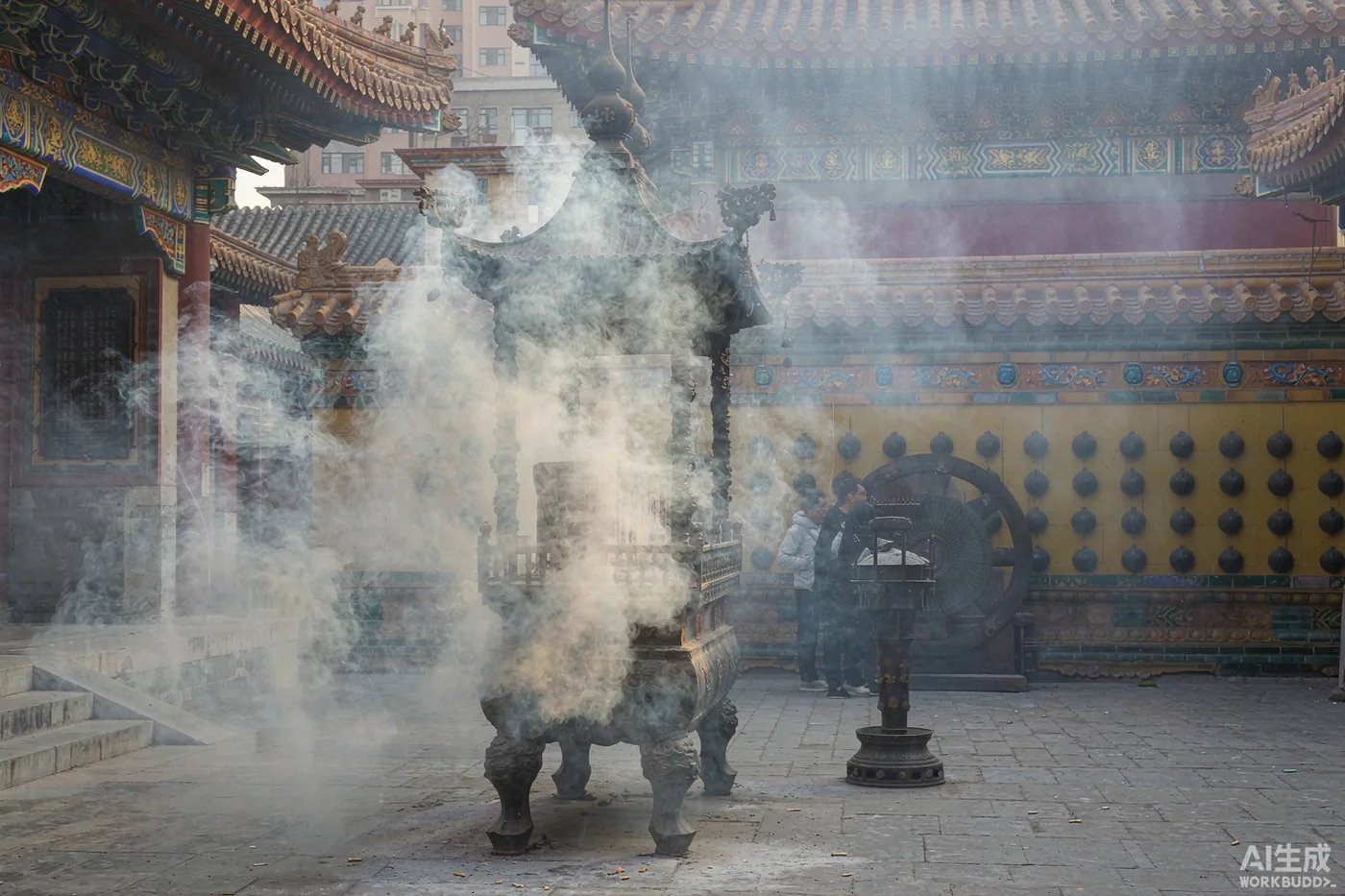
The etiquette that applies almost everywhere, plus practical detail on Beijing's three most important sacred sites — what they cost, how to book without a Chinese phone number, and when to go to avoid the crowds.
Beijing's temples are not museum pieces — most are working religious sites where people come to light incense, pray and leave with a blessing. That makes them the most atmospheric places in the city, and also the easiest to get wrong. This guide covers the three that matter most to a visitor: Yonghe Temple (Tibetan Buddhist, spectacular and crowded), Baiyun Temple (Taoist, quiet, ten yuan) and Niujie Mosque (Beijing's oldest and largest mosque, with rules worth knowing before you turn up), plus the etiquette that applies at almost every one of them.
Step over thresholds, never onto them — a threshold symbolises an obstacle and standing on one is the most common casual mistake visitors make. Remove hats and sunglasses before entering a hall. Photography inside halls is prohibited nearly everywhere; courtyards, roofs and exteriors are usually fine. Dress to cover shoulders and knees; this is rarely enforced but it decides how welcome you look. Keep your voice down, do not point at statues, and if a queue is moving clockwise around a hall, follow it rather than cutting across.
A Qing princely palace converted into a Tibetan Buddhist monastery, and the busiest temple in Beijing. Entry is 25 yuan, half price at 12 yuan for students and minors aged 6 to 18, free for children under six or under 1.2 m. Booking runs through the WeChat official account for Yonghe Temple visitor and devotee services, which is Chinese-only; if you have no Chinese number or cannot complete it, bring your passport to the on-site ticket window and buy a paper ticket with cash or mobile payment. Gates open at 09:00, with last admission roughly 30 minutes before closing. Take Line 2 or Line 5 to Yonghegong station, exits C or F, two minutes on foot. Free eco-friendly incense is handed out inside — do not bring your own. The star is the Maitreya Buddha carved from a single piece of white sandalwood, rising 18 metres above the floor in the Pavilion of Ten Thousand Happinesses. The first and fifteenth of the lunar month and weekends are packed; weekday mornings before 10:30 are the calm window.
The ancestral temple of the Quanzhen Taoist school, standing on the site of a Tang-dynasty temple founded in 739 and still home to the national Taoist association. It is the best-value hour in Beijing: ten yuan at the door, no reservation, students half price, free for over-60s and under-6s, and free for everyone on the first and fifteenth of the lunar month. Summer hours run roughly 08:30 to 17:00 with last entry around 16:30; winter closes about half an hour earlier. Metro Line 1 to Muxidi or Nanlishi Lu, then a 10- to 15-minute walk. Four things locals come for: finding and touching the three stone monkeys, which are scattered and harder to locate than they sound; tossing a coin through the giant coin at Wofeng Bridge; touching the bronze mule for health; and paying respects at the Year God hall in your birth year. The back garden is genuinely quiet.
Founded in 996 and given its name by imperial decree in 1474, Niujie Mosque is Beijing's oldest and largest mosque and a national heritage site — a rare fusion of Chinese palace architecture with Arabic decoration, and a prayer hall that holds more than a thousand people. It is also a living place of worship rather than a tourist attraction: the prayer hall is generally not open to non-Muslim visitors for sightseeing, and Friday midday prayers draw well over a thousand. The respectful way to visit is to treat Niujie as a neighbourhood rather than a monument — walk the street, eat at the halal places on Shuru Hutong, and dress conservatively. If you are Muslim you are welcome to attend prayers; go outside prayer times if you want to look around quietly, and avoid Friday lunchtime and Ramadan evenings when the community is at its busiest.
Guangji Temple near Fuchengmen is the seat of the Buddhist Association of China and a working monastery with a fraction of Yonghe's visitors. For architecture, the two Catholic churches are the surprise: the North Church at Xishiku, gothic and reached from Xisi on Line 4 or Ping'anli on Line 6, and the East Church on Wangfujing, served by Line 1 and by Line 8 — which makes it a straight ride up from the south of the city. Both are free, both are busiest at Christmas and Easter, and both are happy to have quiet visitors outside service times.