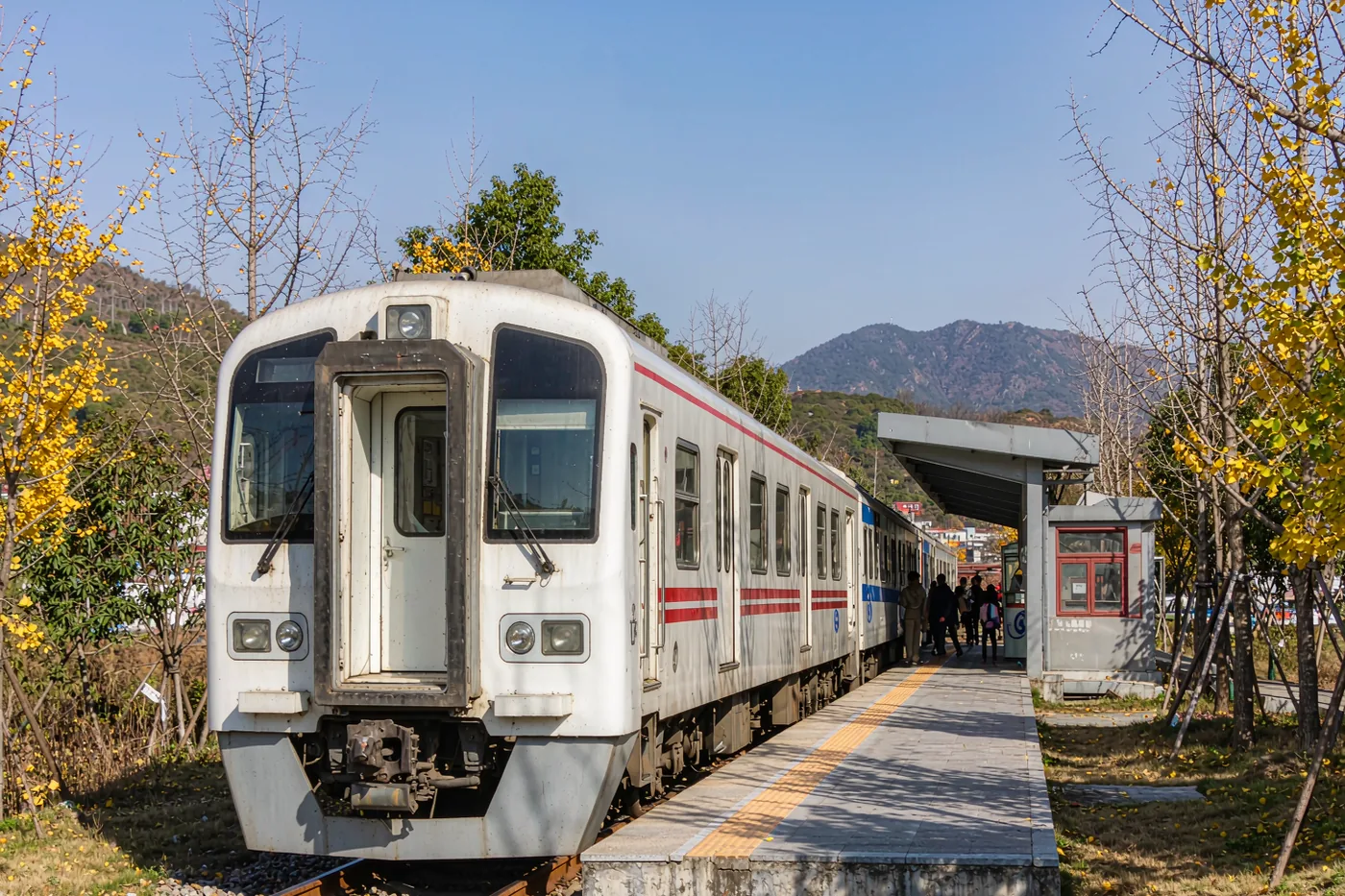
Four suburban rail lines run by China Railway share Beijing's metro fare ladder but split sharply on ID rules: S2 needs no real-name ticket, the other three do. Here is how a passport actually works on each.
Beijing's suburban railways (shijiao tie lu) are the awkward middle child between the metro and mainline trains: four commuter lines operated by China Railway Beijing Group, not by Beijing Subway. They use the metro's distance-based fare ladder, yet they follow railway rules — fixed timetables, platform check-in, and, on most lines, mandatory real-name tickets. That split confuses visitors, because one line, the S2, works exactly like buying a bus ticket with cash, while the other three behave like an intercity train that wants your passport. This guide walks through the whole network, the fare system, and the precise path for a foreign passport on each line.
All four lines are ordinary-looking trains on national rail tracks, usually with free seating and no reserved seats on suburban tickets. Frequencies are low, so treat them as trains you plan around, not as a metro you just turn up for.
Suburban lines use the same distance ladder as the metro, calculated separately for each line: 3 yuan up to 6 km, 4 yuan to 12 km, 5 yuan to 22 km, 6 yuan to 32 km, then 1 yuan per extra 20 km. Two consequences matter. First, rides stay cheap: on the Sub-Central Line, Liangxiang to Beijing West costs 6 yuan and the full 63.7 km line costs 8 yuan; the new western stations are cheaper still (Yamenkou East to Beijing West is 4 yuan, Houlücun to Beijing West 5 yuan). Second, there is no through-faring with the metro: a suburban trip and a metro trip are billed as two separate journeys, so no transfer discount. The Huairou-Miyun Line runs roughly 145 km, so end-to-end rides reach the top of the ladder - Beijing North to Gubeikou is about 12 yuan [verify current fare].
This is the single rule that changes how you buy. The S2 sits outside the railway real-name system: you can buy a paper single ticket at the station with cash, no ID, no booking, free seating — or tap in with any Transport-Union contactless card, and the metro QR codes in the Yitongxing app work too. The Sub-Central, Huairou-Miyun and Tongmi lines are the opposite: identity-checked lines. They accept 12306 e-tickets (issued as free-seating "no seat" tickets), plus railway smart cards and the Yitongxing QR code once it has passed real-name verification with face matching. There is no anonymous paper ticket on those three — a passport is the visitor's ticket, effectively. Note the Yitongxing QR on S2 needs no face matching, but on the other three it does.
For the three real-name lines, the 12306 app or website is the reliable path: register with your passport, pick the suburban train exactly as you would any train, and pay by card or a wallet. The e-ticket shows "no seat" (wu zuo) - that just means free seating, not that the train is full. At the station, enter through the ticket gates: machines scan Chinese ID cards automatically, so as a passport holder you will most likely use the staffed manual channel with your passport and booking record [verify station by station]. At smaller suburban stations this can be a single staffed gate - arrive early. Ticket windows and vending machines at suburban stations also sell these e-tickets and can register a passport manually. Crucially, check-in closes 3-5 minutes before departure on these lines, earlier than most metro habits suggest.
The metro apps do work here, but only after an extra verification step most visitors cannot easily complete. To use the Yitongxing QR code on the three real-name lines, your account must pass real-name plus face verification inside the app's suburban railway section - realistically that needs a mainland phone number and often Chinese ID. A physical Beijing Yikatong card must also have the suburban railway function activated with real-name registration before it opens suburban gates. Without those, do not improvise: the 12306 e-ticket is the foreign visitor's default. One consolation: the monthly cumulative discount (20% off past 100 yuan, 50% past 150) is shared with the metro network, so long-stay visitors who do get a verified card should activate the suburban function on it.
Headways are the biggest shock for metro users. The Sub-Central Line, the busiest, runs 26 trains a day after the 2026 upgrade, weighted to morning and evening peaks, with 12 through services linking Fangshan and Tongzhou. The Huairou-Miyun Line runs about 8 return trips a day, the Tongmi Line about 3. The S2 is the scarcest: 2 pairs a day from Tuesday to Thursday, 3 pairs on Friday to Monday and public holidays. Times in between are long - if you miss a train, the next one may be hours away, which is why every suburban platform has a proper departure board and why you should check the exact timetable in 12306 the night before. Last services wrap up around 21:00-21:30, much earlier than the metro.
The Huairou-Miyun Line is the most tourist-useful: from Beijing North or Qinghe station to Yanqi Lake in about an hour, and to Gubeikou for Gubei Water Town and the Simatai Great Wall - far more relaxing than the expressway coaches. The S2 still works for Badaling, but plan around Nankou: the old Huangdian station closed in October 2025, so reaching the new departure point in Changping takes a bus or taxi [verify best access route]. If you have already read our dedicated S2 guide, re-check its departure station advice against this change. The Sub-Central Line is less of a sightseeing tool and more of a cheat code for southwestern Beijing: it connects Beijing West with Liangxiang and with Tongzhou's canal-side Qiaozhuang East. The Tongmi Line duplicates what buses already do well; skip it unless you collect railway lines.
Beijing West is the integration showcase: it has a dedicated suburban railway exit, and transfers to metro Lines 7 and 9 come with mutual security-check recognition, so you do not re-screen when moving between suburban and metro sides. The newly rebuilt western-section stations (Yamenkou East, Fangshan East, Houlücun, Liangxiang) have fusion gates that accept every ticket type - rail e-ticket, cards and QR codes - on the same machines. Small rural stations on the Huairou-Miyun and Tongmi lines are quiet, often with minimal staffing; budget a few extra minutes for the manual passport check and for finding the entrance, which can be a modest single building rather than a metro-style complex.