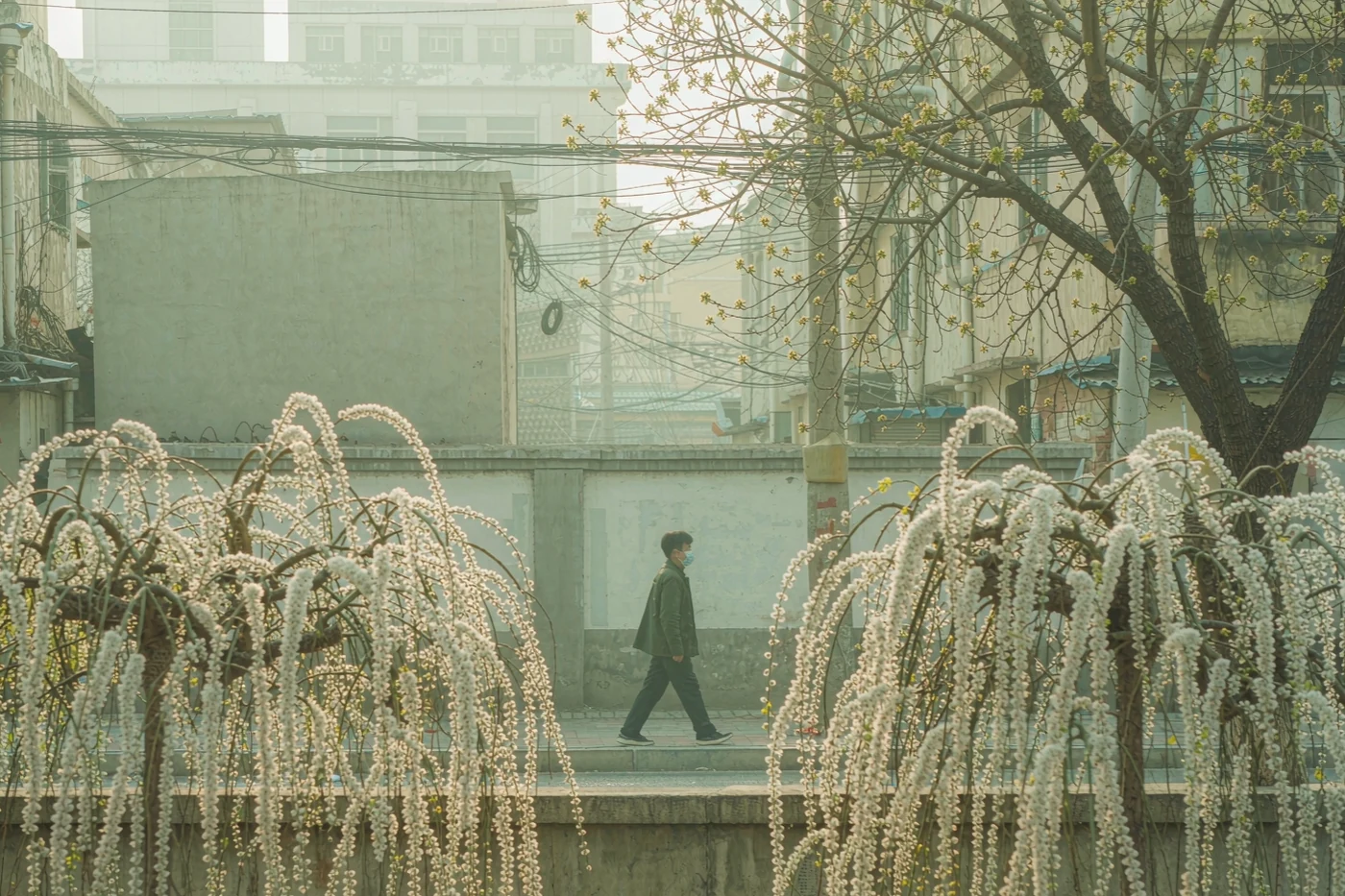
Explore Beijing / Beijing Spring Allergies: Pollen, Willow Catkins and How to Get Through Them
Beijing Spring Allergies: Pollen, Willow Catkins and How to Get Through Them
Tree pollen peaks mid-March to mid-April; willow and poplar catkins run from early April for about fifty days. The two calendars, the daily 10:00-16:00 peak, what to buy at a Beijing pharmacy, and how to see an allergy doctor here.
11 min read · KOULING's Beijing Travel Guide
Beijing in spring looks like the easy season: mild days, blue skies, everything in bloom. If you get hay fever at home, though, the stretch from early March to late May is the one that fights back, and the city throws two separate problems at you that most guidebooks merge into one. There is tree pollen, which peaks from mid-March to mid-April and is what makes your eyes itch. And there are willow and poplar catkins, the white spring snow that begins in early April and runs for about fifty days. Both are predictable to the week, both are worst at the same hours of the day, and both are manageable once you know the calendar, the clock, and the four characters every allergic Beijinger is taught. This is the version written for someone with two weeks here who does not want to spend them sneezing.
Two seasons, not one: the pollen calendar and the catkin calendar
The most useful thing to understand is that pollen and catkins are not the same event, and they only partly overlap. Tree pollen starts earlier and finishes earlier. Catkins begin just as the pollen peak is fading, and keep going for another month. Arrive in mid-March and you are in pollen season. Arrive in late April and you are in catkin season. Arrive in the last week of April and you can get both at once.
Tree pollen — Early March to mid-May, with the heavy weeks from mid-March to mid-April, according to the allergy centre at Beijing Shijitan Hospital. This is the one that sets off itchy eyes and a streaming nose.
Willow and poplar catkins (杨柳飞絮) — Roughly early April to late May, about fifty days in total. In 2026 the municipal forecast put the start at 6 April and the end in late May; the start date shifts by a week or two with how warm the spring runs.
First wave, mid-April — Mainly white poplar (毛白杨), concentrated inside the Fifth Ring Road — the dense old central districts. Any one area gets about a week of heavy fall.
Second wave, late April to early May — Willows, Euramerican poplar and other poplars join in, spreading from the city out across the plain. This is the wave visitors notice most.
Third wave, mid-May — Cooler mountain districts north and west of the city. Central districts are largely finished by early May.
The order the trees let go — Elm from late February, cypress from around mid-March, poplar and willow just after, pine from mid-to-late April, then plane and birch carrying April and May. If your symptoms begin in the second week of March, it is almost certainly cypress.
The daily clock: 10:00 to 16:00 is the hour to be indoors
Whatever the calendar says, the day has its own rhythm. Pollen counts in Beijing run highest between 10:00 and 17:00, and the municipal catkin forecast names 10:00 to 16:00 as the peak for flying fluff. Warm, dry, lightly breezy weather pushes both up; rain, a drop in temperature and strong winds clear the air. That gives you a simple way to build a day: be outside from opening time until about ten, spend the middle of the day indoors or in a covered courtyard, then go back out after five, or straight after a shower passes. Sunrise at the Great Wall, or a 07:00 walk along the moat, is often perfectly comfortable for someone who cannot cross a park at noon.
Best windows — Early morning, evening, and the hour right after rain. The city's own advice for outdoor exercise is morning, dusk or post-rain.
Worst window — Midday to late afternoon on a warm, dry day with a light breeze.
Rinse on the way in — Wash your face with clean water and rinse your nose and mouth with saline. Keep windows shut on catkin days, and vacuum or damp-wipe whatever drifts inside.
The catkins are not the allergen — they are the delivery service
This surprises most visitors. Zhang Yinghong, a deputy chief physician in ENT at Peking University Third Hospital, has put it plainly in the state press: the catkin itself is not an allergen. What it is, is light and sticky — so it picks up dust mites, pollen grains and mould spores and carries them straight into your face, a moving carrier for the things you are actually allergic to. Two consequences follow. A day with a modest pollen count but heavy catkins can still flatten you, and brushing the fluff off your face and coat at the door is worth as much as any tablet. One more thing the authorities warn about every year: dry catkins are extremely flammable and spread fast. Never flick a cigarette butt into a drift of them, and keep them out of car and camera intakes.
Where it is worst, and the swaps that save a day
Exposure is not uniform. The first catkin wave is explicitly a Fifth Ring Road problem — the dense old central districts with mature poplars. For pollen, the famous hotspot is the Temple of Heaven, whose centuries-old cypress canopy releases visible clouds of pollen in March and now runs its own control programme. The other side of the coin is that parks treated with a catkin-binding agent are dramatically calmer: one application cuts airborne catkins by more than eighty per cent for the whole season, and Olympic Forest Park's north section was being sprayed in April 2026.
Highest exposure — Inside the Fifth Ring Road during the mid-April wave; mature tree belts in old parks; canal and river banks lined with willow.
Lower exposure — Indoor sites, open water, wide plazas — and the northern hills in April.
Treated parks — Ask which parks have been sprayed this year. Treated ground is far calmer than an untreated street of old poplars.
The May flip — From mid-May the third wave moves into the cooler mountain districts, so the hills stop being the escape they were in April.
Check the forecast the way people here do
Daily pollen report — Follow 气象北京, the Beijing weather bureau's WeChat account. It posts the previous day's dominant pollen types every day, produced together with Beijing Tongren Hospital, and it is the fastest free signal you will get.
Catkin risk level — The land-greening bureau and the weather bureau run a catkin monitoring and forecast platform issuing a level 1 to 5 risk warning. Levels 4 and 5 are high risk, refreshed hourly with a seventy-two hour outlook.
Ask the front desk — Hotel staff live through this every spring and know which parks are bad this week. Ask before you commit a morning to being outdoors.
What to buy at a pharmacy — show them these characters
Beijing pharmacies are everywhere, usually marked with a green cross, and the antihistamines you know are sold here under their generic names for a fraction of home prices. Write the Chinese characters down and hand them over: the brand on the box will not match anything you recognise, but the generic name is the same drug. The prices below are typical rather than exact.
氯雷他定 (loratadine) — Non-drowsy oral antihistamine and the standard first-line choice. One tablet a day; also sold as 开瑞坦. A box of generics runs about ¥10–40 [verify].
西替利嗪 (cetirizine) — The other common non-drowsy antihistamine. Mildly sedating for some people — take the first one in the evening and see how you react.
糠酸莫米松鼻喷雾剂 (mometasone nasal spray) — Steroid nasal spray, the most effective thing for a blocked nose and sneezing. Sold as 内舒拿 among others; ask the pharmacist whether your box is over the counter [verify].
生理性海水鼻腔喷雾 (saline nasal spray) — Cheap, safe, and the fastest relief after a dusty afternoon. Rinse properly rather than just spraying once.
人工泪液 (artificial tears) — Flushes pollen out of the eye. For severe itching, add an antihistamine drop such as 奥洛他定 [verify].
扑尔敏 (chlorphenamine) — The old antihistamine. Very cheap and very drowsy — fine before bed, a bad idea before a long flight or a drive.
孟鲁司特 (montelukast) — Prescription only in China. If it is part of your usual regimen, bring it with you rather than counting on a pharmacy counter.
Start before you land
Everything in this guide works better as prevention than as cure. Beijing Tiantan Hospital's own allergy guidance is that anyone with recurring spring allergic rhinitis should start first-line treatment one to two weeks before the forecast start of the pollen they react to — a nasal steroid spray, a nasal or oral antihistamine, or a leukotriene antagonist. If you know your triggers and roughly when you are flying, start early and arrive with your system already covered.
Begin one to two weeks out — Prevention started before exposure beats treatment started after the first sneezing fit, by a wide margin.
Bring what already works — Pack your usual brand in its original box with the leaflet. Pharmacies here can top you up, but not necessarily with your exact product.
Move the trip if you can — Late May, June and September give you the same city with a fraction of the pollen. If your dates are fixed, at least front-load the indoor sights.
The four-character rule: 躲、防、护、吃
Allergy clinics in Beijing teach prevention as four single characters — avoid, block, protect, eat — and it is worth memorising because it works as a checklist you can run through in ten seconds before you leave the room.
躲 — avoid — Watch the forecast and stay in on dry, warm, breezy days, especially around midday.
防 — block — Mask, glasses, long sleeves. Dry laundry indoors rather than on the balcony, and run an air filter in the room if the hotel has one.
护 — protect the skin — Do not scratch or scrub; moisturise; wear soft, close-fitting fabrics.
吃 — eat — More vitamin C, fewer spicy and irritant foods. The least glamorous of the four and the one locals actually follow.
And when you get back in — Face washed, nose and mouth rinsed with saline, clothes changed — ideally outside the bedroom. Free laundry at your hotel earns its keep in April.
Itchy eyes: the trick that actually works
Eye itching is the symptom that sends people to the pharmacy, and rubbing makes it worse — the allergy centre at Beijing Shijitan Hospital warns that rubbing aggravates the swelling and invites infection. Their trick is a cold compress: boil water, let it cool to 4–10°C, soak a clean towel and wring it out, rinse the eye two or three times with artificial tears, then lie back with the compress over closed eyes for five to ten minutes. If you wear contact lenses, switch to glasses on high-count days; lenses hold pollen against the cornea.
When it is more than hay fever
Two or three days of sneezing is a pharmacy problem. Wheezing, a tight chest, a cough that keeps you awake, or any swelling of the lips and throat is not — go to an emergency department or call 120. If over-the-counter medication is simply not holding you, Beijing's allergy departments (变态反应科) are strong and inexpensive by international standards.
Peking Union Medical College Hospital — Allergy department, 1 Shuaifuyuan, Dongcheng. Metro Lines 1 and 5 to Dongdan. Book through the 北京114预约挂号 WeChat account; the seventh day's slots release at 16:00 daily. 010-69151188.
Beijing Tongren Hospital — Nasal allergy department, 1 Dongjiaominxiang, Dongcheng. Metro Lines 2 and 5 to Chongwenmen. Slots open 08:45 for the coming seven days. 010-58266699.
Beijing Shijitan Hospital — Allergy centre in Haidian, near Beijing West Railway Station (Lines 7 and 9) — the same team that runs the city's pollen counts. Slots open 09:30, bookable up to ninety-one days ahead. 010-63925588.
What it costs — Budget a few hundred yuan for a first visit including allergen testing, whether a skin prick test or a specific IgE blood panel [verify]. Ask for an itemised receipt and a diagnosis note if you intend to claim on travel insurance.
Numbers change — Hospital switchboards and booking rules move around; confirm on the hospital's own account, or ask the front desk to call for you [verify].
The spring allergy kit
A steroid nasal spray and an oral antihistamine — Start them before you fly, not after the first sneezing fit.
Saline nasal spray and artificial tears — Buy the large bottle here. It is cheap and you will use it constantly.
Wrap-around sunglasses — They do more for itchy eyes than eye drops do.
A mask you can actually wear for hours — A close-fitting one for catkin days. The flimsy paper kind barely stops the fluff.
Your own medicine, in the original box — With the leaflet or prescription — it also answers questions at the airport.
A short note of your diagnosis — Useful if you end up in an allergy clinic and cannot explain your history in Chinese.