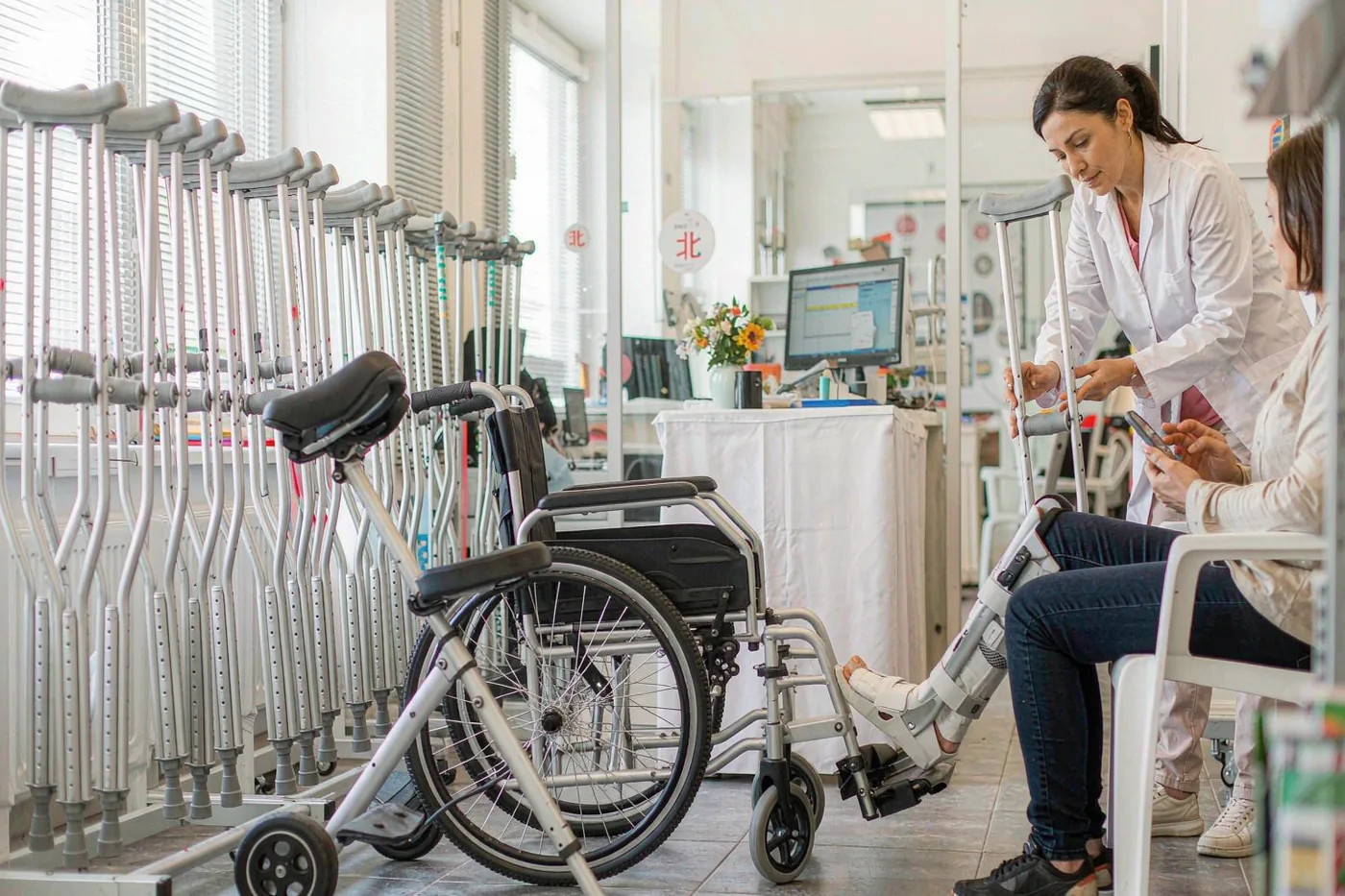
Explore Beijing / Broke a Leg Mid-Trip: Renting Crutches, Knee Scooters and Hospital-Grade Wheelchairs in Beijing (with Hotel Delivery)
Broke a Leg Mid-Trip: Renting Crutches, Knee Scooters and Hospital-Grade Wheelchairs in Beijing (with Hotel Delivery)
A broken foot or sprained ankle doesn't have to end your Beijing trip. Here's how to get mobility equipment quickly — pharmacies, medical equipment rental services, and hospitals — plus how to have it delivered straight to your hotel.
5 min read · KOULING's Beijing Travel Guide
A fractured foot or bad ankle sprain in a foreign city sounds like a trip-ender, but Beijing is surprisingly workable on crutches or a knee scooter. The city's metro has elevators at most stations, major attractions offer wheelchair access, and medical equipment rental is a mature business here. This guide walks you through getting the right equipment fast, without Mandarin, and often with same-day delivery to your hotel door.
First: Get a Proper Diagnosis
Before renting anything, know what you're actually dealing with. A sprain that needs a brace and a fracture that needs a cast are different problems. Beijing's international-friendly hospitals — Beijing United Family Hospital and Raffles Medical — have English-speaking staff and can do X-rays on the spot. A consultation runs roughly CNY 500–1,500 (about US$70–210) depending on imaging [verify before travel]. They'll also write you a diagnosis report in English, which is useful for travel insurance claims. Bring your passport — it's required for foreign patient registration at any hospital [verify before travel].
Your Three Rental Routes
There are three practical ways to source mobility equipment in Beijing, from fastest to most custom. All are realistic for a foreigner without Mandarin.
Pharmacies (fastest for crutches) — Large pharmacy chains such as Nepal or Yaodian branches sell basic aluminum crutches for roughly CNY 60–200 (US$8–30) — often cheaper than renting for a short trip [verify before travel]. Staff rarely speak English; show a translation app or a photo of what you need.
Online rental platforms (knee scooters, wheelchairs) — Chinese platforms like Xianyu (闲鱼) and Meituan or JD rental listings offer knee scooters (膝部代步车) and hospital-grade wheelchairs for roughly CNY 30–80 per day (US$4–11) plus a deposit [verify before travel]. These are Chinese-language apps; your hotel front desk can help you order and translate.
Hotel-assisted delivery — This is the easiest route: ask your hotel front desk (or a Chinese-speaking friend) to call a medical equipment rental service and arrange same-day delivery to the lobby. Most Beijing hotels will happily do this — it's a routine request.
Hospital-Grade Wheelchairs: Buy vs. Rent
For a multi-week stay with a cast, a basic folding wheelchair may be worth buying outright: prices start around CNY 400–800 (US$55–115) at pharmacies and medical supply shops [verify before travel], comparable to 1–2 weeks of rental. Hospital-grade options with brakes, removable footrests and higher weight limits run more. If you rent, expect a deposit of several hundred yuan returned at pickup [verify before travel]. Never ship or fly with a rental — buy if your itinerary ends in Beijing; hotels can often help arrange a courier return if plans allow.
Beijing United Family Hospital
Beijing's best-known international hospital. English-speaking orthopedics, same-day X-rays, and English medical reports for insurers. In the east of the city (Chaoyang district); take a taxi or DiDi rather than the metro if you're injured.
Metro
Nearest station varies by campus — confirm current line and station, or use a taxi
Opening hours
24-hour emergency; outpatient clinics typically 08:30–17:30 [verify before travel]
Tickets
Consultation roughly CNY 500–1,500 (US$70–210) with imaging [verify before travel]
How long
Half a day for diagnosis, imaging and casting
Raffles Medical Beijing
Another international clinic popular with expats, with English-speaking doctors and direct billing for some Western insurers. Good for a second opinion or paperwork support.
Metro
Confirm current line and station for the clinic's location
Opening hours
Typically weekdays 08:30–17:30, some weekend hours [verify before travel]
Tickets
Consultation roughly CNY 600–1,500 (US$85–210) [verify before travel]
How long
1–3 hours
Major Attractions with Wheelchair Access
Once you're mobile, don't write off sightseeing. The Palace Museum (Forbidden City), the Temple of Heaven park and Beijing's major museums have ramps, elevators and free wheelchair loans at the entrance in many cases [verify before travel]. Bring your passport for entry at all of them — foreign visitors must book tickets online with ID in advance [verify before travel].
Metro
All three sites are reachable by metro — check elevator availability per station in advance
Opening hours
Generally 08:30–17:00, closed Mondays at most museums [verify before travel]
Tickets
Forbidden City CNY 40–60 (US$6–8) high/low season; Temple of Heaven park CNY 10–15 (US$1.50–2) plus building combo tickets [verify before travel]
How long
2–4 hours per site at reduced mobility pace
Practical Tips for Getting Around Injured in Beijing
Use DiDi instead of the metro on bad days — Rides across the city center typically cost CNY 20–60 (US$3–8). DiDi's English version app works with foreign cards and lets drivers see your pickup point precisely — crucial when you can't walk far [verify before travel].
Book accessible-ground-floor rooms or ask for a room change — Chinese hotels don't always advertise accessible rooms; call or ask the front desk for a room near the elevator. Staff will usually accommodate.
File insurance claims immediately — Keep every receipt (hospital, pharmacy, rental) and ask for English documentation — the international hospitals above provide these. Travel insurers typically require the report within days of the incident.
Ask your embassy's list of English-speaking doctors — The US Embassy and most EU/UK consulates in Beijing publish vetted medical provider lists — a good backup if the hospitals above are full.
Download a translation app before you need it — Google Translate may be unreliable in China; Pleco, Baidu Translate or Apple's built-in translation work well and can translate photos of Chinese product labels.