Explore Beijing / Receiving and Sending Packages in Beijing: Fengchao Lockers, Cainiao Stations and the Post Office
Receiving and Sending Packages in Beijing: Fengchao Lockers, Cainiao Stations and the Post Office
Where your parcel actually ends up in Beijing, how to get it out of a Fengchao locker or a Cainiao station, how to write a Chinese address that doesn't bounce, and how to send a parcel with nothing but your passport.
13 min read · KOULING's Beijing Travel Guide
Beijing's parcel network is one of the most efficient things you will run into in China, and one of the least explained. Order something in the morning and it can be sitting in a grey locker downstairs by dinner — same-day inside the city is normal, and next-day from a province away is ordinary. The catch is that almost none of it is signposted in English. The message telling you where your parcel is arrives in Chinese, the locker screen is Chinese-only, and the pickup code has a deadline. This guide walks through how to actually receive things in Beijing as a foreign visitor: where parcels go, how to get them out, how to write an address that won't bounce, and how to send a parcel yourself using nothing but your passport. For what you are not allowed to post and the customs rules on sending things home, see our separate posting-and-shipping guide — this one covers the everyday domestic side.
The three places your parcel ends up
Very few parcels in Beijing are handed to you in person. Couriers handle hundreds of stops a day and calling each recipient is not viable, so the default is to drop the parcel somewhere and send you a code. Knowing which of the three it went to saves a lot of wandering around the block.
Handed over in person — the courier calls your number and waits — often only a minute or two. Miss the call and it gets redirected to a locker or a station
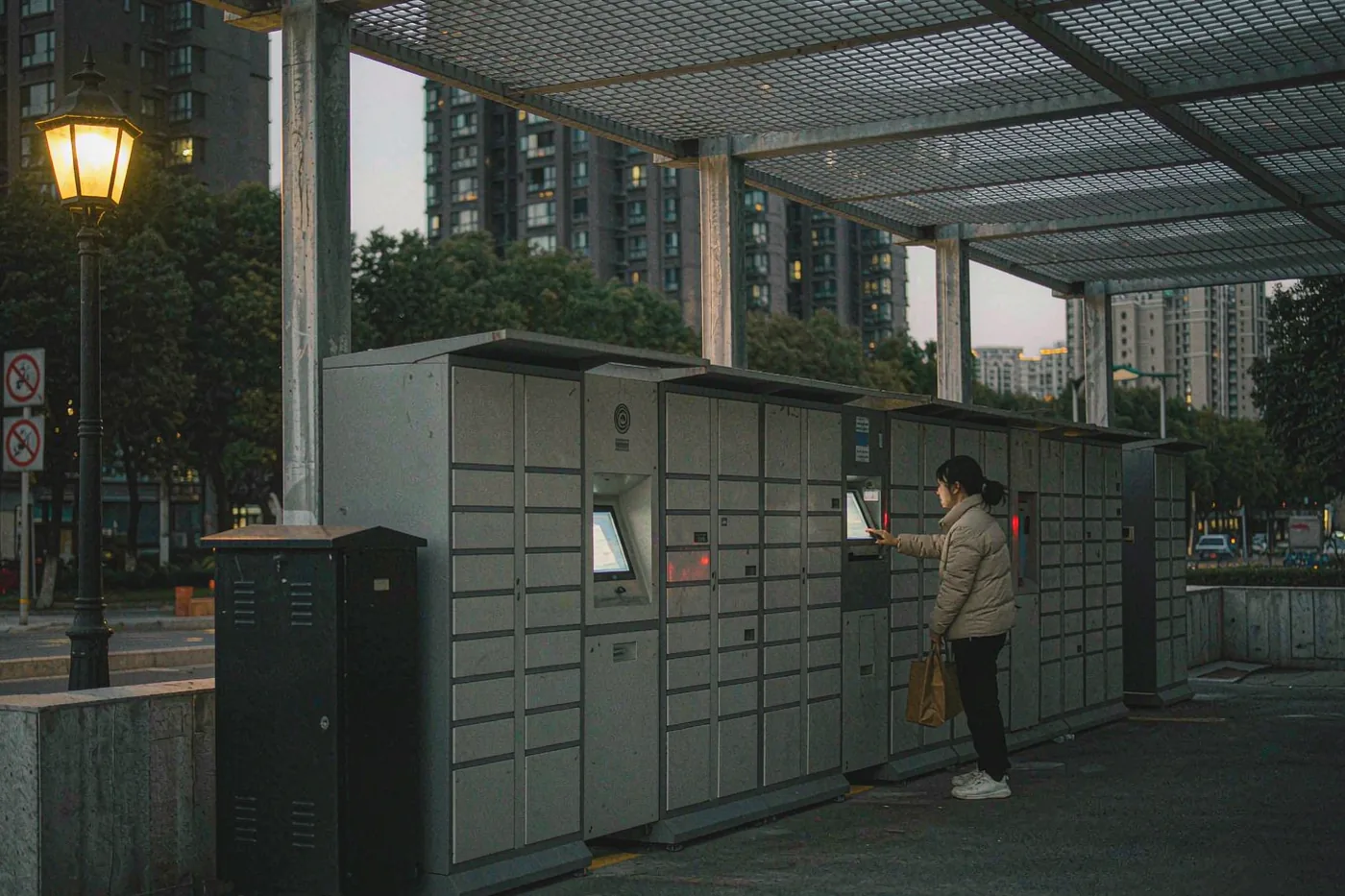
Fengchao locker (丰巢快递柜) — grey banks of metal cabinets in residential compounds, office lobbies and supermarket entrances. Self-service and open 24 hours, but fees start once the free window closes
Cainiao station (菜鸟驿站) or 快递驿站 — a shop-front counter — frequently a convenience store or a hairdresser — that holds parcels for several couriers at once. There is a human behind the desk, which makes it the easiest option if you don't read Chinese
Post office counter — only applies to China Post and EMS. You get a paper collection slip and must show ID to collect
Fengchao lockers: 18 hours free, then ¥0.50
Fengchao is the locker network you will hit most often. A parcel goes in, you get an SMS with a code and a free-storage window, and you tap the code on the screen to pop the door. The free window is 18 hours from delivery. After that, the fee runs at ¥0.50 per 12-hour block — any part of a block counts as a full one — and stops at ¥3. That is small money, but the annoying part is how the clock starts: couriers routinely deposit late at night, so a parcel dropped at 23:00 is already nearly out of free time before you wake up. If you are staying somewhere for a while, open the Fengchao app and go to 我的 → 偏好设置, where you can switch off courier deposit or block specific courier companies. It is not a perfect shield — couriers still use the locker when the merchant has masked your phone number behind a privacy number — but it cuts the problem down. Before you walk to the locker, have WeChat Pay or Alipay ready on your phone; the overtime screen is a QR code and there is no cash slot.
Free window — 18 hours from the moment the parcel is deposited; the exact figure is stated in the SMS or WeChat notice
Overtime charge — ¥0.50 per 12 hours, part-blocks rounded up, capped at ¥3 per parcel
Long-abandoned parcels — reportedly pulled out by the courier after about five days for redelivery or a phone call; local practice varies, so check the notice on the cabinet
Offline deposit refusal — Fengchao app → 我的 → 偏好设置. You can block by courier company and by weekday/weekend, though not by time of day
Payment — QR code on screen, WeChat Pay or Alipay only — no cash, no foreign cards at the cabinet
Cainiao stations: the counter with a human
A Cainiao station (菜鸟驿站) is the friendlier of the two options for anyone who doesn't read Chinese, because there is a person to talk to. You walk in, read out the code from your SMS or show the identity QR code in the 菜鸟 app, and they find the parcel on the shelves behind them. Cainiao's own help pages put the free holding period at five days from the day the parcel is signed in; some stations hold longer, and the notice pinned up in the shop is the authority that actually matters. Stations are not legally obliged to take everything. Per the official Taobao rules, they can refuse large appliances, fresh food, jewellery and antiques, and anything valued over ¥5,000 — and they can refuse purely on size: longest side over 55 cm, or length plus width plus height over 110 cm. Opening hours follow whichever shop hosts the counter, which usually means somewhere around 08:00 to 21:00. Over Chinese New Year, many stations simply shut for a week or two.
Free holding — five days from sign-in per Cainiao's help documentation — some stations allow longer; check the posted notice
Pickup code (取件码) — arrives by SMS, but you can also just show the staff your tracking page or the identity QR in the 菜鸟 app
One code, all your parcels — the identity QR (身份码) in the 菜鸟 app lets staff pull every parcel under your phone number at once
Refused categories — large appliances, fresh food, jewellery and antiques, and items over ¥5,000 in declared value
Size ceiling — longest side over 55 cm, or length + width + height over 110 cm — the station can turn it away
Hours — tied to the host shop, commonly around 08:00–21:00, with long closures around Spring Festival
When the pickup code never arrives
The single most common frustration is not the locker fee — it is never learning that the parcel arrived at all. Three things cause it. First, if you bound the Fengchao WeChat account, the system switches from SMS to WeChat push, which is far easier to miss. Second, if the merchant used a privacy number (隐私号码) to protect your real one, the locker cannot match you and the notification quietly fails. Third, ordinary SMS filtering. None of this means the parcel is lost. Every platform shows the code somewhere else, and the counter staff can find your parcel from your phone number alone if you show them the tracking page on your screen.
Taobao or Tmall order — open the order → 查看物流 (view logistics). The pickup code and the drop location appear at the top of the tracking page — no SMS needed
Alipay 我的快递 — search 我的快递 in Alipay; it aggregates every parcel tied to your phone number across carriers, which is the closest thing to a universal inbox
菜鸟 / 裹裹 app — the fullest view, plus the identity QR. Chinese interface only, but the parcel digits are universal
At the counter — show the staff your phone number or the tracking page; they can search by number and hand it over without the code
If the number on the order is foreign — roaming numbers generally receive the SMS, but delivery is less reliable than a Chinese SIM. Putting a hotel or friend's number on the order is the safer bet
Writing an address that actually gets delivered
Chinese addresses run big-to-small, the exact reverse of the English order, and rewriting one into English word order is the fastest way to confuse a courier. The other hard rule is the phone number: it is mandatory, it is how the courier reaches you, and it is how the station finds your parcel. Postcodes matter for China Post and barely at all for private couriers. Postcode is the one field where you can guess safely if you have to.
Order of the parts — 北京市 → 区 (district) → 街道/路 (street or road) → 小区或大厦 (compound or building) → 楼号 (building number) → 单元 (entrance) → 室 (room)
Template — 北京市 丰台区 XX街道 XX小区 3号楼 2单元 1501室 — copy the shape, fill in your own parts
Phone number — 11 digits for a mainland SIM. Without a reachable number, most couriers will not attempt delivery at all
Recipient name — write the name as it appears on the booking or on your passport. Style doesn't matter, consistency does
Don't translate it yourself — ask your hotel or host to write the address in Chinese and paste that in. A machine translation of a compound name will not match what the courier's app knows
Postcode — Beijing city-level code is 100000; district codes vary. Private couriers rarely check it ⚠️ 待人工确认
Having parcels delivered to your hotel
Hotels in Beijing take in parcels for guests as a matter of routine, and it is the simplest option you have — no codes, no lockers, no fees. Two things make it work: the name on the parcel has to match the name on your booking, and you have to add your room number somewhere. Front desks sort incoming parcels by room, and a parcel with no room number tends to sit in a tray until someone claims it. Ordering ahead is genuinely worth doing — a parcel that arrives the day before you check in is usually held at the desk waiting for you.
Use the hotel's Chinese address — copy it straight from your booking confirmation, or ask the front desk to write it out for you on paper
Match the booking name — a parcel addressed to a different name may never be matched to your room
Add the room number — put it in the address line or in the order notes so the desk can sort it immediately
Collect before you check out — most hotels will hold parcels for a short time afterwards but are not obliged to — confirm at the desk if you are expecting something
Keep it reasonable — a desk handling two hundred rooms is not set up for ten boxes. For anything bulky, use a station or a locker instead
Sending a parcel inside China: your passport is enough
China requires real-name sending (实名收寄) on all parcels, and the rule surprises a lot of visitors who assume it is residents-only. It isn't. Under the national regulation on real-name collection and delivery, a foreign citizen's passport is explicitly listed as a valid identity document, alongside the mainland ID card. So you can walk into any courier outlet, hand over your passport, and send a parcel — no Chinese ID, no local phone contract, no Chinese bank account. The courier records your document type and number but is not supposed to write it on the waybill itself. Bring the physical passport; a photo on your phone is usually refused, because the terminal wants to read the document.
Bring the physical passport — the courier scans or keys in the number — a photo on your phone will normally be turned down
Describe the contents in Chinese if you can — ask the clerk to write the item name for you; vague entries like 'gift' get flagged at sorting
Keep the waybill number — it is your only proof of sending if anything goes wrong
No ID, no send — under the real-name rules, a courier who accepts a parcel without checking ID is the one breaking the law — don't take it personally
Sending from the hotel desk — many front desks will call a courier for you and handle the paperwork. Easiest option if your Chinese is limited
What it costs, and which carrier to pick
Prices below are typical walk-in rates for a 1 kg parcel, drawn from 2026 market comparisons rather than any carrier's official tariff — the app will show you the exact figure before you confirm, and that number is the one that counts. The useful rule is not brand loyalty but weight: below about a kilogram the cheap carriers and the premium ones differ by a few yuan, and above about three kilograms the gap becomes large enough to matter.
SF Express (顺丰) — the reliable default. Roughly ¥12–15 within Beijing and ¥18–23 for 1 kg to another province; pickup usually within the hour and next-day delivery on most routes
ZTO / YTO / STO / Yunda (中通 · 圆通 · 申通 · 韵达) — the cheap workhorses. About ¥7–10 within the city and ¥11–15 cross-province for 1 kg, taking two to four days
China Post / EMS (邮政) — cheapest, especially for weight: around ¥5–6 within the city and ¥8–10 cross-province at 1 kg, but slow — three to seven days
JD Logistics (京东) — strong inside Beijing and often next-day, but you order it through the JD app rather than walking in
Anything over 3 kg — the spread widens fast. A 5 kg box runs roughly ¥20 by post, ¥28 by ZTO, ¥42 by SF — pick by weight, not by brand
Insure valuable items — declare the value and pay for 保价. Without it, compensation is capped at a small multiple of what you paid for postage, not the item's worth ⚠️ 待人工确认
When a parcel is late, stuck, or gone
Nine times out of ten, 'delivered' in the tracking app does not mean handed to you — it means deposited somewhere. Before assuming loss, check the nearest locker and the nearest station; the tracking entry usually names which one. If it is genuinely missing, the fastest route is the courier's own phone number, which is shown on the tracking page for the delivery attempt. A Chinese speaker at your hotel front desk making that one call resolves the large majority of cases. For Taobao and Tmall orders, refunds for lost parcels go through the seller, not the courier — open 查看物流 → 投诉 on the order and file there.
Delivered but not in your hands — check the locker and the nearest station first; 'delivered' almost always means 'dropped somewhere'
Call the courier — the delivery attempt line on the tracking page shows their number. Ask the front desk to dial for you if your Chinese is thin
Platform complaint — Taobao/Tmall: 查看物流 → 投诉 on the order. The seller handles the refund, and they will usually push the courier harder than you can
National postal complaint line — 12305 is the postal-authority complaint number for disputes a carrier won't resolve. Verify the current number and language support before relying on it ⚠️ 待人工确认
Check the tracking by number — any of the aggregator apps will track a waybill number across carriers without you knowing which company holds it
Put a reachable phone number on every order — no number, no delivery attempt — this is the single highest-value habit
Screenshot the tracking page — the pickup code lives there even when the SMS never arrives
Collect from lockers the same day — the 18-hour free window starts the second the courier closes the door, not when you notice
Turn off locker deposit if you are staying a while — Fengchao app → 我的 → 偏好设置
For bulky items, choose a station over a locker — locker doors have hard size limits and a big box may simply not fit
Carry your passport when sending — it is a legally valid ID for real-name sending, and a photo is usually refused
Insure anything you would mind losing — default compensation is pegged to postage, not to value
Ask the front desk for the address in Chinese — never machine-translate a compound or building name yourself