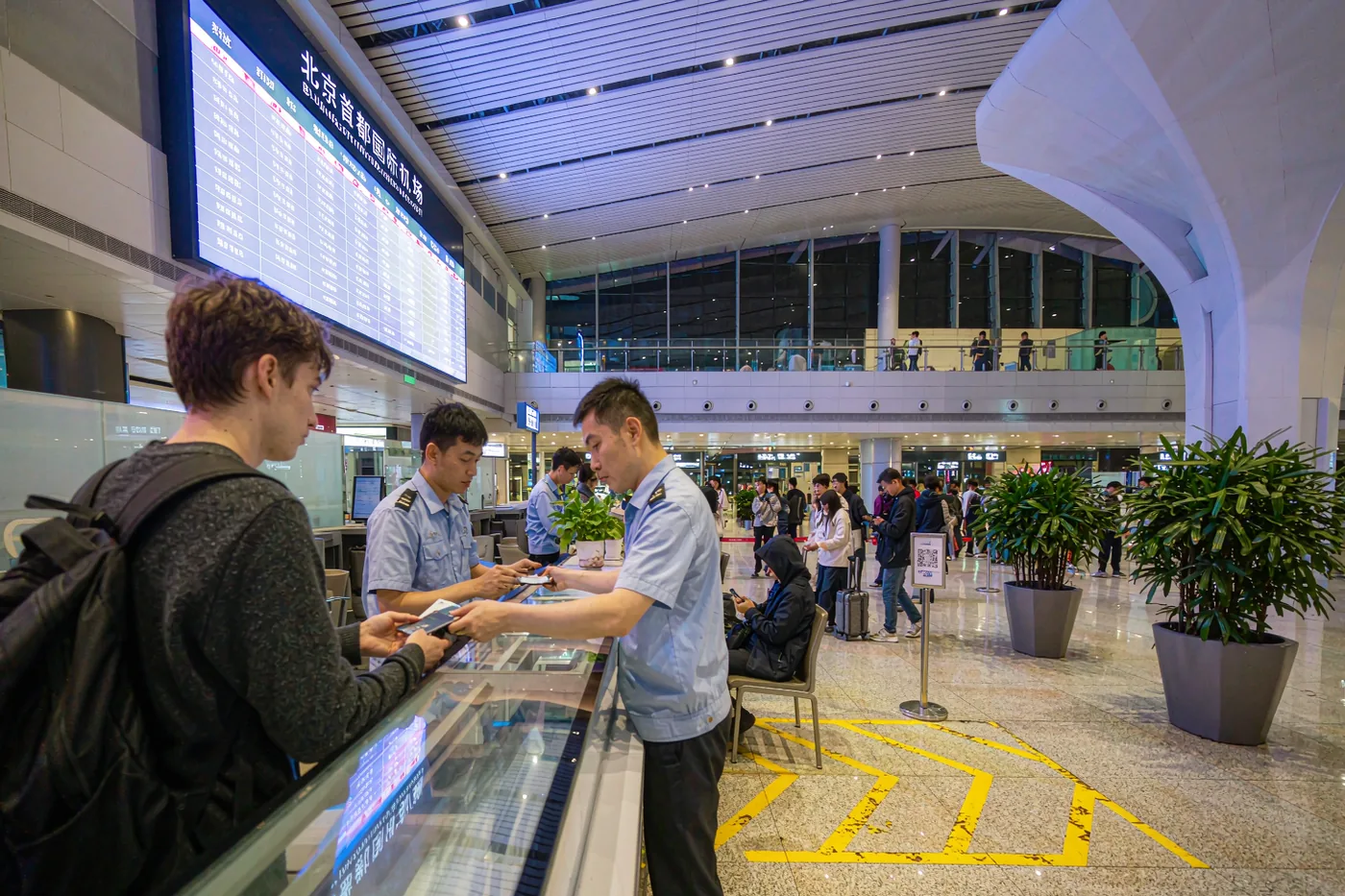
China does have a visa on arrival — the port visa — but it is not a tourist visa you can simply buy at the gate. Who qualifies, what to bring, what it costs, and how Beijing's airports handle it.
Every few weeks someone lands at Beijing Capital Airport holding a passport with no Chinese visa in it, asking the same question: can I just get one at the airport? The answer is a qualified yes. China does issue visas at the border — the port visa, or kou'an qianzheng — but unlike a true tourist visa on arrival, it is reserved for people with an urgent, documented reason to enter. This guide explains who can actually use it, what to prepare before you fly, what it costs, and where the offices are at Beijing's two airports. If you came for plain sightseeing and have time before your trip, none of this applies to you: use the visa-free entry policy or a regular visa instead [verify].
A port visa is a method of getting a visa, not a category of visa. That distinction comes straight from the National Immigration Administration, and it matters. The visa sticker you receive at the airport is the same kind of document you would have collected at an embassy — an M visa for business, an F visa for exchanges, a Q2 for family visits — it is just issued at the border instead of abroad. The legal basis is Article 20 of the Exit and Entry Administration Law, which lets the port visa authority issue a visa to a foreigner with an urgent need to enter who could not complete the process at an embassy in time. Two hard limits are written into the law itself: the visa is valid for a single entry, and the duration of stay stamped on it cannot exceed 30 days [verify].
The official list of qualifying situations is narrow. You may apply if you urgently need to enter China for business cooperation, visits and exchanges, investment or starting a business, visiting relatives, or other private affairs, or for humanitarian reasons such as attending a funeral or visiting a critically ill family member — and you had no time to arrange a visa at an embassy before travelling. Conditions were relaxed further in January 2024, when the immigration authorities expanded the eligible categories and eased the paperwork [verify]. What is not on the list: planned tourism. An individual traveller cannot show up for a holiday and ask for a port visa. Group tourism is possible only when a licensed Chinese travel agency organises the trip and applies to the port visa authority in advance on the group's behalf.
Beijing has port visa offices at three points, and all of them operate around the clock according to the Beijing Public Security Bureau's published service guide: the port visa office at Terminal 2 of Capital Airport (PEK), the one at Terminal 3 of Capital Airport, and the port visa office at Daxing Airport (PKX). You apply on the landside of the border inspection area, before passing immigration. One rule that catches people out: a port visa must be used to enter through the port that issued it. If your visa is issued at the Daxing office, you enter China at Daxing — you cannot collect the visa at one airport and walk through immigration at another. If you are connecting onward, factor that into your booking.
The core package is the same for everyone: a passport valid for the trip, the port visa application form, and materials that prove your urgent reason. The proof is where applications live or die. For urgent business (an M visa), the inviting Chinese company must provide an invitation letter that states the business purpose, why the matter is urgent and cannot wait, the main itinerary, plus a copy of its business licence. For an exchange visit (F visa), an official letter explaining the urgent matter. For a family visit (Q2 visa), an invitation from your Chinese or permanent-resident family member that explains the family relationship and the emergency. For crew (C visa), a letter from the transport operator. The Beijing guide also lists special channels for Zhongguancun talent and interns — those matter to expats, not to visitors. Vague stories do not work; officers can and do interview applicants to verify the reason is real [verify].
You are allowed to apply on arrival with nothing arranged in advance, but the National Immigration Administration explicitly recommends against it. Here is why: the port visa authority can refuse an application without giving a reason — the law says so explicitly — and if you are refused at the counter, you are stuck airside with a wasted flight. The standard practice is for your inviting company or contact to submit the application on your behalf before you travel. The authority reviews it, and if it passes, issues a port visa acceptance notice (the receipt form) to the inviting unit, which stamps it and sends it to you. You then fly to Beijing with that notice plus your passport, and the actual visa sticker is issued at the airport after your documents are checked. This pre-review step turns a gamble into a near-formality, and Chinese companies that invite foreign guests regularly already treat it as routine.
The published fee standard for a single-entry visa is 160 yuan per person for most nationalities; nationals of countries with reciprocal fee agreements pay the agreed rate instead [verify]. Bring cash in yuan — the offices at the border are not set up like retail counters. The visa itself is a proper sticker visa placed in your passport, valid for one entry, with a duration of stay of up to 30 days written on it. The clock starts when you pass immigration, not when the visa is printed. If your genuine need exceeds 30 days, you do not get a longer visa at the border: you apply to the local exit-entry administration (the public security bureau in your district) while your port visa stay is still valid, and they can convert or extend your arrangements.
Three different schemes get confused with each other, and picking the wrong one is how people end up refused at check-in. The 240-hour transit visa-free policy lets eligible passport holders transit through China to a third country without any visa, staying up to 240 hours in approved areas — that is a transit arrangement, not entry for business or family visits, and it has its own guide on this site. Unilateral visa-free entry now covers many European and Asian nationalities for short ordinary trips, usually up to 30 days, again with its own conditions. The port visa is the fallback for everyone else: people whose nationality carries no visa-free deal, whose purpose does not fit transit rules, and whose reason to travel is genuinely urgent. Check in this order: visa-free entry, then transit schemes, then a regular e-visa or embassy visa, and only then the port visa [verify].
Four things can go wrong, and you should plan around all of them before you book a flight. First, your airline, not the border, checks documents at check-in: many airline staff have never heard of the port visa and may refuse to board you without a visa or a documented approval. Get the pre-declaration notice so you can show something concrete. Second, approval is discretionary — the authority may decline without explaining why, so an urgent reason with weak paperwork is a real refusal risk. Third, you must enter at the issuing port, which constrains multi-city routings. Fourth, the 30-day ceiling is a hard legal limit; do not plan a two-month stay on a port visa. If any of these risks is unacceptable for your trip, arrange a regular visa through an embassy or the online application channel instead — that process is well documented elsewhere on this site.