Explore Beijing / Beijing Photo Spots: Where and When to Shoot Without a Drone
Beijing Photo Spots: Where and When to Shoot Without a Drone
Twelve ground-level locations that beat any aerial shot — Jingshan at golden hour, Mutianyu and Jinshanling on the Wall, hutongs at dawn, CBD at blue hour — plus timing, gear and the rules that get photographers told off.
6 min read · KOULING's Beijing Travel Guide
As of 2026 Beijing is closed to drones citywide and you cannot legally bring one into the city (see our drone rules guide) — which is a smaller loss than it sounds. Every iconic Beijing image was made from the ground: the palace roofscape from Jingshan, the Wall snaking over a ridge, hutong lanes in morning light, the CBD at blue hour. This guide gives twelve locations, the time of day each one wants, where to stand, and the rules that get photographers stopped.
Timing beats location
The same spot produces a postcard or a grey snapshot depending on the hour.
Golden hour — Roughly 20–40 minutes after sunrise and before sunset. In summer that is around 4:30–5:30am and 18:00–19:00; winter sunrises are late but the air is clearest.
Blue hour — The 20–30 minutes after sunset, when city lights balance with residual sky light. This is the window for long-exposure cityscapes.
Avoid 10:00–15:00 — Harsh overhead light, peak crowds, and haze at its most visible. Indoors or lunch, not landscape.
Air matters — Clarity is best after rain or on a windy day. On high-AQI days the light scatters and everything reads flat — don't blame your camera.
Arrive early — Get to a spot 20–30 minutes before the light, to pick a position and wait. The best ledge is taken by whoever turns up first.
Forbidden City & Jingshan — the money shot
The palace from above, and the palace from inside. Both need booking or timing.
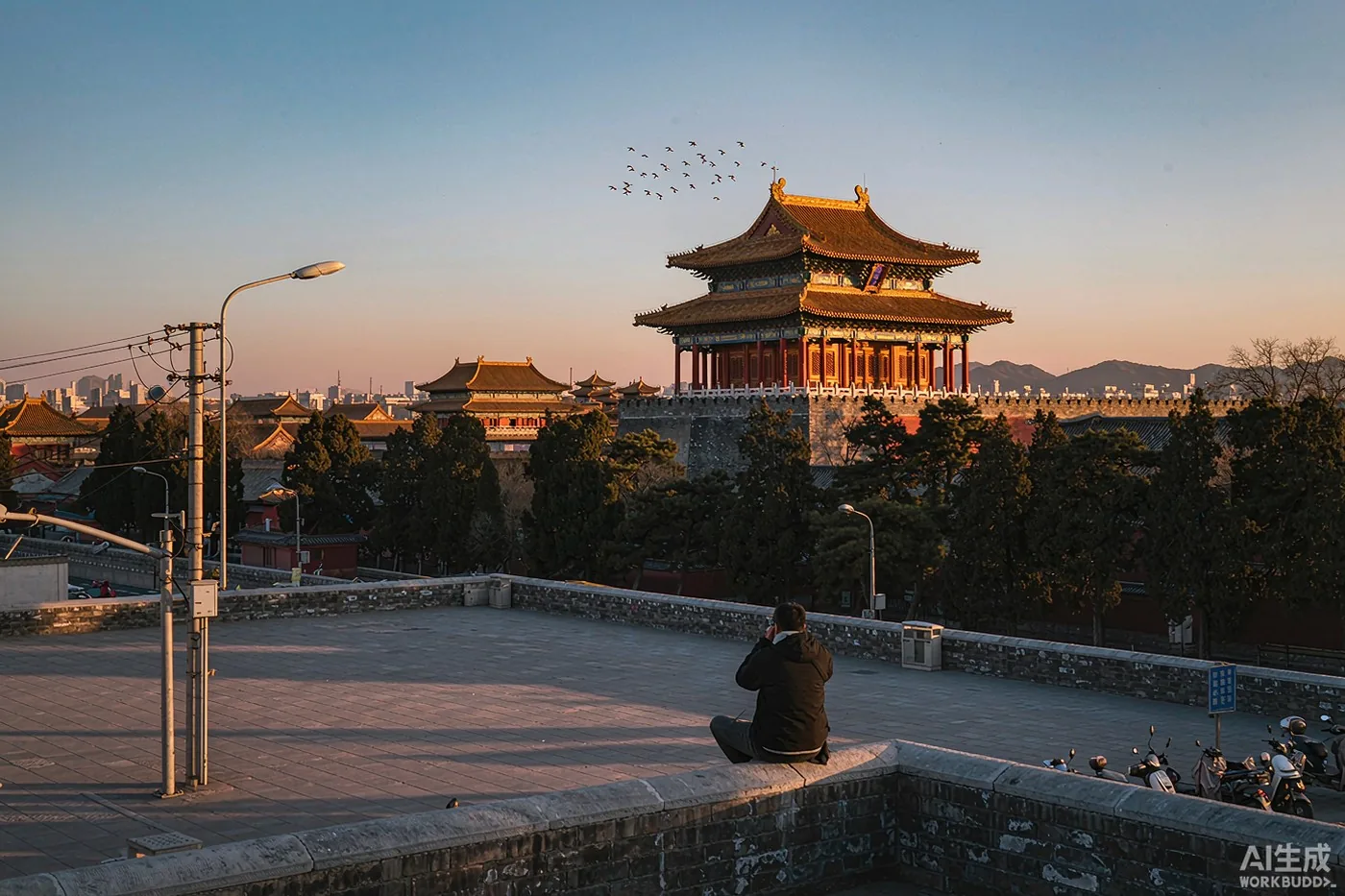
Jingshan Wanchun Pavilion — The only place to shoot the whole roofscape. RMB 2 entry, about 10–15 minutes up from the south gate. Sunset is the classic — the glazed tiles go gold — but 6:30–8:00am is empty and can catch the palace in morning mist.
Meridian Gate — Symmetrical red wall against blue sky; best from the forecourt in morning light.
Side corridor at the Hall of Supreme Harmony — Step off the central axis and the crowds disappear from frame — the shot that makes the palace look empty.
Treasure Gallery corridor — Red wall with hard shadow — the strongest interior light in the palace.
Imperial Garden — Pavilions and old trees, softer and quieter than the courtyards.
Gate of Divine Prowess at dusk — Backlit exit shot along the wall.
Moat corner towers (free) — Outside the east and north moat, especially at dusk — the classic silhouette, no ticket needed.
The Great Wall
Two sections do almost all the work: one for the classic curve, one for photographers willing to start at 4am.
Mutianyu — The iconic wall-over-ridge composition, restored brick against forested mountains. Morning light brings out texture; take the cable car up and save your legs for walking the wall.
Jinshanling — Xiaojinshan Tower — The acknowledged best seat for cloud-sea sunrise. Opens 5:00 in peak season, with early entry around 4:00 for sunrise shooters. Tickets RMB 65 peak / RMB 55 low season; cable car RMB 60 one-way, RMB 100 return.
When clouds happen — Highest probability is a clear morning after an overnight rain with a big temperature drop. After 9:00 the mist clears and the tour groups arrive.
Lenses — Wide angle for the wall's curve, telephoto to compress ridge layers, tripod for smooth long exposures of moving cloud.
Dawn on the ridge — It is cold up there even in June — bring a light shell. Steps are steep and wet with dew: non-slip shoes, head torch if you start in the dark.
Temples, parks and lakes
Slower subjects, and the ones that still work at 9am.
Temple of Heaven — The Circular Mound and Hall of Prayer for Good Harvests: blue tiles and gold finial are most saturated in low morning sun. The park's morning tai chi crowd is the better human subject.
Summer Palace, Kunming Lake — Reflections are calmest at sunrise and blue hour; the Marble Boat is the signature frame. Winter brings frozen water and far fewer people.
Beihai Park — The White Dagoba, best framed from the round city or the Five-Dragon Pavilions.
Shichahai / Houhai — Sunset and lantern-lit night reflections along the bar strip.
Hutongs and street
The most Beijing-looking frames are usually within a 10-minute walk of a metro exit.
Nanluoguxiang, Wudaoying, Guozijian Street — Courtyard gates, red lanterns, everyday life. Low sun rakes across the narrow lanes and gives depth; snow in winter is the bonus.
Yangmeizhu Xiejie & Liulichang — Old shopfronts and brick carving, with noticeably fewer visitors than Nanluoguxiang.
Etiquette — Signal before photographing residents; don't step into courtyards; some gateways post no-photography notices — respect them.
Drum & Bell Towers — Shoot the towers from the south for clean elevation, or from the surrounding hutong roofs at the café level.
Modern Beijing and night
Blue hour into night is where the modern city earns its keep.
CCTV Headquarters — Beijing's most geometric building; frame it from the streets east of the Third Ring.
Guomao CBD — The skyline shot — best in blue hour, when the towers still read against the sky rather than black.
Olympic Park — Bird's Nest and Water Cube light up after about 19:30 in summer; reflections in the water in front.
Sanlitun & Solana — Neon signs, street light and people — the easiest place to shoot at night without a tripod.
Wangfujing — Illuminated shopfronts and pedestrian energy.
Gear and the rules
What to carry, and what will get you stopped.
Three lenses' worth — Wide for context, telephoto for compression, tripod for blue hour and cloud exposures. A phone handles daylight fine.
Drones — Citywide no-fly and drones may not be brought into Beijing at all in 2026. Don't attempt it — confiscation, fines and possible detention.
Selfie sticks & tripods — Banned inside the Forbidden City and in most museums. Use them outside and in parks.
Don't photograph — Military sites, police and government buildings. You can be asked to delete images.
Commercial shoots — Wedding, fashion and paid portrait work inside scenic sites requires the site's permission. Book it, don't assume.
Tripod tactics — Where tripods are unwelcome, a small clamp or a phone against a wall gets the same long exposure.
Related Beijing guides
If you found this useful, these cover the next question most visitors ask: