Where to buy a phone in Beijing without being taken for a ride: the five Apple stores and how to reach them, what mainland-model phones do differently, how the departure tax refund applies, and what a repair actually costs.
Somewhere between a cracked screen on day two and a charging port that gives up on day five, a lot of visitors to Beijing end up standing in a phone shop. The good news is that Beijing has genuine Apple retail stores staffed in English, with fixed prices and the same warranty you would get at home, plus brand stores for every Chinese manufacturer and same-day delivery from the big online platforms. The bad news is that it also has a gray market that has spent twenty years refining the art of selling a foreigner a phone that is not quite what was discussed. This guide covers where to buy, what a mainland-model phone does differently from the one you have at home, how the departure tax refund works on a phone, where the scams actually are, and what repairs really cost.
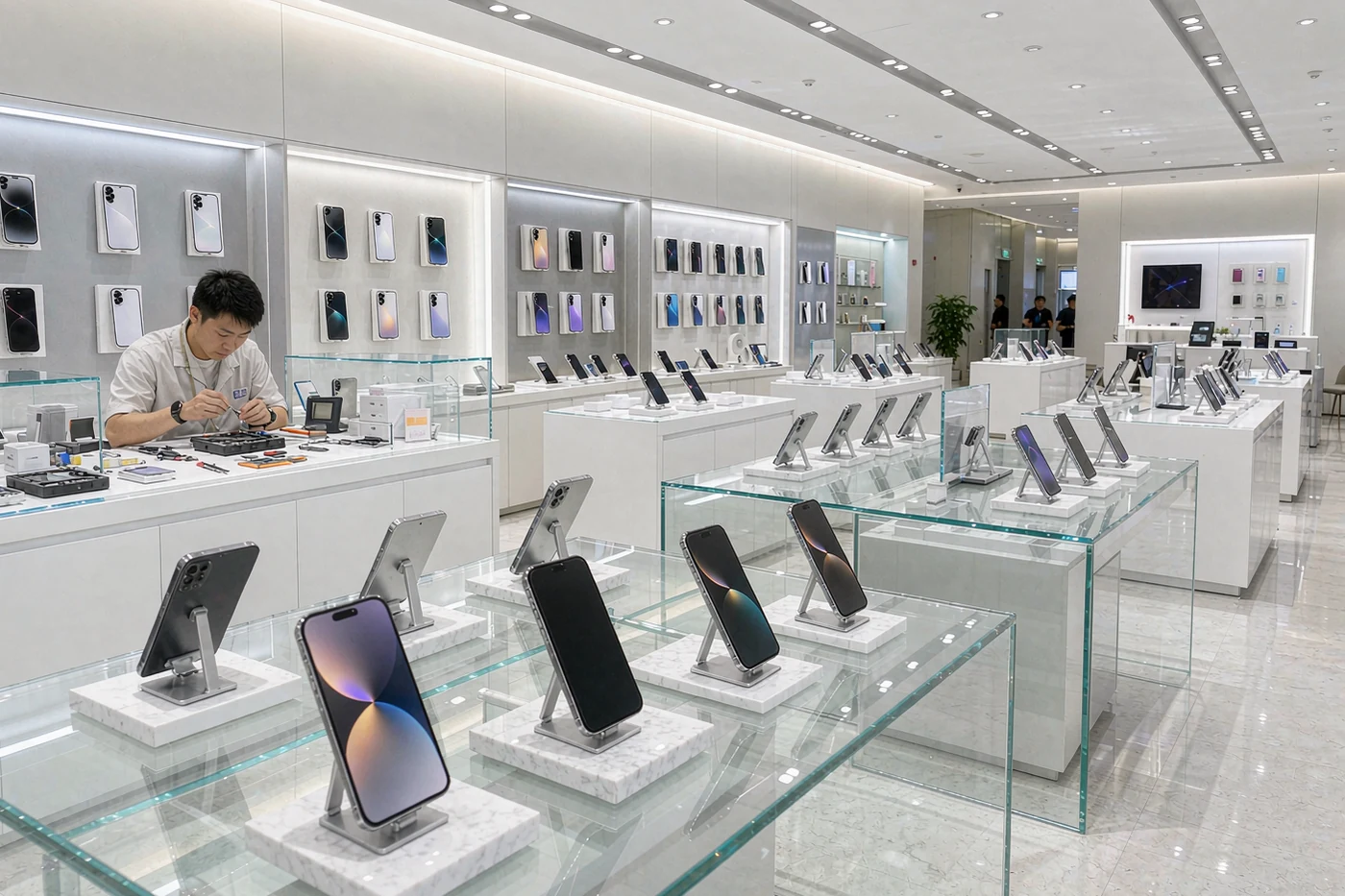
Apple runs five of its own retail stores in Beijing — not resellers, the real thing — with fixed prices, English-capable staff and Genius Bar service. All five are inside malls you can reach directly by metro, which matters more than it sounds in a city this size. Check the current list and today's opening hours on Apple's China retail page before you cross town; store rosters and hours do change.
For anything that is not an iPhone, the equivalent of 'official' is the brand's own store, or its flagship storefront on JD.com or Tmall. Xiaomi runs walk-in Xiaomi Home stores all over Beijing; Huawei, Honor, vivo and OPPO all have mall branches. Prices at brand stores are fixed — there is nothing to haggle over, and if someone opens with a negotiation, that tells you something about who you are dealing with. When you pay, ask for a 发票 (fapiao, the official invoice). You need it for any warranty claim and for the tax refund, and it is far harder to obtain once you have left the shop.
Three things catch visitors out. First, network features: mainland-model iPhones have historically shipped without eSIM, using two physical SIM cards instead, so if your whole connectivity plan depends on an eSIM, check the spec page for the exact China model number before you buy rather than assuming. Second, software: Huawei has not shipped Google services since 2019, and other Chinese brands ship a China ROM that is not the same build as the global one. If Google Play, Android Auto or one specific app matters to you, open it in the shop and prove it works before paying. Third, bands: Chinese-market variants sometimes omit LTE bands used in Europe and North America, which matters if you plan to keep the phone after the trip.
A phone is expensive enough that the VAT refund is worth the paperwork. Foreign passport holders on a short stay can claim VAT back on goods carried out unused, subject to a per-store, per-day minimum — commonly around ¥500 at a single tax-free shop on a single day. The refund is calculated against the VAT: roughly 11% on goods taxed at 13%, and about 8% on goods taxed at 9%, minus a handling fee, so in practice you get around 9–11% of the price back. Ask for the tax-refund form at the till, keep it with the fapiao and your passport, then present the goods, receipts and form to Customs when you fly out. Some shops offer an on-the-spot 'instant refund' (即买即退). Ask whether they do — but confirm the threshold and rate on the day, because both are set by policy and do change.
Zhongguancun, in the northwest of the city on Line 4, is Beijing's old electronics district and still the place visitors get taken to when someone wants to sell them a phone. The buildings are real and the shops are real; the problem is the pricing model. The classic routine is a price far below the official one, a friendly explanation about 'unlocked', 'Hong Kong version' or 'no tax', and then either a switch at the counter or a phone that turns out to be locked, refurbished, or not the model discussed. Nothing here is illegal to walk into — just understand that the discount is the product. And if anyone suggests continuing the conversation on WeChat or paying cash without an invoice, the deal is over.
China's second-hand market is enormous and genuinely useful, and it is where most foreign-buyer scams happen now — online rather than down an alley. Xianyu (Alibaba) and Zhuanzhuan are the two main consumer platforms; AiHuiShou is a trade-in and refurbished channel. The rules that matter: pay inside the app, because the platform holds your money until you confirm receipt; never accept an invitation to finish the deal on WeChat; and treat an inspection report as a starting point rather than a guarantee, because mis-graded phones on these platforms are well documented. For phones, look for the 验货宝 inspection-backed option, where the device goes to the platform's inspection centre before it reaches you.
For an iPhone, the official route is a Genius Bar appointment at any of the five stores, booked through the Apple Support app or Apple's China site. Walk-ins are taken if a technician is free, but do not build your day around it. Apple publishes out-of-warranty estimates: for recent models these run around ¥3,198 for a screen, ¥1,298 for back glass, ¥969–¥1,048 for a battery, ¥1,949 for a rear camera and ¥7,298 for 'other damage'. With AppleCare+ the same work is ¥188 for a screen or back glass, ¥628 for other accidental damage, and ¥0 for a battery below 80% capacity. Authorised service providers set their own prices. Apple generally services iPhones bought abroad, but for parts specific to a regional variant it can refuse — let them read the serial number before you plan around it.
If your phone is out of warranty, out of Apple's supported list, or simply not worth ¥3,198, a third-party shop is a reasonable call — a screen or battery swap is a walk-in, same-day job in most Beijing malls and electronics streets, and the price is a fraction of the official one. What you give up is parts provenance: a screen can be an original pulled part, a refurbished unit or a copy, and those are genuinely different products at different prices. Ask which grade of part you are getting, how long the job takes, and whether there is any warranty on the repair. Two things are non-negotiable: back everything up, and sign out of your Apple ID, Google account, WeChat and Alipay before the phone leaves your hands.
Google Pixel, Nothing and Sony are not sold through official channels in mainland China and there is no manufacturer service network for them. If you carry one, treat it as effectively unrepairable here: keep your data in the cloud, and accept that a third-party shop may attempt a screen or battery but will not have genuine parts. Samsung's retail presence in China is much smaller than in most countries — service exists in Beijing, but it is not on every corner. If your trip is long or your work depends on the phone, this is the strongest argument for buying an inexpensive local handset as a backup rather than gambling on a repair.
Work through it in this order. Write your IMEI down before you travel — you will need it for insurance or police paperwork, and it is on the SIM tray, in Settings and on the box. If the phone is stolen, file a police report: most travel insurers require one, and the station will give you a receipt. Then use Find My iPhone or Find My Device to lock it and, if it comes to it, erase it. Have your carrier block the SIM, and change the passwords on everything that was signed in, starting with WeChat and Alipay. For a replacement, a Xiaomi Home store or a JD order delivered to your hotel will put a working phone in your hand the same day or the next — considerably faster than anything involving an insurance claim.