Explore Beijing / Overnight Sleeper Trains from Beijing: Soft Sleepers to Xi'an, Shanghai and Beyond
Overnight Sleeper Trains from Beijing: Soft Sleepers to Xi'an, Shanghai and Beyond
How to book and ride China's overnight sleeper trains from Beijing — soft sleeper vs hard sleeper, what a cabin looks like, and which routes are worth the night on rails.
6 min read · KOULING's Beijing Travel Guide
China's overnight sleeper trains remain one of the best-kept secrets for first-time Western visitors. You board around evening, sleep horizontally in a lockable cabin, and wake up in a new city with a full day ahead of you — no airport transfers, no hotel checkout scramble, and a rail ticket that often costs less than a night's lodging plus a flight. High-speed rail has taken most of the limelight, but for long distances like Beijing to Xi'an or Beijing to Shanghai, a sleeper can save you both a day and a hotel night. Here's how it works, what to expect, and how to book as a foreigner.
Soft Sleeper vs Hard Sleeper: Which Should You Book?
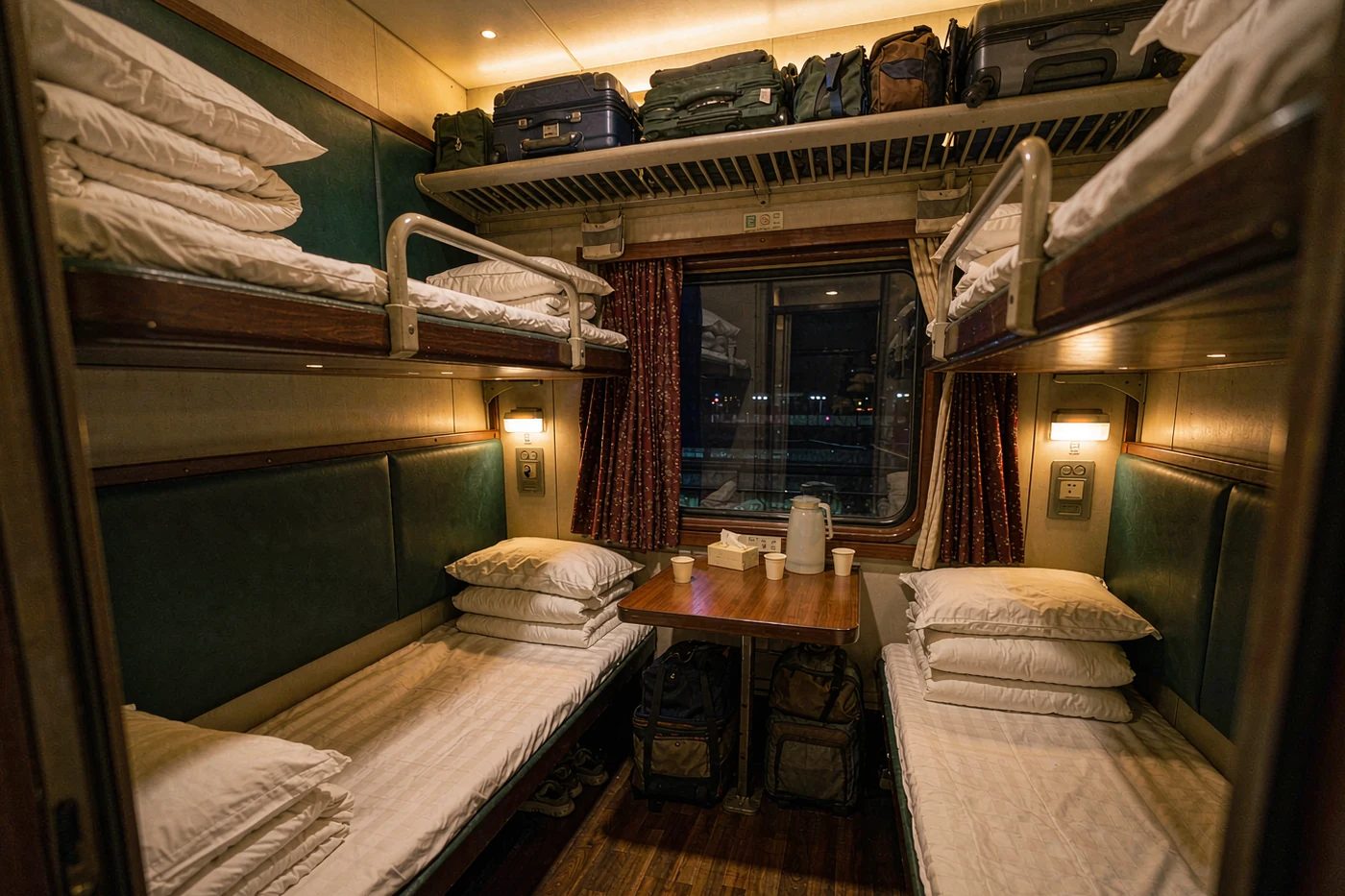
Despite the names, neither class is 'hard' in a painful sense — hard sleeper is open-plan with six bunks per bay and no door, while soft sleeper is a closed four-berth cabin with a lockable door, softer mattresses, and reading lights. For first-time visitors we recommend soft sleeper: better sleep, more privacy, and cleaner shared facilities. Prices vary by route and train, but as a rough guide expect hard sleeper to run roughly 150–350 CNY (about US$21–49) and soft sleeper roughly 300–600 CNY (about US$42–84) for long-distance runs [verify before travel]. Newer high-speed overnight D-trains also offer vertical sleeper pods in two- and four-berth configurations, which some travellers find more comfortable.
Hard sleeper (硬卧) — Open bay of six bunks (upper, middle, lower), no door. Cheapest lie-flat option and perfectly safe; less privacy and more foot traffic through the night.
Soft sleeper (软卧) — Lockable four-berth cabin, wider bunks, reading lights, power outlets. Best choice for light sleepers and couples; occasionally sold as an exclusive four-berth for families.
High-speed sleeper (动卧) — On newer D-trains, individual pods with beds arranged vertically. Quieter, faster journeys, usually higher prices [verify before travel].
Lower vs upper bunk — Lower bunks are prized — you can sit up and are near the floor. Upper bunks are cheaper but have little headroom. You generally can't choose when booking, so book early for the best chance of a lower berth.
Booking as a Foreigner
You can book online or in person. The official 12306 channel now accepts foreign passports and international payment cards, and third-party platforms like Trip.com offer English interfaces for a small service fee. Tickets typically go on sale around 14–15 days before departure [verify before travel] — sleeper berths on popular routes sell out fast, so set a reminder. Your passport is your ticket: at the station you pass through a passport gate or manual check, so arrive 45–60 minutes early. Bring your passport everywhere — you'll need it to board, and conductors may check it on the train.
12306 official app/website — Now supports foreign passports and some international cards [verify before travel]. English language option available. Cheapest route, no service fees.
Trip.com and other agents — English-friendly, accepts international cards, adds a service fee per ticket. Good fallback if 12306 rejects your card.
At the station — Ticket windows at Beijing's major stations can issue sleeper tickets with your passport, but popular berths may be sold out by then — best used as a backup [verify before travel].
Beijing West Railway Station (北京西站)
The main departure point for overnight conventional trains to Xi'an and cities to the south and west. It's huge, so budget time to get through security, passport check, and find your waiting room — your ticket or app shows the gate roughly 1–2 hours before departure [verify before travel]. Metro Line 9 and Line 7 serve the station.
Metro
Line 9 and Line 7; confirm current line and station exit for your train [verify before travel].
Opening hours
Station open roughly 05:00–24:00; overnight trains depart throughout the evening, typically 18:00–23:00 [verify before travel].
Tickets
Sleeper fares to Xi'an roughly 300–600 CNY (US$42–84) depending on class and train [verify before travel].
How long
Beijing to Xi'an by conventional sleeper around 11–13 hours [verify before travel].
Beijing South Railway Station (北京南站)
The hub for high-speed and overnight high-speed D-trains toward Shanghai and eastern cities. If you're taking a D-train sleeper with vertical pods, this is likely your departure point. The station connects directly to Metro Line 4 and Line 14, with plenty of cafes and shops in the departure hall.
Metro
Line 4 and Line 14 [verify before travel].
Opening hours
Departures from early morning to late evening; D-train sleepers often depart around 19:00–21:00 [verify before travel].
Tickets
Beijing–Shanghai D-train sleeper roughly 400–700 CNY (US$56–98) depending on class [verify before travel].
How long
Beijing to Shanghai on overnight D-train sleeper around 9–12 hours [verify before travel].
Beijing Railway Station (北京站)
The historic station northeast of Tiananmen serves some classic sleeper routes, including trains to the northeast and certain Xi'an departures. Check your ticket carefully — 'Beijing Station', 'Beijing West', and 'Beijing South' are three different places across town. Metro Line 2 serves Beijing Station directly.
Metro
Line 2 [verify before travel].
Opening hours
Open through the day; overnight departures concentrated in the evening [verify before travel].
Tickets
Fares vary widely by route and class; soft sleeper typically 300–600 CNY (US$42–84) for long hauls [verify before travel].
How long
Varies by destination; Beijing to Harbin sleeper around 8–10 hours [verify before travel].
On Board: What to Expect
Life on a Chinese sleeper is pleasantly routine. Each berth comes with a pillow, blanket, and fitted sheet — bedding is provided in both classes. There's a hot-water boiler at the end of each carriage, so bring instant noodles, tea, or a thermos. Toilets are squat-style (occasionally one western toilet on soft sleeper carriages) [verify before travel], and there's a simple washroom with running water. Bring your own toiletries and a phone charger — many soft sleeper cabins now have power outlets, but sockets vary by train age. Lights go out around 22:00, and the aisle stays dimly lit. Security is good: cabin doors lock, and attendants patrol the carriages. Keep valuables in your bag near your pillow and you'll be fine.
Pack a small overnight bag — Large suitcases go on an overhead rack or under the lower bunk. Keep one small bag with essentials, snacks, and chargers at your berth.
Food and water — A dining car exists on most conventional trains but meals are basic; most passengers bring instant noodles and snacks. Hot water is free — bring a collapsible cup. Bottled water is available to buy on board.
Getting off — Attendants usually wake you 30–40 minutes before arrival. Double-check your stop time the night before — some stations are announced in Chinese only.
Practical Tips for Your First Sleeper
Book 14–15 days ahead — Sleeper berths on popular routes sell out within hours of going on sale [verify before travel]. Set an alarm for the release time.
Check the station name on your ticket — Beijing has several major stations. 'Beijing West' and 'Beijing South' are 30–40 minutes apart by metro — arrive at the right one.
Bring cash or set up mobile payment — Onboard food carts may prefer Alipay/WeChat Pay; have a small amount of CNY cash as backup [verify before travel].
Earplugs and eye mask — Even in soft sleeper, you'll hear corridor chatter and announcement chimes. Pack earplugs, an eye mask, and slippers or thick socks.
Consider a daytime high-speed alternative — If sleepers are sold out, the Beijing–Xi'an or Beijing–Shanghai high-speed trains take 4.5–6 hours [verify before travel] — faster but you'll lose a day and need a hotel night.