Explore Beijing / Milk Tea in Beijing: Prices, Chains, and How to Order
Milk Tea in Beijing: Prices, Chains, and How to Order
Milk tea is Beijing's default street drink. The price ladder from ¥4 to ¥30, what the sugar and ice dials mean, and how to order without speaking Chinese.
7 min read · KOULING's Beijing Travel Guide
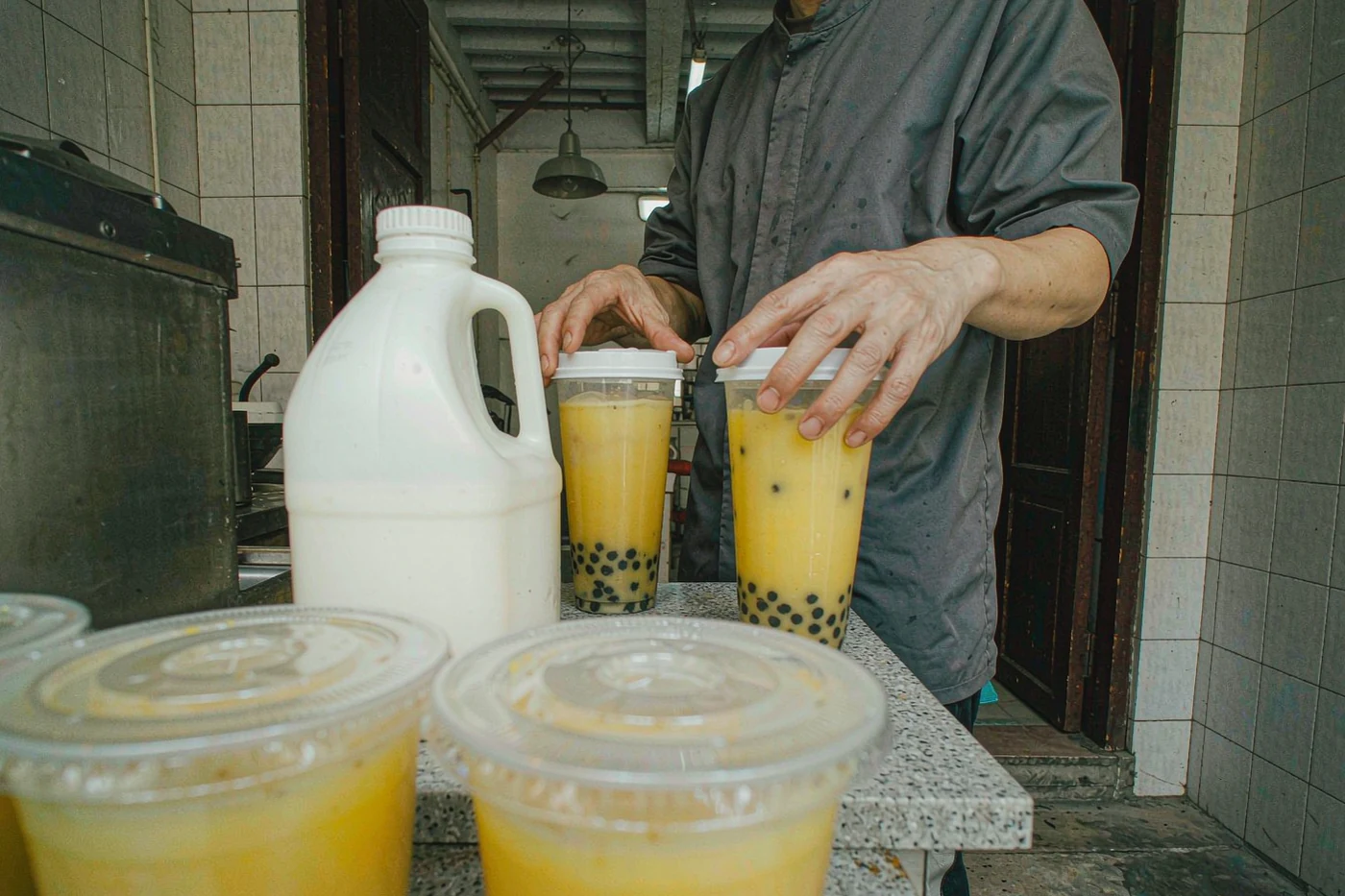
Beijing runs on milk tea. Within a block of almost any shopping street or metro exit you will pass a Mixue with its snowman logo, a CHAGEE with a line out the door at 3 p.m., a Heytea behind the mall glass. Milk tea (奶茶, nǎichá) here is not the occasional dessert it often is back home: it is a mass-market daily drink, most cups cost 6–20 RMB, and tea shops outnumber coffee shops several to one. This guide covers the price ladder, the four dials you choose when ordering — sugar, ice, size, toppings — and the exact mechanics of ordering in person or through an app without speaking Chinese.
What you are actually buying
Nearly every shop on the street is a chain making drinks to order from brewed tea, milk and fresh fruit. Styles fall into a few families: classic milk tea, fresh fruit tea blended from whole fruit, cheese-foam tea capped with salted cream, and pure tea lattes. Recipes change monthly and seasonal menus come and go, so treat any menu as a moving target. Also note this is a grab-and-go counter experience — for the sit-down, gongfu-style tradition, see our separate Beijing tea house guide.
The price ladder: which chain costs what
Chains sort cleanly into four price bands. Bands shift a few yuan with city and seasonal menus [verify], but the relative positions hold.
Mixue Bingcheng 蜜雪冰城 — ¥4–8 — The volume king, with tens of thousands of stores nationwide. Iced lemon water and jasmine milk green start around ¥4–7 [verify]; soft-serve cones are on the menu too.
Goodme, A Little Tea, CoCo, Auntea Jenny — ¥10–15 — 古茗, 一点点, CoCo都可, 沪上阿姨. The mid-band workhorses: customizable, consistent, rarely more than a two-minute wait.
CHAGEE, Heytea, ChaPanda — ¥15–25 — 霸王茶姬, 喜茶, 茶百道. Signature milk teas and cheese-fruit teas; the design-heavy flagships live in this band.
Nayuki 奈雪的茶 — ¥18–30 — The premium band; a few seasonal products run higher [verify]. Often co-located with its own bakery counter.
Dial one: sugar (糖度)
Most chains share the same ten-point sweetness scale, so the terms below transfer everywhere. Start at half sugar — you can always go sweeter next order, but a full-sugar first cup is often cloying. Note that scales are not identical across brands: 30% at one chain can taste closer to 50% at another [verify].
全糖 — full sugar — Sweeter than most Western soft drinks; only for the committed.
七分糖 — 70% sugar — A moderate choice for fruit teas.
五分糖 / 半糖 — 50% sugar — The safe default for a first cup.
三分糖 / 微糖 — 30% sugar — Tea flavor comes through; the regulars' setting.
无糖 / 不另外加糖 — no added sugar — Milk, fruit and toppings still carry some natural sweetness.
Dial two: ice (冰量) — and winter hot drinks
Ice is the second standard dial. By November, Beijing daytime temperatures are near or below freezing, so the hot option matters: milk teas almost always can be made hot, while fruit teas usually cannot, and some chains pull hot options from the menu once winter stock settles [verify]. Asking is free — say the word for hot or point at the 热 on the screen.
正常冰 — normal ice — Standard; the drink is cold and lightly diluted as it melts.
少冰 — less ice — More liquid in the same cup; flavor holds up longer.
去冰 — no ice — Still made cold, just without cubes.
常温 — room temperature — The middle option when it is freezing outside.
热 / 温 — hot / warm — Winter staple for milk teas; rarely available for fruit teas.
Dial three: size (杯型)
Sizes are simpler than at Western coffee chains. Most shops offer two — medium and large — with a handful adding an extra-large. The gap between medium and large is usually ¥1–3 [verify], so large is the default unless you want a short walk's worth of liquid. Order phrases put size after the drink name.
中杯 — medium — The default on most menus; roughly 500 ml [verify].
大杯 — large — Usually only ¥1–3 more; what most regulars order.
超大杯 — extra large — Not every chain carries it; more common at Mixue and mid-band brands.
Toppings (加料)
Toppings cost roughly ¥1–6 each depending on the chain [verify]. For a first cup, one topping is plenty — sweetness and texture stack fast.
珍珠 — tapioca pearls — The classic; ¥1–3 almost everywhere.
椰果 — coconut jelly — Crunchy, light, less sweet than pearls.
布丁 — pudding — Egg pudding that sinks to the bottom.
仙草 / 烧仙草 — grass jelly — Herbal jelly; the 烧 version arrives warm and saucy.
红豆 — red beans — Sweetened and soft.
奶盖 — cheese foam — A salted cream cap you sip through the gap, not a mix-in; ¥3–6 [verify].
How to order: counter or QR code
Two routes. At the counter, point at the menu board or use the phrase below, pay by Alipay or WeChat, and take a pickup number. Or scan the QR code on the counter (扫码点单): it opens a WeChat or Alipay mini program with the full menu, customization dials and mobile payment. Alipay can translate the page in-app, or a staff member can tap it through with you. Pickup numbers are announced in Chinese, so watch the screen above the counter instead of listening.
One pearl milk tea, large, less ice, 30% sugar — 我要一杯珍珠奶茶,大杯,少冰,三分糖 (wǒ yào yì bēi zhēnzhū nǎichá, dà bēi, shǎo bīng, sān fēn táng) — works at virtually any counter.
Do you have hot drinks? — 有热饮吗?(yǒu rè yǐn ma) — the winter question.
Drink here or takeaway? — 在这儿喝还是打包?— the cashier's question. Answer 在这儿喝 (here) or 打包 (to go).
Signature drinks worth a first order
If the wall menu paralyzes you, these five cover the whole range from ¥5 to ¥30 and are each chain's calling card.
Iced lemon water 冰鲜柠檬水 (Mixue) — Arguably the best-selling single drink in the country; ¥4–7 and sharply refreshing [verify].
Jasmine milk green 茉莉奶绿 (Mixue) — The ¥6 answer to what everyday milk tea tastes like here [verify].
Grape cheese-foam 多肉葡萄 (Heytea) — The drink that made the category: hand-peeled grapes under a salted cream cap.
Boya Juexian 伯牙绝弦 (CHAGEE) — Jasmine green tea with milk by the brand's own real-milk standard; its default bestseller since launch.
Green bottle 瘦瘦小绿瓶 (Nayuki) — A low-GI vegetable-forward fruit tea for the sugar-wary.
Getting it delivered
Milk tea is among the most delivered categories in China. Meituan (美团) and Eleme (饿了么) both cover central Beijing; delivery plus packaging fees typically add ¥3–8, and menu prices run ¥1–3 higher than in store [verify]. The 2025 delivery-subsidy war briefly pushed famous drinks down to one-cent promos before regulators stepped in, so budget for normal prices now. Cold drinks arrive in good shape; hot drinks survive 20–30 minutes of transit fine.
Small print worth knowing
Four things surprise first-timers. First, base quality differs: CHAGEE, Heytea and Nayuki brew from whole leaves and use real milk, while the cheapest cups at budget chains may use non-dairy creamer (植脂末) — fine for the price, just know what you are drinking. Second, no-sugar does not mean sugar-free: milk, fruit and toppings carry natural sugar regardless. Third, seasonal and viral items sell out (售罄) by mid-afternoon on weekends — the counter screen is the truth, not the poster outside. Fourth, you will never have to hunt for a shop: chains cluster at mall food floors, metro exits and transport hubs, densest around Wangfujing and Qianmen, and most trade past 22:00 [verify]. A branch one block off the main drag is quieter and identically priced.
Start at half sugar, less ice — The safest first order at any chain; adjust from there.
Pick the busy shop — High turnover means fresher brewed tea and chewier pearls; slow batches go hard.
Large is a cheap upgrade — 大杯 over medium typically adds ¥1–3 [verify].
Ask for 热 in winter — Milk teas usually can be made hot; fruit teas usually cannot.
One topping, not three — Toppings stack sweetness and cost; pearls alone are the classic.
Have Alipay or WeChat Pay ready — Counters and mini programs both run on QR payment; cash is rarely used.
Watch the screen, not the caller — Pickup numbers are announced in Chinese; the display shows the same number.