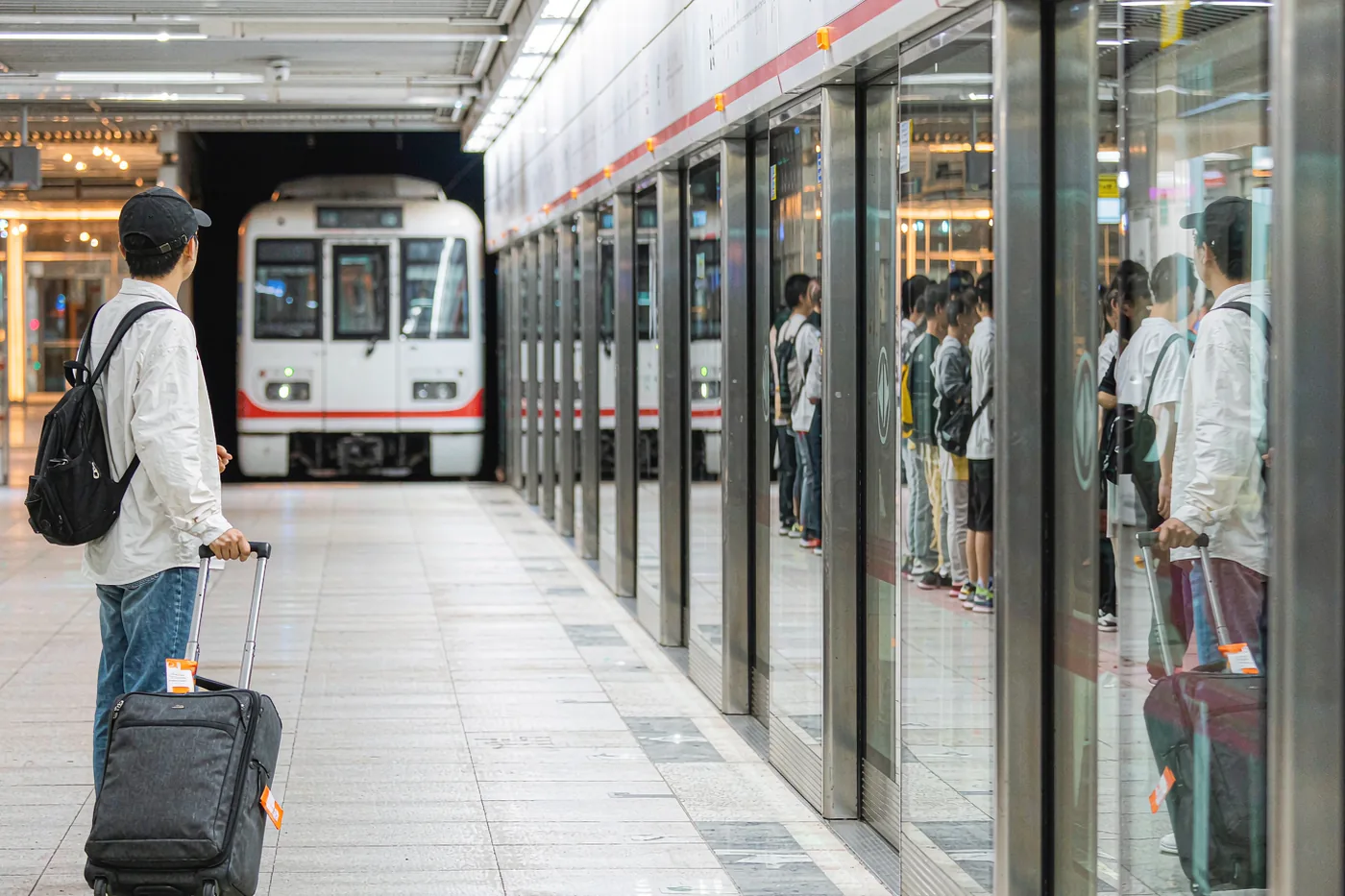
Explore Beijing / Beijing Metro Off-Peak Guide: When to Ride With Luggage Without Fighting the Crowds
Beijing Metro Off-Peak Guide: When to Ride With Luggage Without Fighting the Crowds
Rush hour on the Beijing Subway is real, predictable, and easy to avoid. Here's when the trains are quiet enough to roll on a suitcase — and which lines to dodge entirely.
4 min read · KOULING's Beijing Travel Guide
The Beijing Subway is one of the world's largest metro networks, clean, cheap, and usually the fastest way across town — a typical ride costs around CNY 3–7 (about US$0.40–1.00). But during morning and evening rush hours, certain lines and interchange stations get crushingly packed, and maneuvering a suitcase through that is miserable. The good news: crowding follows a very predictable rhythm, and if you shift your journeys by an hour or so, you'll often get a seat and room for your bags. [verify before travel]
Know the Peak Windows
Beijing's rush hour is roughly 7:00–9:00 a.m. and 5:00–7:30 p.m. on weekdays, with the worst crush in the core business districts. Weekend peaks are milder and shift later — mid-morning and late-afternoon shopping crowds rather than commuters. If you're arriving or departing with luggage, aim for the windows in between.
Best quiet windows (weekdays) — Roughly 10:00 a.m.–4:30 p.m. — trains are noticeably emptier after 9:30 a.m. and before 4:30 p.m. [verify before travel]
Worst times to avoid — 7:30–9:00 a.m. toward the city centre, and 5:30–7:00 p.m. outward from the centre. These are the truly packed trains. [verify before travel]
Late night — Most lines wind down between about 10:30 p.m. and 11:30 p.m., varying by line — check the last train time for your route, especially if heading to the airport express. [verify before travel]
Holidays — During Chinese national holidays (early October, late January/early February), patterns shift and stations can be crowded all day. [verify before travel]
Lines and Stations to Dodge at Rush Hour
Not all lines are equal. A few carry extreme commuter loads and pass through dense interchange stations where transferring with luggage is genuinely hard. If your itinerary is flexible, ride these outside peak windows.
Line 1 and Line 10 — Two of the busiest lines, crossing the CBD and major interchanges like Guomao. Expect wall-to-wall people at peak. [verify before travel]
Line 4 and Changping line corridors — Heavy commuter feeder routes into the city centre; northbound/southbound peak trains can be standing-room only. [verify before travel]
Big interchanges: Xizhimen, Guomao, Dongzhimen — Long transfer walks, stairs, and dense crowds at rush hour. Allow extra time and use elevators where available. [verify before travel]
Practical workaround — For long cross-city trips with luggage, consider a ride-hailing car (Didi, roughly CNY 30–80 / US$4–12 across town) during peak windows instead. [verify before travel]
Beijing Capital Airport Express and Daxing Airport Express
Both airport express lines have dedicated luggage space and are far roomier than ordinary metro lines — the easy exception to the rush-hour rule. Fares are higher than standard metro (roughly CNY 25–35 / US$3.50–5 per person, depending on line). Buy tickets or use a transit card at the gate.
Metro
Capital Airport Express serves Terminal 2 and Terminal 3; Daxing Airport Express serves Daxing Airport — confirm current route and interchange stations. [verify before travel]
Opening hours
Trains run roughly early morning to late evening, roughly every 8–10 minutes; confirm exact first and last departures for your day. [verify before travel]
Tickets
About CNY 25–35 (US$3.50–5) per person, higher than standard metro fares. [verify before travel]
How long
Roughly 20–40 minutes to central transfer points, depending on line and station. [verify before travel]
How to Buy Tickets and Enter the Station
Every station has security screening (bags go through an X-ray machine) and ticket machines with an English language option. Machine touchscreen interfaces and station signage are bilingual. If you'd rather skip ticket queues, use a transit card or mobile payment — though foreign visitors sometimes find a simple single-journey ticket the easiest option.
Metro
All stations are accessible via the network; check a metro app or station map for your nearest entrance. [verify before travel]
Opening hours
Most lines operate roughly 5:00 a.m. to 11:00 p.m.; exact times vary by line and station. [verify before travel]
Tickets
Single journeys from about CNY 3 (under US$0.50) based on distance; machines accept cash and sometimes mobile payment — carry small bills as backup. [verify before travel]
How long
Allow 5–10 minutes from street to platform including security and ticket purchase.
Practical Tips for Riding With Luggage
Ride between 10 a.m. and 4 p.m. — This is your sweet spot: seats are often available, elevators and gates are uncrowded, and you won't feel rushed. [verify before travel]
Use the first or last carriage — These are usually slightly less crowded than the middle cars and often closer to station elevators. [verify before travel]
Look for the elevators — Every major station has at least one accessible route — ask staff 'wú zhàng'ài diàntī' (barrier-free elevator) or show the phrase in your translation app. [verify before travel]
Security check is mandatory — Bags pass through an X-ray at every entrance; allow a few extra minutes at busy interchanges. [verify before travel]
Keep your bag in front of you — On crowded trains, place your suitcase between your legs or hold it directly in front — it's both courteous and secure.