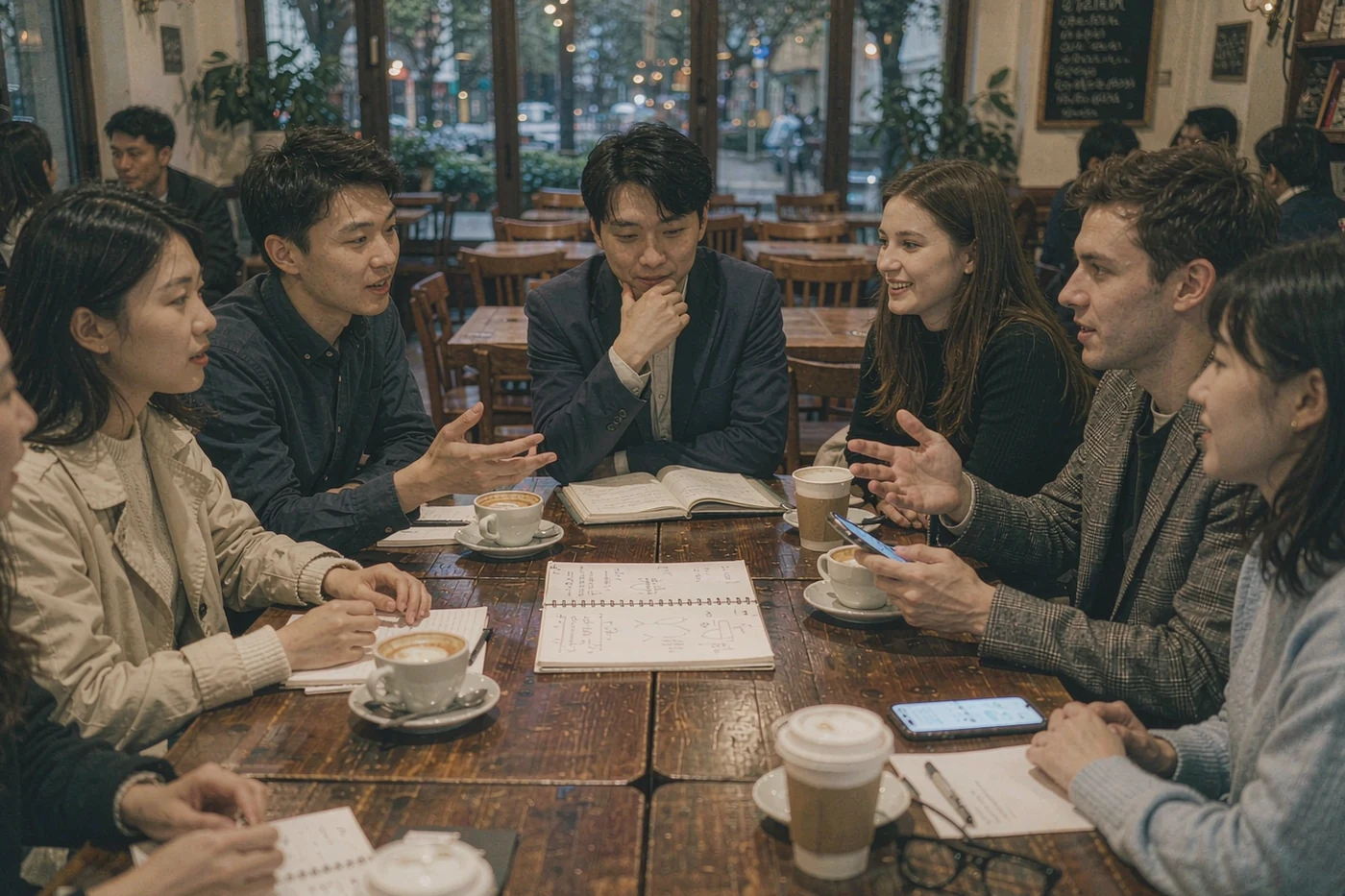
Beijing's social life is not hidden, it just runs on WeChat. The channels that reliably turn a visit into real friendships: language exchange apps, Beijing Language and Culture University, English salons listed on Chinese ticketing sites, cultural institutes, weekly sports groups and the 6 a.m. park crowd.
Beijing rewards the solo traveller: it is walkable in patches, the metro is cheap and predictable, and nobody bats an eyelid at someone eating alone. What the city does not do is introduce you to people. That social layer is not hidden behind a language barrier — plenty of Beijingers under forty speak some English — it is hidden behind WeChat, behind university campuses, behind weekly clubs that never advertise in English, and behind a local habit of being introduced rather than introducing yourself. This guide sets out the channels that reliably produce friendships with actual Beijingers, roughly in order of how much effort each costs, from 'download an app tonight' to 'be standing in a park at half past six in the morning'. A few are famous inside China and invisible outside it. Most are boring and repetitive. Almost none of them require fluent Mandarin, and none of them require you to spend your evenings in an expat bar.
Every club, class, pub quiz, hiking trip and badminton court booking in Beijing ends in the same place: a WeChat group, a 群 (qun). If you use WeChat only as a payment app, you are standing outside the building with the door open beside you. You do not need group invitations from strangers on day one; you need to know how the mechanism works, so that when someone offers you a QR code in a hostel lobby you use it in the right minute rather than later in the week.
Here is the asymmetry that makes this the highest-yield option available to you. Millions of Chinese users are looking for English conversation practice; comparatively few are looking for a Mandarin teacher who pays them. If English is your first language, your inbox fills up within hours of a profile going live. The usual mistake foreigners make is writing a profile that asks ('I want to learn Chinese'). Write one that offers something: conversation practice, proofreading a CV, IELTS or TOEFL preparation, help with an English presentation, pronunciation coaching.
If you want Chinese people who are actively looking for foreigners, go where Chinese people study languages for a living. Beijing Language and Culture University (北京语言大学, BLCU) in Haidian is nicknamed the Little United Nations, after the Wall of Nations on campus, which carries the names of the 161 countries its international students come from. Chinese students on the same campus read English, French, Spanish, Arabic and Korean as majors, and most of them would rather practise with a real person than with a textbook. The campus sits at 15 Xueyuan Road (学院路15号): Line 15 to Liudaokou (六道口) for the east gate, roughly 400 to 800 metres south depending on which gate you aim at, or Line 13 to Wudaokou (五道口) for the south gate. Visitor rules for outsiders change from year to year, so walk in during daylight, carry your passport, and treat access as something to check rather than assume. [verify] Right next door, Wudaokou has been Beijing's student quarter for two decades — cheap Korean restaurants, second-hand bookshops and language exchange evenings that anyone can walk into.
The classic 英语角 (English corner) — a knot of people practising English in a park corner every Sunday morning — still exists in memory more than in reality. What replaced it is better organised: ticketed events listed on Chinese platforms, usually free, often held inside a park or a café back room, run by language schools, translation companies or simply by enthusiastic individuals. You will find them only if you search in Chinese.
This is the most underrated route to a conversation with a Beijing intellectual. The Beijing German Cultural Centre · Goethe-Institut China runs a full programme of talks, readings, film screenings and exhibitions from its base at Originality Square, 798 Art District, 2 Jiuxianqiao Road, Chaoyang (朝阳区酒仙桥路2号798艺术区创意广场, +86 10 5762 6166); its language department is elsewhere, on the 17th floor of Tower B, Cyber Tower, 2 Zhongguancun South Street in Haidian (+86 10 8251 2909). Events are advertised as free but usually require registration by email, and the interesting ones cap numbers tightly — a recent monthly reading club took 25 to 30 people for five sessions spread over as many months. Other cultural institutes in Beijing, including the Spanish Instituto Cervantes and the French Alliance Française (法语联盟), run comparable programmes with similar conditions — confirm current address and booking arrangements for yourself. [verify] Note that plenty of events are conducted mainly in Chinese, sometimes with partial interpretation. Go anyway: the audience is local, curious, and unafraid of talking to a stranger.
Repetition is the whole trick. A single event produces a pleasant evening; a weekly activity produces friends inside a month, because friendship is mostly accumulated low-stakes contact. Sport is the easiest category, because it needs almost no shared language and Beijing has enormous indoor provision for it.
Before work, Beijing's parks belong to people who have both time and a wish for company. Near every main gate you will find tai chi groups keeping formation, circles kicking a jianzi (毽子, a weighted shuttlecock) and simply opening a gap when you step in, water-brush calligraphy on paving stones, ballroom dancing to a boombox, choirs, diabolo spinners, and men playing xiangqi over a crowd of advisors. It is free, entirely uncommercial, asks nothing of your Mandarin beyond a smile and a willingness to look silly, and the regulars are largely retired — the group most pleased to have a foreigner join, and the least likely to be practising their English on you. Any large park will do; Temple of Heaven Park (天坛公园, Line 5 to Tiantan East Gate / 天坛东门) and Chaoyang Park are reliable because they have wide flat paved areas close to a gate. Go twice in the same week at the same hour and by the third visit someone will hand you a racket. Timings shift with season and weather: roughly 06:30 to 08:00 in the morning, and again around 19:30 to 21:00 after dinner. [verify]
For most foreigners the failure point is not meeting people, it is the follow-up. Chinese social conventions here are warmer and more frequent than many visitors expect, and reading them as clingy or as vague are the two common mistakes. The conventions below are ordinary, not exotic.
Long-stay loneliness is rarely solved by effort; it is solved by routine. Enrol in anything with a timetable: a term of classes at BLCU, a weekly calligraphy or dumpling-making workshop, a gym whose group classes you attend on the same two evenings, a coworking space where the same faces appear every morning (see our guide to coworking cafés and remote work in Beijing for places with an actual community rather than just plugs). Shop at the same market stall, eat lunch at the same noodle shop three days running, learn the name of the person who runs it. Volunteer placements — river clean-ups, animal shelters, museum guiding — recruit almost entirely through WeChat groups, and if your visa and Chinese level allow it they are the fastest possible route into a local circle. If you are working remotely, treat your schedule as the resource it is: two fixed recurring activities per week beats any amount of social ambition.
None of this is dangerous, and Beijing is a safe city to meet people in. Still: make the first meeting in a public place in daylight; share your live location (实时位置) with a friend through WeChat; keep your passport in the hotel safe and carry a photo of the photo page instead. Dial 110 for police. Two patterns are worth knowing specifically. The first is the friendly stranger near a tourist site who suggests a traditional tea ceremony or a student art exhibition — that road leads to a bill for several hundred yuan, and our guide to Beijing's tea houses covers it in detail. The second is subtler: someone you met through a language app who, after a couple of pleasant meetings, steers the conversation toward an investment scheme, a business opportunity or a product you could sell to people back home. Legitimate friendships here are repetitive and slightly dull — eating noodles, playing badminton, complaining about the weather. Anything that arrives wrapped in urgency and percentages is not a friendship.