Explore Beijing / Lost Something in Beijing: How to Get Your Phone, Bag or Wallet Back
Lost Something in Beijing: How to Get Your Phone, Bag or Wallet Back
Phone left in a Didi, bag left on the metro, wallet left at the airport: the four Beijing lost-property channels, the hotlines that actually answer, and how to collect an item after you have already flown home.
11 min read · KOULING's Beijing Travel Guide
Losing something in Beijing feels hopeless for about ten minutes, and then it usually isn't. This city returns a surprising amount of property: Beijing's metro hotline alone took roughly 34,000 lost-item calls in a single year, and Daxing airport's lost-property room receives close to 500 handed-in objects a day. What defeats visitors is not bad luck — it is not knowing which of several separate channels handles their case. A phone in a Didi, a bag on the metro, a wallet at Capital Airport and a jacket in a restaurant are four different recovery paths with four different phone numbers. This guide gives you each one in the order that works, plus the two-minute preparation that turns a lost item into a found one.
The first fifteen minutes: locate it before you report it
Do the locating before the reporting. Most things that feel stolen are still sitting in the last place you stood up from, and a found item needs no paperwork at all — while a reported one starts a process you cannot easily stop.
Track or ring the phone first — Use Find My iPhone, 查找, or Android's Find My Device from another device or a hotel computer. If it returns a location, screenshot it with the timestamp visible — that is the first thing any dispatcher asks for.
Freeze what can be spent — Cards go through your bank's app or its international collect number. If the phone went with the cards, sign out of Alipay and WeChat Pay from another device or a desktop browser, then call the bank.
Work backwards through three places — The seat you left, the vehicle you rode, the last counter you paid at. Call each one before assuming theft — in Beijing, found property is far more common than stolen property.
Write the facts down while you still remember them — Line and direction, carriage or plate if you have it, the exact time you boarded and got off, and what the item looks like. Every channel below asks for the same four things.
Left it in a Didi or another ride-hailing car
Didi is the easiest case, because the app holds the exact car, the driver and the route, and the company publishes a procedure for lost items. Move inside the first half hour and you may never need customer service at all.
Under 30 minutes: redial the in-app number — Didi connects passengers and drivers through a virtual number rather than real ones. That number keeps working for roughly 30 minutes after you pay, so redial it from the trip record before it goes dead.
Under 24 hours: get a fresh virtual number — Open the trip and tap the call button again and the system issues a new virtual number. Didi's published rule is that a driver's virtual number sent to you stays valid for 48 hours and must be dialled from the phone that received the SMS.
Over 24 hours: report to Didi customer service on 400-000-0999 — The lost-property team can contact the driver and, if needed, the one or two passengers who rode in that car after you. They call drivers between 08:00 and 22:00 only, so a 2 a.m. report waits until morning.
Know which category your item falls into — Didi classes anything worth ¥2,000 or more — phones, laptops, ID documents — as a valuable item, along with documents that matter regardless of price. Valuables get a fuller search than an umbrella or a takeaway box.
If the driver denies finding it — Didi's rules put the legal liability on a driver who keeps a passenger's property. Ask customer service to log it formally, and if the item is expensive, add a 110 police report.
Left it in a Beijing taxi
A street-hailed taxi is harder than a Didi because nothing ties you to that car — unless you have the receipt. That slip of paper is the single best reason to take the 发票 every single time.
The 发票 is your whole case — The printed receipt carries the taxi company name and the licence plate. Photograph it when you pay, or at least keep the paper — it turns a search into one phone call to the company's dispatch desk.
No receipt, but you remember the plate — Call 12328, Beijing's transport services hotline, which runs 24-hour manned service and covers taxis as well as buses, metro, coaches and the transport card. Staff can trace the car through its GPS record using the plate plus your pick-up time and place.
No receipt and no plate — Still call 12328 with the time, the exact kerb you were picked up from and where you got out. It is a weaker search, but dispatchers do run it.
Add 110 for anything expensive — For a laptop or a large amount of cash, file a police report as well. Police can request CCTV that a dispatcher cannot. Ask for the report number — your insurer will want it.
Left it on the subway
The metro is the most common place to lose something and, by volume, the most commonly recovered: around 34,000 lost-item calls reached the hotline in one recent year, and bags and documents made up about 70% of them.
Call 010-96165, the Beijing Subway service hotline — It runs from roughly 05:00 to midnight and handles lost-property enquiries directly. Operators relay your description to the relevant station area, and matching is done on route and item description, so be specific.
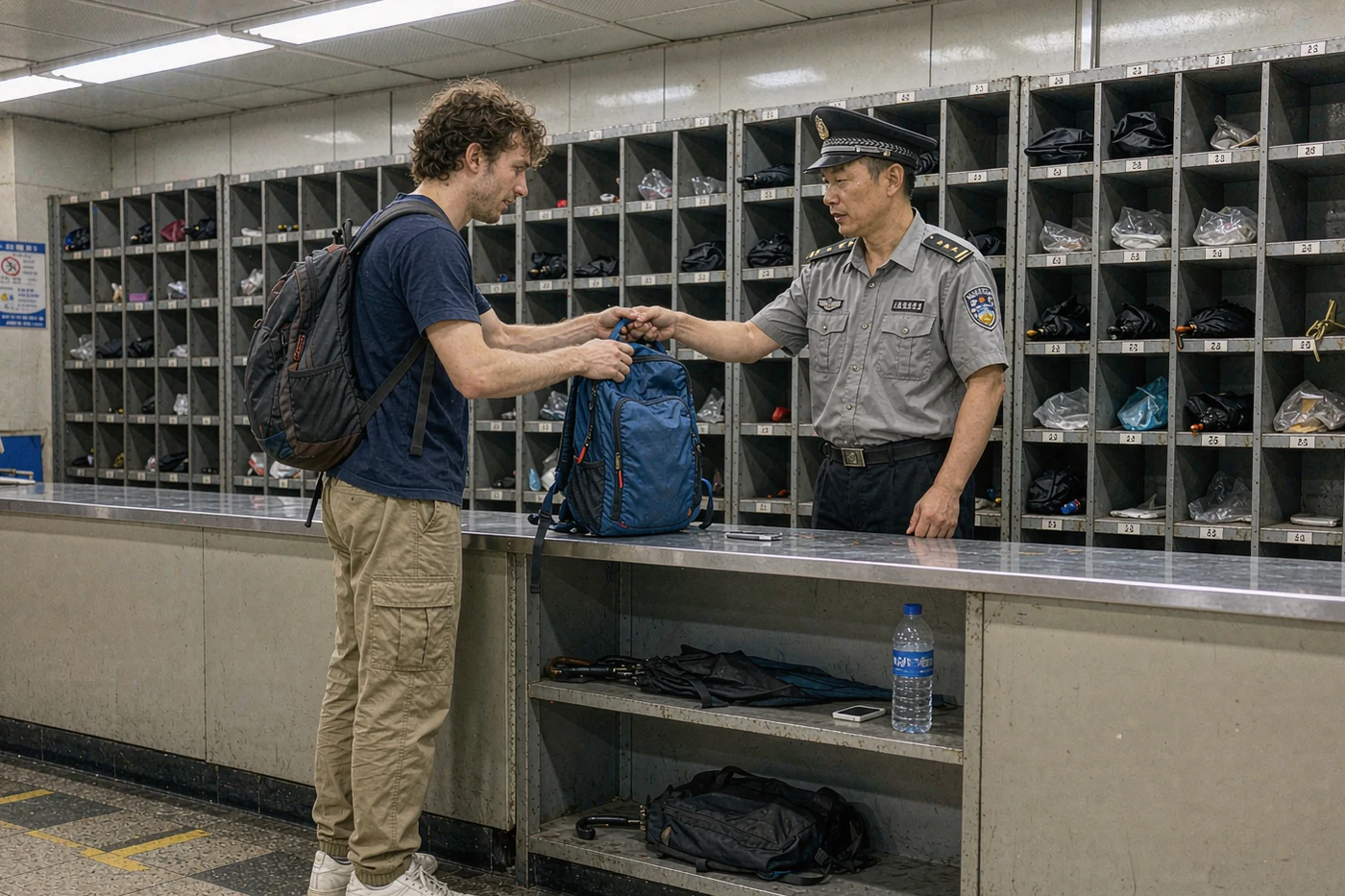
Or ask at any station service centre (客服中心) — Staff at the concourse level can radio the station you name and log the item. Do this before you leave the network — once you are outside, the hotline is your only channel.
Give them the four facts — Line and direction of travel, roughly which carriage or door you used, the time you were on the train, and the item's colour, brand and size. Vague descriptions are the main reason searches fail.
Understand what happens to handed-in property — Items handed in are logged and held, and the hotline calls you back when something matches. Start the call the same day — the longer the gap, the further the item has moved.
Left it at the airport
Both of Beijing's airports run a real lost-property office, and the Daxing one is genuinely good: every object is photographed, logged into a searchable system, and the most recent week of items is published online with pictures.
One number covers both airports: 010-96158 — Capital (PEK) and Daxing (PKX) both route lost-property enquiries through the airport service hotline. At Daxing the counter sits on the west side of the arrivals hall on Level 2 and is staffed 24 hours.
Search Daxing's online list yourself — The Daxing app and WeChat mini-program carry a 失物招领 (lost and found) section listing the last seven days of handed-in items with photos and the location each was found in. Older items are not published — call instead.
Book collection at least 24 hours ahead — Daxing asks you to phone and make an appointment before collecting. Bring the original of your ID; if someone collects for you they need their own ID, a copy of yours, and a signed letter of authorisation.
Courier collection is allowed — If you have already flown out, a courier can collect on your behalf with the same paperwork. There are express companies inside the terminals, and this is the usual route for visitors who only notice the loss at home.
Retention: about a year for most things, seven days for power banks — Daxing publishes its holding periods: valuables, documents and ordinary items one year; perishables 24 hours; power banks and spare lithium batteries seven days. Under China's Civil Code, unclaimed lost property passes to the state after a year.
Left it on a train or at a railway station
Chinese railways sell every ticket against an ID number, and that real-name system is quietly on your side: it ties you to a specific train, carriage and seat.
Call 12306, the national railway hotline — Report the loss with your train number, date, carriage and seat. Station service desks (服务台) log lost items too, so if you are still inside the station, go there first.
The station that matters is the one you left — Property is handed in at the station where you alighted or where the train terminated, not your departure station. Ask which station your train ended at before you start calling around.
Security trays and waiting halls cause most losses — The security checkpoint and the seat you waited in produce the majority of station losses. The same applies to the security tray if you also took a domestic flight.
Left it in a hotel, restaurant, shop or sight
There is no central number for this category, which is exactly why visitors give up on it. It is also the category where one phone call placed within the hour usually works.
Phone them, do not email — Hotels, restaurants and shops in Beijing nearly always hold a found item behind the counter for at least a day or two. Ask whoever answers to physically go and look while you stay on the line.
Hotels will courier it to your next stop — If you have already checked out, ask the front desk to send it on; you pay the courier on arrival. Give them the address written in Chinese, not a screenshot of an English booking page.
Big sights have a lost-property point — Museums, the Forbidden City and the Summer Palace log found items at an exit or the ticket office. Asking staff for 失物招领 is enough.
CCTV is police-only — Staff will not replay cameras for you. If the item is valuable and the venue will not help, call 110 and ask for a report — police can request the footage.
12345 as a last resort — Beijing's city services hotline runs 24 hours with English-speaking operators. It will not find your item, but it will push a complaint to the right body when a business stonewalls you.
When someone found it and will not give it back
Most lost-property stories in Beijing end with a stranger handing something over. A few end with a driver or a bystander deciding the item is theirs. The second case has a proper legal route, and it starts with evidence rather than argument.
Do not accuse, do document — Message or call through the platform so there is a record, and keep the screenshots. A written refusal is far more useful to police than your memory of a conversation.
Report it to 110, in the district where it happened — Refusing to return found property is a legal matter in China, not merely a dispute. Give police the item's value, where it went missing and any tracking evidence you hold.
Expect to prove ownership — A serial number, a photo of you with the item, a receipt, or the location history from Find My. Evidence of ownership is what turns a report into action.
Insurers want the police report number — If you intend to claim, ask for the report number before you leave the station. Most travel policies will not process a theft claim without one.
Getting it back after you have already left China
Retention periods start to matter the moment you are on the plane. The published Daxing standard is a fair guide to how the rest of the system behaves: long for valuables and documents, short for food and batteries.
Authorise someone in writing — A signed letter of authorisation (委托书), a copy of your passport, and the collector's own ID. Airports and most hotel counters require all three.
Courier is the realistic option — Hotels and airports will release an item to a courier holding that paperwork, and you pay on delivery. Get the tracking number before you board.
If it was your passport, do not wait for a courier — A passport runs on a separate track — police station report, then a loss certificate, then your embassy — and it carries deadlines. Start it immediately rather than waiting for someone to post it.
Watch the short deadlines — Power banks and spare lithium batteries are held around seven days and perishables around 24 hours, after which no further search or return is offered. Arrange collection early.
The two-minute kit that makes recovery possible
A photo of your passport page, stored somewhere else — In your email and cloud, not only on the phone — the phone is usually the thing that goes missing with everything else.
Find My switched on before you land — Find My iPhone, 查找 or Find My Device, and confirm you can log into it from a browser. It is the one channel where you can locate the item yourself.
Photograph the taxi 发票 — That slip carries the plate and the company, and it is your only lead on a street-hailed taxi. One photo beats any amount of description.
Three numbers, saved — Metro 010-96165, taxis and buses 12328, airports 010-96158 — plus 12345, which has English-speaking operators around the clock.
Your hotel's name and address, in Chinese, on paper — Hand it to a driver, a dispatcher or a courier. It works far better than pronouncing an English address down the phone.