Explore Beijing / Long-Term Stay in Beijing: SIM Card, Bank Card, and Setting Up WeChat Pay & Alipay
Long-Term Stay in Beijing: SIM Card, Bank Card, and Setting Up WeChat Pay & Alipay
A practical setup guide for staying in Beijing for weeks or months: getting a local SIM, opening a bank account, and linking everything to WeChat Pay and Alipay so you can live like a local.
7 min read · KOULING's Beijing Travel Guide
China runs on two superapps — WeChat and Alipay — and once you're staying longer than a vacation, you'll want the full local setup: a Chinese phone number, a local bank card, and both payment apps linked and working. This guide walks you through each step in order, because each one depends on the one before it. Rules, fees, and document requirements change often, so treat every specific figure here as something to verify before travel or on arrival [verify before travel].
Step 1: Get a Chinese SIM Card
A Chinese phone number is the foundation of everything else — you need one for real-name registration, receiving verification codes, and opening a bank account. The three major carriers are China Mobile, China Unicom, and China Telecom. As a foreigner you must register with your passport, which you can do at official carrier stores at the airport or in the city. Bring your passport, have a local address handy (your hotel works), and expect the process to take 30–60 minutes. Plans typically cost around CNY 30–100 (roughly USD 4–14) per month depending on data [verify before travel]. Staff at flagship stores in tourist areas often speak some English; neighborhood stores may not, so bring a translation app.
Where to buy — Official carrier stores (China Mobile, Unicom, Telecom) at the airport or major shopping streets are the easiest for first-timers. Avoid third-party resellers for your main number.
What to bring — Your passport (required for real-name registration) and a local address. Some stores ask for a cash deposit or an initial top-up [verify before travel].
eSIM vs physical SIM — Physical SIMs are the safest bet for foreign passports; eSIM support for foreigners varies by carrier and store [verify before travel].
Step 2: Set Up WeChat Pay and Alipay
Even before you have a Chinese bank card, download both apps and set them up with your international card. WeChat (微信, Weixin) is the messaging app that doubled as a wallet; Alipay (支付宝, Zhifubao) is the payments-focused app. Both now accept major foreign credit cards like Visa, Mastercard, and others linked to your passport — this alone covers most tourist payments. There are typically small transaction fees or per-transaction limits on foreign cards [verify before travel]. Once you have a Chinese bank card (Step 3), link it to both apps: payments become instant, fee-free, and limits disappear. QR codes rule daily life — from street food to supermarkets, you scan or show your code.
Do this before you fly — Download both apps, register with your international number, and add your foreign card while still at home — it's much easier with stable internet and English support.
Linking a Chinese card — After opening a bank account, add the card in Wallet or Bank Cards settings. Most link instantly; if it fails, try again after 24 hours or visit the bank [verify before travel].
Everyday uses — You'll use these apps for far more than paying: taxi-hailing (Didi inside Alipay/WeChat), metro QR tickets, food delivery, shared bikes, and utility bills.
Step 3: Open a Chinese Bank Account
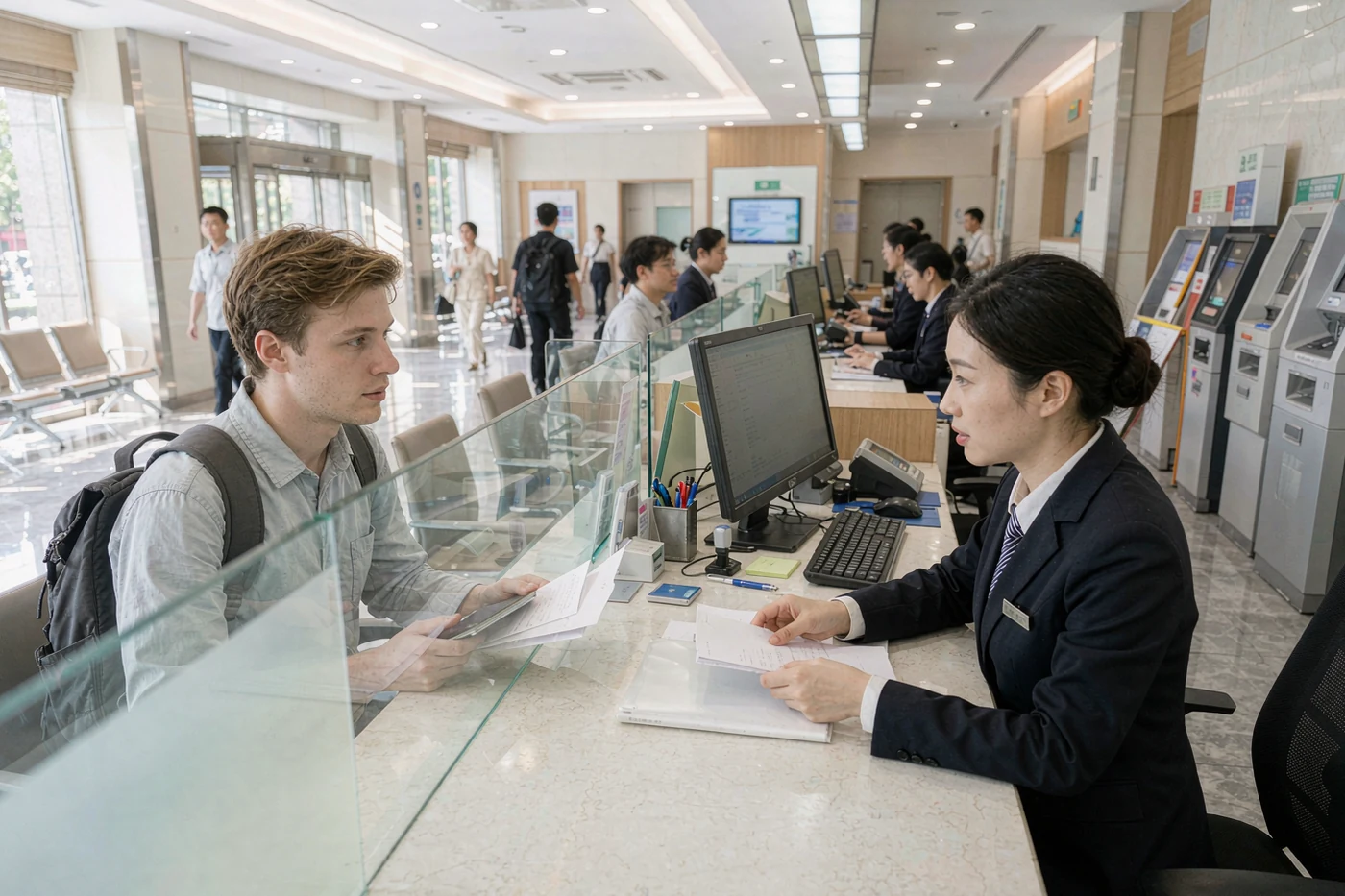
If you're staying a month or more — especially on a work or student visa — a local bank account is worth the paperwork. It lets you receive salary or stipends, avoid foreign-card fees, and link to WeChat Pay and Alipay with no limits. The most foreigner-friendly banks in Beijing are typically Bank of China (中国银行), ICBC (工商银行), and China Merchants Bank (招商银行); larger branches near business districts or university areas are used to serving foreigners. Requirements generally include your passport, a valid visa or residence permit, a local phone number, and sometimes proof of address or employment. Some banks have recently tightened requirements, so call or visit first to confirm what they currently require [verify before travel].
Documents to bring — Passport, visa/residence permit, Chinese SIM card, and if possible an employment or enrollment letter plus a local address. Requirements differ by branch [verify before travel].
Choosing a branch — Pick a large branch with experience serving foreigners — ask your hotel, employer, or university which branch they recommend.
What you'll get — A debit card (usually issued same-day or within a week [verify before travel]), a CNY account, and mobile banking — which itself requires the bank's app and your Chinese number.
Initial deposit — Many accounts require a small minimum deposit, commonly CNY 1–100 (under USD 15) [verify before travel].
Cash, Cards, and Backup Plans
Even with everything set up, carry a little cash. Small vendors, some taxis, and a few markets still prefer CNY notes, and ATMs are everywhere — bank lobbies, malls, and metro stations. Foreign cards work at Bank of China and other major bank ATMs for withdrawals (expect your home bank's fees plus possible local fees [verify before travel]). Keep your passport on you for any in-person financial errand, and take photos of your card numbers and account details, stored securely, in case of loss. Finally, don't rely on a single app: keep both WeChat Pay and Alipay funded, since a few merchants only accept one.
How much cash — CNY 200–500 (about USD 30–70) is plenty for a week of backup. ATMs dispense large notes; ask for smaller bills when possible.
Tipping — Tipping is not expected in China. No need to tip taxi drivers, waiters, or hotel staff.
If a payment fails — Have cash as a fallback and your hotel's address card in Chinese to show a driver. Hotel front desks at foreigner-friendly hotels can usually help troubleshoot.
Bank of China — Wangfujing Area Branch
A convenient central option for opening an account or using a foreign-card ATM, within walking distance of major hotels and shopping. Branch-level services and English ability vary, so call ahead or ask your hotel to confirm this branch handles foreign account openings [verify before travel].
Metro
Wangfujing area, served by Metro Line 1 and Line 8 (confirm current station exits) [verify before travel]
Opening hours
Typically Mon–Fri roughly 09:00–17:00, some weekend service at larger branches [verify before travel]
Tickets
No entry fee; account opening is free but may require a minimum deposit [verify before travel]
How long
Allow 1–2 hours for account opening, plus waiting time
China Mobile / China Unicom Flagship Store
Major carriers operate large flagship stores in central Beijing where staff routinely register foreign passports for new SIM cards. Bring your passport and phone (unlocked). You can also buy a short-term tourist SIM here if you're not yet staying long-term [verify before travel].
Metro
Multiple locations; flagship stores cluster near Wangfujing and other major shopping districts (confirm nearest branch) [verify before travel]
Opening hours
Typically 09:00–18:00 daily, though hours vary by store [verify before travel]
Tickets
SIM plans from roughly CNY 30–100/month (USD 4–14) [verify before travel]
How long
30–60 minutes for registration and activation
Related Beijing guides
If you found this useful, these cover the next question most visitors ask:
One phone number for everything — Your Chinese number becomes your identity across banking and apps. Keep the SIM active with periodic top-ups even when traveling, or accounts tied to it can be affected.
Real-name verification everywhere — Expect your passport to be requested for SIMs, bank accounts, train tickets, and some venue entries. Keep a photocopy handy but carry the original for official errands.
Set up apps at home first — WeChat and Alipay registration with a foreign card is far easier on your home network. Do it before departure, then upgrade with a Chinese card on arrival.
Bring an unlocked phone — Your phone must be carrier-unlocked to accept a Chinese SIM. Confirm with your home carrier before you leave [verify before travel].
Ask for help at your hotel — Front desks at international hotels handle these requests daily and can call banks or carriers in Chinese on your behalf.